
Ressources
Explorez une large gamme de ressources sur le GCED afin d’approfondir votre compréhension et de renforcer vos activités de recherche, de plaidoyer, d’enseignement et d’apprentissage.
1,445 résultats trouvés
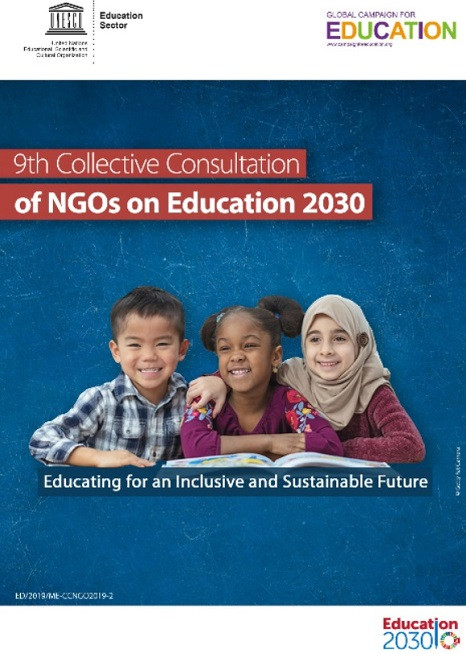 9th Collective Consultation of NGOs on Education 2030: Educating for an Inclusive and Sustainable Future Année de publication: 2020 Auteur institutionnel: UNESCO | Global Campaign for Education (GCE) This includes proceedings and key messages of the 9th Global meeting of the Collective Consultation of NGOs on Education 2030 (CCNGO 2019) organized by UNESCO from 2-5 December 2019 in Hammamet, Tunisia and generously hosted by the Global Campaign for Education (GCE), alongside the Arab Campaign for Education for All (ACEA) and the National Association of the Right to Education (ANDET). The CCNGO 2019 aimed to build on CSOs(Civil Society Organisations) experiences and strong commitments to strengthen collective initiatives towards the realisation of the SDGs and education related targets. The focus and major theme of the Meeting was the role and engagement of civil society organizations in supporting equity and inclusion in the implementation of SDG4-Education 2030 at national, regional and global level. 9e Consultation collective des ONG sur l’Éducation 2030: Éduquer pour un avenir inclusif et durable Année de publication: 2020 Auteur institutionnel: Organisation des Nations Unies pour l'éducation, la science et la culture (UNESCO) | Global Campaign for Education (GCE) Cela comprend les actes et les messages clés de la 9eRéunion mondialede la Consultation collective des ONG sur l’Éducation 2030(CCONG2019) a été organisée par l’UNESCO du 2 au 5 décembre2019 à Hammamet, Tunisie,où elle a été généreusement accueillie par la Campagne mondiale pour l’éducation(CME), la Campagne arabe pour l’éducation pour tous(ACEA) et l’Association nationale du droit à l’éducation(ANDET). La Réunion mondialede la CCONG2019 avait pour but derenforcer les initiatives collectives visant à la mise en œuvre des ODD et des cibles relatives à l’éducation ens’appuyantsur l’expérience des OSC et leur forte mobilisation. La réunion avait pour thèmecentral l’action et l’engagement des organisations de la société civile en faveur de l’équité et de l’inclusion dans le cadre dela mise en œuvre de l’ODD 4 –Éducation 2030aux niveaux national, régional et mondial.
 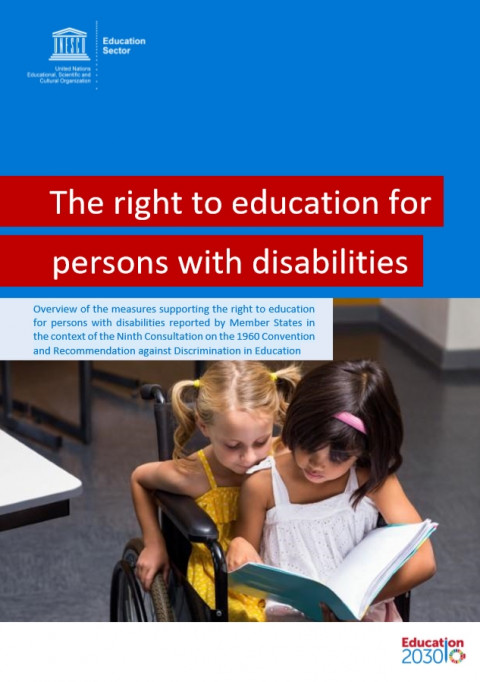 The Right to Education for Persons with Disabilities Année de publication: 2019 Auteur institutionnel: UNESCO Persons with disabilities are often excluded from the education system, whether out-of-school entirely, educated in separate institutions or participating in a mainstream system which is not adapted to their needs and abilities. The 2030 Agenda commitment to ‘leave no one behind’ has reinforced the global discourse towards inclusive, equitable education. As part of its mandate, UNESCO monitors the implementation of the 1960 Convention and Recommendation against Discrimination in Education. During the Ninth Consultation on the implementation of this instrument, almost all Member States reported upon measures that they have taken in relation to the right to education for persons with disabilities. This document compiles practical examples extracted from these reports for information sharing and advocacy.
 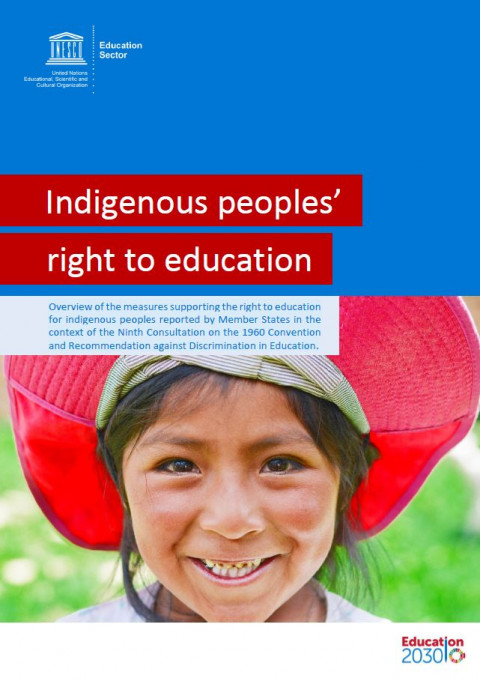 Indigenous Peoples’ Right to Education Année de publication: 2019 Auteur institutionnel: UNESCO Among the many inequalities that indigenous peoples face, the lack of access to quality education is particularly blatant. The 2030 Agenda commitment to ‘leave no one behind’, brings new impetus to ensure that indigenous peoples’ priorities are heard. In 2017, UNESCO adopted the Policy on engaging with indigenous peoples. Concurrently, as part of its mandate, UNESCO monitors the implementation of the 1960 Convention and Recommendation against Discrimination in Education. During the Ninth Consultation on the implementation of this instrument, several Member States reported upon measures they have taken in relation to the right to education for indigenous peoples. This document (Indigenous Peoples’ Right to Education: Overview of the Measures Supporting the Right to Education for Indigenous Peoples Reported by Member States in the Context of the Ninth Consultation on the 1960 Convention and Recommendation against Discrimination in Education) compiles practical examples extracted from these reports for information sharing and advocacy.
 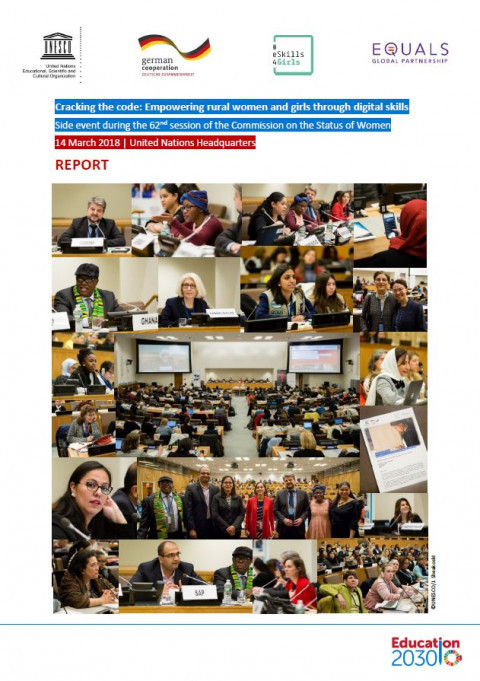 Cracking the Code: Empowering Rural Women and Girls through Digital Skills; Side Event during the 62nd Session of the Commission on the Status of Women, 14 March 2018, United Nations Headquarters: Report Année de publication: 2018 Auteur institutionnel: UNESCO | Germany. Federal Ministry for Economic Cooperation and Development (BMZ) UNESCO and the German Federal Ministry of Economic Cooperation and Development (BMZ) co-organised the side event ‘Cracking the code: Empowering rural women and girls through digital skills’ on 14 March 2018, United Nations Headquarters in New York, on the margins of the 62nd session of the CSW. More than 500 participants participated in the event while a broad global audience followed the discussions through live webcast.This report provides an overview of the discussions and examples of government, civil society organizations, and private sector initiatives to close the gender digital gap and empower rural girls and women to be ICT users, creators and innovators through gender-responsive digital skills training as well as science, technology, engineering and mathematics (STEM) education more broadly.
 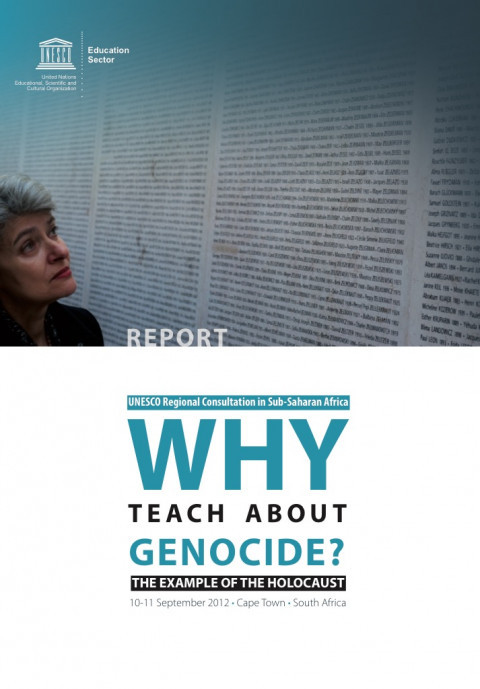 UNESCO Regional consultation in sub-saharan Africa: Why teach about genocide? The example of the Holocaust, 10-11 Septembre 2012, Cape Town, South Africa: report Année de publication: 2013 Auteur institutionnel: UNESCO The rst UNESCO consultation on « Why Teach about Genocide? The Example of the Holocaust » was organized following the UNESCO General Conference resolution 34C/61 on Holocaust Remembrance. The consultation of Member States is part of a series of initiatives launched by UNESCO to promote education about the Holocaust and other genocides, in particular with a view to contributing to the prevention of genocide and mass atrocities and promoting education for peace.The consultation took place in Cape Town, South Africa, on 10-11 September 2012 in the presence of senior representatives from the Ministries of Education of 14 countries in Sub-Saharan Africa. The following countries were represented: BENIN, BURUNDI, DEMOCRATIC REPUBLIC OF THE CONGO, CÔTE D’IVOIRE, ETHIOPIA, REPUBLIC OF MAURITIUS, NAMIBIA, KENYA, RWANDA, SENEGAL, SOUTH AFRICA, TANZANIA, TOGO and ZAMBIA. Experts in Holocaust and genocide studies from various countries and institutions were invited to present key issues throughout the consultation and participate in the discussions. The consultation was supervised by the Education Sector of UNESCO/Division of Education for Peace and Sustainable Development/Section of Education for Peace and Human Rights and UNESCO Regional Bureau for Education in Africa (BREDA, Dakar, Senegal)The main purpose of the meeting was to discuss how the history of the Holocaust, and more generally the history of genocide, could be included in the curricula of participating countries. The meeting also clari ed various conceptual and pedagogical issues, and paved the way for further cooperation between UNESCO and participating Ministries of Education on how to launch new educational programmes in interested countries.
  International Task Force on Teachers for Education 2030 Strategic Plan 2018–2021 Année de publication: 2018 Auteur institutionnel: UNESCO With the end of the EFA era, the TTF has decided to articulate its activities around the newly adopted international education goals. The Strategic Plan 2018–2021 builds on the Sustainable Development Goals (SDGs), especially the SDG 4.c target on teachers, and the Education 2030 Incheon Declaration and Framework for Action adopted in 2015. Plan stratégique 2018 - 2021. Équipe spéciale internationale sur les enseignants pour Éducation 2030 Année de publication: 2018 Auteur institutionnel: UNESCO Avec la fin de l'ère EPT, l'Équipe spéciale sur les enseignants a décidé d'articuler ses activités autour des objectifs d'éducation internationale nouvellement adoptés. Le Plan stratégique 2018-2021 se fonde sur les Objectifs de Développement Durable (ODD), en particulier sur la cible 4.c de l'ODD 4 sur les enseignants, ainsi que sur la Déclaration d'Incheon et le Cadre d'action Éducation 2030 adoptés en 2015. Ce nouveau plan stratégique a été informé par une évaluation externe réalisée en 2016-2017. Les conclusions et les recommandations de l'évaluation ont été discutées par le comité directeur du de l'Équipe spéciale sur les enseignants en mai 2017 et donnent certaines des orientations de ce plan stratégique. Plan Estratégico 2018 - 2021. Equipo especial internacional sobre docentes para Educación 2030 Année de publication: 2018 Auteur institutionnel: UNESCO Con el final de la era de la EPT, la TTF ha decidido articular sus actividades en torno a los objetivos educativos internacionales recientemente adoptados.El Plan Estratégico 2018-2021 se basa en los Objetivos de Desarrollo Sostenible (ODS), especialmente en la meta del ODS 4.c sobre docentes, y en la Declaración de Incheon y el Marco de Acción para la realización del Objetivo de Desarrollo Sostenible 4 adoptados en 2015.Este nuevo Plan Estratégico fue informado por una evaluación externa realizada en 2016-2017. Las conclusiones y recomendaciones de la evaluación fueron discutidas por el Comité Directivo de la TTF en mayo de 2017 e impulsan algunas de las direcciones estratégicas de este Plan Estratégico.
  Sustainability Education Principal Training Manual Année de publication: 2012 Auteur institutionnel: UNESCO | Beijing Sustainable Development Education Association | China National Council for Sustainable Development Education Secretariat This article is devoted to explaining the application of sustainable development in China.