
Ressources
Explorez une large gamme de ressources sur le GCED afin d’approfondir votre compréhension et de renforcer vos activités de recherche, de plaidoyer, d’enseignement et d’apprentissage.
1,407 résultats trouvés
 Protect Her Rights, Strengthen Your Laws: Her Atlas; Status Report on Girls’ and Women’s Right to Education Année de publication: 2022 Auteur institutionnel: UNESCO UNESCO’s Her Education, our future initiative, Her Atlas was launched in 2019 with the aim to enhance public knowledge and monitor the status of national constitutions, legislation and regulations related to girls’ and women’s education rights in order to encourage countries to take actions to improve their legal frameworks. Three years after its launch, the research phase has been completed: overall, the legal frameworks of 196 countries have been thoroughly analyzed to evaluate the level of protection of girls’ and women’s right to education around the world. In an interactive world map format, Her Atlas uses a color-coded scoring system to monitor 12 indicators of legal progress towards gender equality in the right to education. This report marks the completion of the first research phase and intends to highlight some key trends outlined by the research work, and to emphasize examples of legal provisions regarding some aspects of girls’ and women’s right to education guaranteed by States’ domestic laws.
 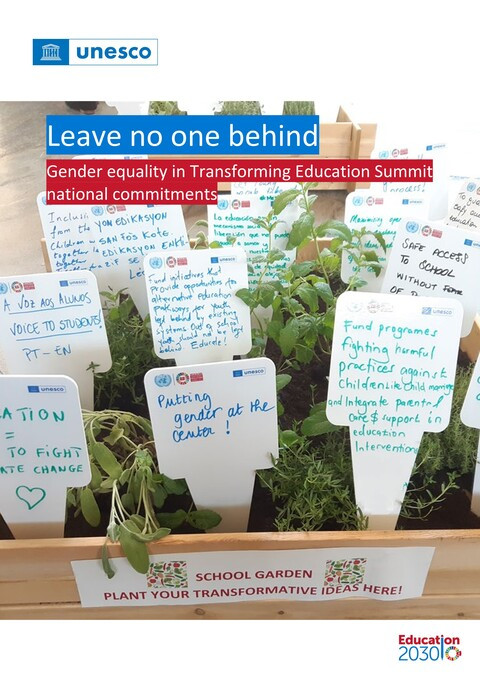 Leave No One Behind: Gender Equality in Transforming Education Summit National Commitments Année de publication: 2023 Auteur institutionnel: UNESCO The Transforming Education Summit was convened in response to a global crisis in education – one of equity and inclusion, quality and relevance. This paper applies a gender lens to the national statements of commitments made by countries during the Summit. It considers the scope of commitments to gender equality and gender- transformative education, common gender themes and considerations emerging across commitments, and notable gaps. It aims to inform future actions by the Global Platform to Drive Leadership and Accountability for Gender Equality and Girls’ and Women’s Empowerment in and through Education, and support to country action to transform education systems to advance gender equality.
 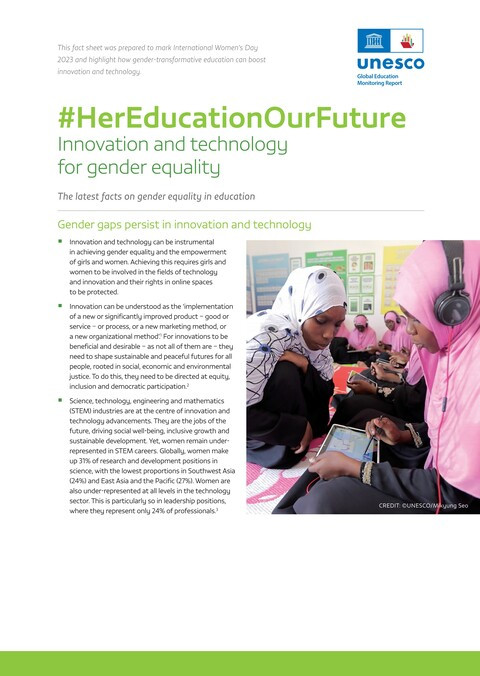 #HerEducationOurFuture: Innovation and Technology for Gender Equality; the Latest Facts on Gender Equality in Education Année de publication: 2023 Auteur institutionnel: UNESCO | Global Education Monitoring Report Team Gender gaps persist in innovation and technology Innovation and technology can be instrumental in achieving gender equality and the empowerment of girls and women. Achieving this requires girls and women to be involved in the fields of technology and innovation and their rights in online spaces to be protected. #SuEducaciónNuestroFuturo: Innovación y tecnología para la igualdad de género: últimos datos sobre la igualdad de género en la educación Année de publication: 2023 Auteur institutionnel: Organización de las Naciones Unidas para la Educación, la Ciencia y la Cultura (UNESCO) | Global Education Monitoring Report Team La brecha de género persiste en la innovación y la tecnología La innovación y la tecnología pueden ser decisivas a la hora de lograr la igualdad de género y empoderar a las niñas y las mujeres. Para lograrlo, es necesario que las niñas y las mujeres participen en los ámbitos de la tecnología y la innovación y que se protejan sus derechos en los espacios en línea. #SonÉducationNotreAvenir: l’innovation et la technologie au service de l’égalité des genres: derniers développements sur l’égalité des genres dans l’éducation Année de publication: 2023 Auteur institutionnel: Organisation des Nations Unies pour l'éducation, la science et la culture (UNESCO) | Global Education Monitoring Report Team Les inégalités entre les genres persistent dans les domaines de l’innovation et de la technologie L’innovation et la technologie peuvent jouer un rôle essentiel en faveur de l’égalité des genres et de l’autonomisation des filles et des femmes. Pour que ces objectifs soient atteints, il faut que les filles et les femmes participent dans les domaines de la technologie et de l’innovation, mais aussi que leurs droits dans les espaces en ligne soient protégés.
  Artificial Intelligence Needs Assessment Survey in Africa Année de publication: 2021 Auteur: Prateek Sibal | Bhanu Neupane Auteur institutionnel: UNESCO There are encouraging signs of AI innovation and development across Africa, from community run AI classes over weekends, AI training bootcamps for students and young researchers to the establishment of private sector and government driven innovation hubs across the continent. Even as there is an enormous potential for AI development, there are also legacy challenges in terms of infrastructure availability as well as human and institutional capacity gaps to develop and govern AI to optimise benefits and minimise harms. Building upon the recommendations of UNESCO report Steering AI and Advanced ICTs for Knowledge Societies, the findings of this survey aim to bridge the information gap concerning the strategic priorities, policy measures, developmental challenges, human and institutional capacity needs, and legal frameworks concerning AI in African countries. Évaluation des besoins en intelligence artificielle en Afrique Année de publication: 2021 Auteur: Prateek Sibal | Bhanu Neupane Auteur institutionnel: Organisation des Nations Unies pour l'éducation, la science et la culture (UNESCO) Le continent africain enregistre des signes encourageants en matière d’innovation et de développement dans le domaine de l’intelligence artificielle (IA) : cours dans des structures de quartier le week-end, formations intensives pour étudiants et jeunes chercheurs, création de pôles d’innovation transnationaux publics ou privés… Cependant, malgré un fort potentiel de développement, des défis subsistent quant à la disponibilité des infrastructures. De même, le développement et la gestion de l’IA dans le but d’optimiser les avantages et de minimiser les dommages se heurtent à des problèmes de compétences humaines et institutionnelles. Les conclusions de cette enquête, qui s’appuient sur les recommandations du rapport de l’UNESCO Piloter l’IA et les TIC avancées pour les sociétés du savoir visent à pallier le déficit d’informations sur les priorités stratégiques, les mesures politiques, les défis relatifs au développement, les cadres juridiques et les besoins de compétences humaines et institutionnelles en matière d’IA dans les pays africains.
  Evaluation de la riposte de l’UNESCO à la pandémie de COVID-19 Année de publication: 2023 Auteur institutionnel: Organisation des Nations Unies pour l'éducation, la science et la culture (UNESCO) Le présent rapport d’évaluation contient les conclusions tirées d’une évaluation complète de la manière dont l’Organisation des Nations Unies pour l’éducation, la science et la culture (UNESCO) s’est adaptée et a répondu à la pandémie de coronavirus 2019 (COVID-19). Il rend compte de la réponse programmatique de l’UNESCO dans tous ses secteurs, et en évalue la pertinence et l’efficacité. Il examine également l’efficacité avec laquelle l’Organisation s’est adaptée pour assurer la continuité de ses opérations tout au long de la pandémie. Axée sur l’apprentissage, l’évaluation a permis de dégager une série d’enseignements et de mettre en évidence les innovations les plus précieuses apportées durant la pandémie. Le présent rapport énonce cinq recommandations visant à guider l’UNESCO vers la pérennisation des innovations les plus efficaces et le renforcement de la résilience de ses activités et de ses programmes en cas de crise.
 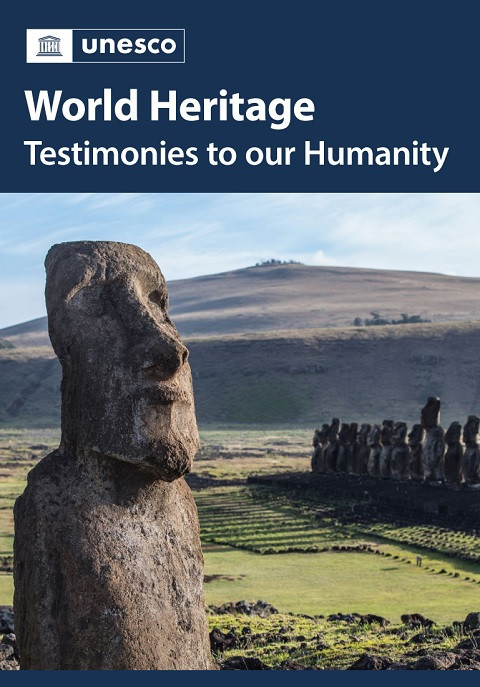 World Heritage: Testimonies to Our Humanity Année de publication: 2022 Auteur institutionnel: UNESCO The Convention for the Protection of the Cultural and Natural Heritage is an international agreement based on the principle that some places on Earth embody outstanding universal value that should be part of the shared heritage of humankind. UNESCO recognizes cultural and natural sites of outstanding universal value, and protects them for the benefit of all. As a basis for mutual understanding and dialogue, the responsibility for protecting our shared heritage requires cooperation among all States Parties as well as civil society, local communities and the private sector. The idea of reconciling the conservation of cultural sites with that of natural sites originated in the United States of America. A White House conference in Washington, D.C., in 1965 called for the creation of a “World Heritage Foundation” that would stimulate international cooperation to protect “the most extraordinary places, landscapes, and historic sites for the present and future of all mankind.” In 1968, the International Union for Conservation of Nature (IUCN) made similar proposals to its members. These proposals were presented at the United Nations Conference on the Human Environment in Stockholm in 1972. Eventually, all parties concerned agreed on a single text. The Convention concerning the Protection of the World Cultural and Natural Heritage was adopted by the General Conference of UNESCO on 16 November 1972. In recognizing both cultural and natural aspects of heritage, the Convention reminds us of the interaction between human beings and nature and the fundamental need to preserve the balance between the two. Evaluation of UNESCO’s response to the Covid-19 pandemic Année de publication: 2023 Auteur institutionnel: UNESCO This evaluation report summarises the findings of a comprehensive evaluation on how UNESCO has adapted and responded to the Covid-19 pandemic. It describes and assesses the relevance and effectiveness of UNESCO’s programmatic response across all of its Sectors, and reviews how efficiently the Organization adapted itself to ensure business continuity during the pandemic. With an overall focus on learning, the evaluation identified a series of lessons and useful innovations made during the pandemic. The report’s five recommendations aim to guide UNESCO towards sustaining useful innovations and further increasing the crisis resilience of its operations and programme.