
Ressources
Explorez une large gamme de ressources sur le GCED afin d’approfondir votre compréhension et de renforcer vos activités de recherche, de plaidoyer, d’enseignement et d’apprentissage.
2,199 résultats trouvés
 Exploration of Civic Educational Thought of Gong Qichang (Journal of Tianjin Normal University: Social Science; No. 5) Année de publication: 2019 Auteur: Yu Lingling Auteur institutionnel: Tianjin Normal University Gong Qichang was one of the main representatives who advocated implementation of civic education during the Republic of China. He had a national rejuvenation ideal, advocated civic education and cultivated modern citizens. The main contents of his civic educational thoughts include :Civic education originated from educational consciousness during the Republic of China aiming at cultivating modern citizens; national traditional culture real social life, and national common ideals constitute the main educational content; the civic educational method of trinity of family, school and society is advocated. Research on civic educational thought of Gong Qichang has positive practical implications. 龚启昌公民教育思想研究 (天津师范大学学报:社会科学版; No 5) Année de publication: 2019 Auteur: Yu Lingling Auteur institutionnel: Tianjin Normal University 龚启昌是民国时期倡导实施公民教育的主要代表人物之一。他胸怀民族复兴理想,力倡公民 教育,培育现代公民。其公民教育思想的主要内容有:民国时期的公民教育源于教育自觉,旨在培育现代公 民;民族传统文化、现实社会生活、国家共同理想三者构成主要教育内容;倡导家庭、学校、社会三位一体 的公民教育方法。研究龚启昌的公民教育思想,仍具有一定的现实意义。
  평화견문록: 평화와 공존을 위한 세계시민교육; 교과통합형 세계시민교육 수업자료집 Année de publication: 2019 Auteur: 강방식 | 강은하 | 김경훈 | 김웅 | 김준구 | 김지광 | 여지화 | 윤상철 | 임재민 | 정미선 | 정애경 Auteur institutionnel: 서울특별시교육청 민주시민생활교육과 본 자료는 학생들의 평화감수성 함양을 위해 학생들이 일상적인 삶에서 경험할 수 있는 소재를 활용한 세계시민교육 수업활동집이다. 학생들은 다양한 관점을 연결하는 교과통합형 세계시민교육을 통해 문제해결력과 비판적 사고를 함양할 수 있다.
  Discussion on Historical Film and Civic Education: Take the Korean Movie Taxi Driver as an Example (Proceedings of 2018 7th ICASS International Conference on Management, Leadership and Social Science) Année de publication: 2018 Auteur: Zhenxing Wang Auteur institutionnel: ICASS International Conference on Management, Leadership and Social Science Historical education is an important content and an effective way to achieve citizenship education. Historical films are an important form of historical education under modern technology conditions. The Korean film "Taxi Driver" recreated the "Gwangju tragedy", an important event in the process of democratization in Korea. The concept of freedom, equality, justice, and the rule of law runs through the entire film and is undoubtedly a very good civic education film. 历史题材影片与公民教育刍议: 以韩国电影《出租车司机》为例 (智能信息技术应用学会会议论文集) Année de publication: 2018 Auteur: Zhenxing Wang Auteur institutionnel: ICASS International Conference on Management, Leadership and Social Science 历史教育是公民教育的重要内容和有效实现途径,历史题材影片则是现代技术条件下历史教育的重要形式。韩国电影《出租车司机》再现了"光州惨案",这一韩国民主化进程中的重要事件。自由、平等、公正、法治的理念贯穿整部影片,无疑是一部很好的公民教育影片。
  The Modernization of Confucianism and the Localization of Citizenship Education (Proceedings of 2015 5th International Conference on Applied Social Science) Année de publication: 2015 Auteur: Huarong Yua | Qiyang Xie Auteur institutionnel: International Conference on Applied Social Science Chinese mainland society is in the transition from traditional society to modern society, as an important symbol of transformation is the birth of modern citizens. It depends on the effective modern citizen education to lay the social foundation to transform from the traditional subject society to the modern civil society. Civic education that originated from western society, in the era of globalization is of universal significance. Due to the different background of Chinese and Western culture, civic education in the Chinese mainland should draw on the reasonable core of the universal value of the Western Civic Education, but not copy the Western model completely. It is beneficial to the development of the modern citizen in the mainland of China and the traditional culture to absorb cultural nutrition from the traditional Confucianism as the core idea of civic education. However, the Confucianism was born in two thousand years ago and is the product of the traditional agricultural civilization and the patriarchal society, so it is necessary to cultivate modern citizens with the creative transformation of Confucianism. 儒学的现代化与公民教育的本土化 (智能信息技术应用学会会议论文集) Année de publication: 2015 Auteur: Huarong Yua | Qiyang Xie Auteur institutionnel: International Conference on Applied Social Science 中国大陆社会正处在由传统社会向现代社会转型之际,作为转型的重要标志之一 是现代公民的诞生。由传统臣民社会向现代公民社会转型,有赖于行之有效的现代公民教育 奠定社会基础。公民教育肇端于西方社会,在全球化的今天具有普适性意义。由于中西具有 不同背景的文化,中国大陆地区的公民教育既要汲取西方公民教育中具有普世价值的合理内 核,又不能全盘照搬西方模式。从传统儒学中吸收文化营养作为公民教育的核心思想内涵, 既有利于中国大陆地区现代公民的养成,也有利于传统文化的绵延,在多元文化的世界格局 中有着重要的价值。但是,由于儒学诞生于两千多年前,是传统农业文明与宗法社会的产物, 因此,必需用创造性的转换的儒学来培育现代公民。
 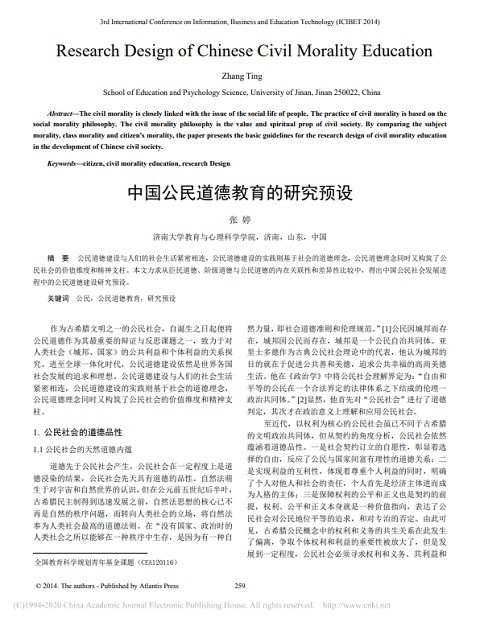 Research Design of Chinese Civic Morality Education (Proceeding of 3rd International Conference on Information, Business and Education Technology) Année de publication: 2014 Auteur: Zhang Ting Auteur institutionnel: International Conference on Information, Business and Education Technology The civic morality is closely linked with the issue of the social life of people. The practice of civil morality is based on the social morality philosophy. The civic morality philosophy is the value and spiritual prop of civil society. By comparing the subject morality, class morality and citizen's morality, the paper presents the basic guidelines for the research design of civic morality education in the development of Chinese civil society. 中国公民道德教育的研究预设 (北京欣永顺文化传播有限公司会议论文集) Année de publication: 2014 Auteur: Zhang Ting Auteur institutionnel: International Conference on Information, Business and Education Technology 公民道德建设与人们的社会生活紧密相连,公民道德建设的实践则基于社会的道德理念,公民道德理念同时又构筑了公民社会的价值维度和精神支柱。本文力求从臣民道德、阶级道德与公民道德的内在关联性和差异性比较中,得出中国公民社会发展进 程中的公民道德建设研究预设。
  The Remapping and Analysis of Human Rights and Peace Education in ASEAN/Southeast Asia Année de publication: 2019 Auteur institutionnel: Strengthening Human Rights and Peace Research/Education in ASEAN/Southeast Asia (SHAPE-SEA) | AUN Human Rights Education Network (AUN-HRE) This book is the result of SHAPE-SEA’s Research Project on “The Remapping and Analysis of Human Rights and Peace Education in ASEAN/Southeast Asia.” It is a follow-up to the 2013 report on “The Mapping and Analysis of Human Rights and Peace Education in Southeast Asia.” It aimed at establishing a systematic updating of developments in human rights and peace education/studies in ASEAN/Southeast Asia. The study investigated courses and programmes on human rights and peace & conflict being undertaken by higher education institutions in all ASEAN member countries and Timor Leste. It had also identified new developments and/or setbacks in human rights and peace education. Researchers located existing academic institutions that have been running programmes and courses on human rights and/or peace. The analysis of existing course syllabi and curriculum in the region was also conducted. To a certain extent, materials being used by instructors were also examined.