
Ressources
Explorez une large gamme de ressources sur le GCED afin d’approfondir votre compréhension et de renforcer vos activités de recherche, de plaidoyer, d’enseignement et d’apprentissage.
3,790 résultats trouvés
 International Conference on Global Citizenship Education and International Solidarity Année de publication: 2022 Auteur institutionnel: Quebec Association of International Cooperation Organizations (AQOCI) Sharing of practices and reflections on education for global and solidarity citizenship. The conference was initiated by the international committee of the Festival des Solidarités (Festisol) and led by AQOCI (Quebec Association of International Cooperation Organizations). Several speakers from several countries discuss the challenges of the decolonial approach to education for global citizenship. The possible emancipation of marginalized people is explored. Conférence internationale sur l'Éducation à la citoyenneté mondiale et la solidarité internationale Année de publication: 2022 Auteur institutionnel: Association québécoise des organismes de coopération internationale (AQOCI) Partage de pratiques et de réflexions sur l'éducation à la citoyenneté mondiale et solidaire. Conférence initiée par le comité international du Festival des Solidarités (Festisol) et animée par l'AQOCI (Association québécoise des organismes de coopération internationale). Plusieurs intervenants venant de plusieurs pays discutent des enjeux de l’approche décoloniale de l’éducation à la citoyenneté mondiale. L’émancipation possible des gens marginalisés est explorée.
  Annual Report 2021 Année de publication: 2021 Auteur institutionnel: University of Sherbrooke. International Cooperation Group Our main orientations in 2021: Increase the capacities of GCIUS project management, through the development of management tools standardized; Increase outreach of the GCIUS with the student community of the UdeS, as well as with the community of practice; Promote mobilization, recruitment, and implementation of strategies equity, diversity, and inclusion in the GCIUS. Rapport annuel 2021 Année de publication: 2021 Auteur: Groupe de Coopération Internationale de l'Université de Sherbrooke Auteur institutionnel: Université de Sherbrooke. Groupe de Coopération Internationale Nos grandes orientations en 2021: Accroître les capacités de gestion de projet du GCIUS, à travers le développement d'outils de gestion standardisés ; Accroître le rayonnement du GCIUS auprès de la communauté étudiante de l'UdeS, ainsi qu'auprès de la communauté de pratique ; Favoriser la mobilisation, le recrutement et la mise en oeuvre de stratégies en matière d'équité, de diversité et d'inclusion au GCIUS.
 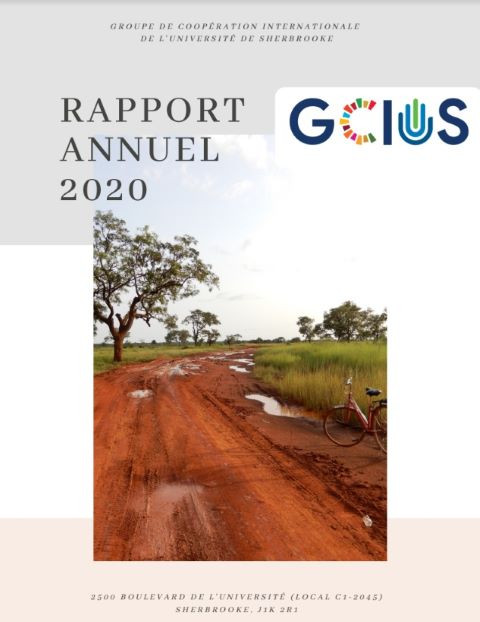 Annual Report 2020 Année de publication: 2020 Auteur institutionnel: University of Sherbrooke. International Cooperation Group The GCIUS has set itself the task of encouraging the emergence of sustainable development of local communities in the countries of intervention and UdeS students, through supportive, inclusive, and dynamic networks. The GCIUS supports students and local communities in the co-construction of multidisciplinary sustainable development projects aimed at improving living conditions for communities in need. Rapport annuel 2020 Année de publication: 2020 Auteur institutionnel: Université de Sherbrooke. Groupe de Coopération Internationale Le GCIUS s'est donné pour mission de favoriser l'émergence d'initiatives de développement durable des communautés locales dans les pays d'intervention et des étudiant.e.s de l'UdeS, via des réseaux solidaires, inclusifs et dynamiques. Le GCIUS appuie les étudiant.e.s et les communautés locales dans la coconstruction de projets multidisciplinaires de développement durable visant l'amélioration des conditions d'existence auprès des communautés dans le besoin.
  Disinformation and Peacebuilding in Sub-saharan Africa: Security Implications of AI-Altered Information Environments; Research Report Année de publication: 2024 Auteur: Eduardo Albrecht | Eleonore Fournier-Tombs | Rebecca Brubaker Auteur institutionnel: United Nations University | Interpeace This report aims to further explore the way in which AI technologies as they currently stand impact peace and conflict, and what methods might be used to mitigate their adverse effects - through the development of better tools and the inclusion of peace and conflict considerations in AI governance frameworks. The report proposes the following recommendations: 1. More funding and support should be provided to civil society organization efforts to expand media literacy and fact-checking initiatives using AI tools to enhance capabilities. 2. Governments need to work with civil society to develop and implement comprehensive, transparent legal frameworks combating disinformation. These legislative measures need to support digital and media literacy campaigns and fact-checking organizations. 3. Social media companies need to expand investment and research into understanding local information environments, so they can better identify and respond to instances of disinformation in all contexts in which they operate and enhance transparency. 4. Peacebuilding organizations need to carefully consider local media ecosystems and information environments when conducting conflict analyses, and factor these dynamics into their projects' frameworks.
  Strengthening Social and Emotional Learning in Hybrid Modes of Education: Building Support for Students, Teachers, Schools and Families Année de publication: 2024 Auteur institutionnel: UNESCO International Bureau of Education (IBE) This Discussion Paper focuses on the essential role of social and emotional learning (SEL) in the global movement to transform education and amplify its social, economic, environmental and personal impacts in a rapidly changing world. It explores how the mainstreaming of SEL into educational policies and practices can contribute to realizing future visions of education that are flexible, reflective, innovative, and impactful. Specifically, the Paper focuses on six topics that, as a whole, reflect global experiences in integrating and implementing SEL in its various forms both during and in the wake of the COVID-19 pandemic. Its main objective is to animate discussion on how to integrate a SEL dimension in hybrid modes of teaching and learning. This introductory overview presents the overall purpose and scope of the Paper, defines its underlying concepts and introduces the topics brought to this forum through the lenses of a diverse group of educators from Africa, the Arab States, Asia, Europe, and Latin America.
  être citoyen numérique, ça te dit ? Année de publication: 2022 Auteur institutionnel: TRALALERE Vinz est très excité, il a été sélectionné pour participer au concours du meilleur citoyen numérique ! En effet, dans les vidéos qu’il a déjà réalisées, il respecte, sans le savoir, la Charte pour l’éducation à la culture et à la citoyenneté numériques. Une belle occasion pour Vinz de nous expliquer les notions de charte et de citoyenneté numérique. Vinz is very excited - he's been selected to take part in the best digital citizen competition! In fact, in the videos he's already made, he unknowingly respects the Charter for Education in Digital Culture and Citizenship. This is a great opportunity for Vinz to explain the concepts of the Charter and of digital citizenship.
  الإطار المرجعي للتربية على المواطنة Année de publication: 2021 Auteur institutionnel: Educational center for Research and Development (Lebanon) وضع المركز التربوي للبحوث والإنماء، بين أيدي الخبراء العاملين قي القطاع التربوي، إطارًا مرجعيًّا لمفهوم التربية على المواطنة للإسهام في تعزيز قيم التربية المدنية والديمقراطية والمساواة والعدالة والكرامة. ويهدف هذا الإطار إلى توفير خلفية نظرية فضلًا عن أفكار عملية للتنفيذ.