
Ressources
Explorez une large gamme de ressources sur le GCED afin d’approfondir votre compréhension et de renforcer vos activités de recherche, de plaidoyer, d’enseignement et d’apprentissage.
109 résultats trouvés
 Education for sustainable development: linking learning and happiness Année de publication: 2007 Auteur: Joel Bacha Auteur institutionnel: UNESCO Bangkok Education for Sustainable Development programmes demonstrating the link between learning and wellbeing and happiness are beginning to emerge throughout the Asia-Pacific region. In small communities throughout the Pacific islands, for example, ESD approaches are helping to engage communities in decision-making about their own lives. L'éducation au développement durable: lier l'apprentissage et le bonheur Année de publication: 2007 Auteur: Joel Bacha Auteur institutionnel: UNESCO Bangkok Des programmes d'éducation pour le développement durable qui démontrent le lien entre l'apprentissage et le bien-être et le bonheur commencent à émerger dans toute la région Asie-Pacifique. Dans les petites localités des îles du Pacifique, par exemple, les approches EDD aident les communautés à prendre des décisions concernant leur propre vie. Envisioning education beyond 2015: Asia-Pacific regional perspectives; final report Année de publication: 2014 Auteur institutionnel: UNESCO Bangkok This report provides a thorough account of the discussions and deliberations that led to the construction of the Asia-Pacific Statement on Education Beyond 2015 (Bangkok Statement), the outcome document of this historic event. Participants reviewed in fine detail EFA progress across the Asia-Pacific region and debated key thematic areas of basic education, skills and competencies, global citizenship education, education for sustainable development, teachers, governance and finance. Participants also looked into implementation strategies, and education ministers from across the region shared their views on remaining challenges, future priorities and strategies for education beyond 2015. Envisager l'éducation au-delà de 2015: Perspectives Régionales Asie-Pacifique; rapport final Année de publication: 2014 Auteur institutionnel: UNESCO Bangkok Ce rapport fournit un compte rendu détaillé des discussions et délibérations qui ont conduit à la construction de la Déclaration de l'Asie-Pacifique sur l'éducation Au-delà de 2015 (Déclaration de Bangkok), le document final de cet événement historique. Les participants ont examiné en cours détail EPT bien dans toute la région Asie-Pacifique et ont débattu des domaines thématiques clés de l'éducation de base, les compétences et les compétences, l'éducation à la citoyenneté mondiale, l'éducation pour le développement durable, les enseignants, la gouvernance et les finances. Les participants ont également examiné les stratégies de mise en œuvre, et les ministres de l'éducation de toute la région ont partagé leurs points de vue sur les défis restant à relever, des priorités et des stratégies futures pour l'éducation au-delà de 2015.
 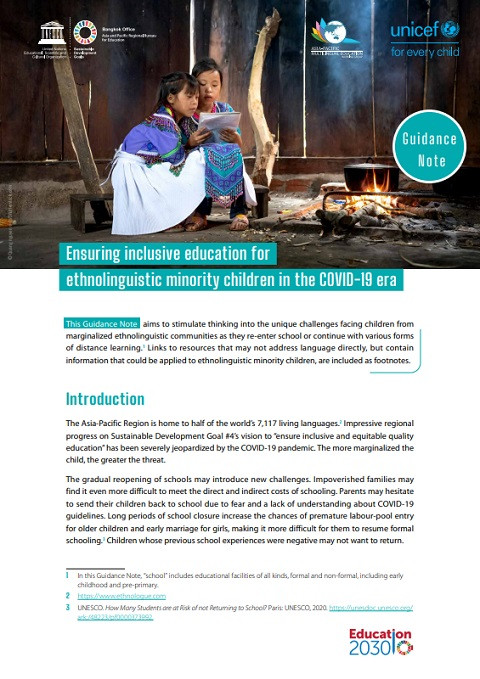 Ensuring Inclusive Education for Ethnolinguistic Minority Children in the COVID-19 Era: Guidance Note Année de publication: 2021 Auteur institutionnel: UNESCO Bangkok This Guidance Note aims to stimulate thinking into the unique challenges facing children from marginalized ethnolinguistic communities as they re-enter school or continue with various forms of distance learning. Links to resources that may not address language directly, but contain information that could be applied to ethnolinguistic minority children, are included as footnotes. Astrolabe: a guide to education for sustainable development coordination in Asia and the Pacific Année de publication: 2011 Auteur institutionnel: UNESCO Bangkok An astrolabe is an ancient instrument used to measure the position of the sun and stars. In the past it was used for a number of purposes, such as determining the time of day or night and measuring one’s current position in relation to the north and south poles. A mariner’s astrolabe was used to determine the latitude of a ship at sea and guide its direction. Similar to the mariner’s astrolabe, the Asia-Pacific Education for Sustainable Development (ESD) Astrolabe aims to assist UNESCO Member States in determining the current position of ESD in their country and guiding education and learning in a desired direction, so as to support the advancement of sustainable development in the national context. The ESD Astrolabe is also intended to complement ongoing efforts to enhance the quality of education throughout the Asia-Pacific region. Astrolabe: un guide de l'éducation pour la coordination du développement durable en Asie et dans le Pacifique Année de publication: 2011 Auteur institutionnel: UNESCO Bangkok Un astrolabe est un instrument ancien utilisé pour mesurer la position du soleil et des étoiles. Dans le passé, il a été utilisé pour un certain nombre de buts, tels que la détermination de l'heure du jour ou de nuit et la mesure de sa position actuelle par rapport aux pôles nord et sud. Un astrolabe de marin a été utilisé pour déterminer la latitude d'un navire en mer et de guider sa direction. Similaire à l'astrolabe du marins, l'Astrolabe de l'Asie-Pacifique pour le développement durable (EDD) vise à aider les États membres de l'UNESCO à déterminer la position actuelle de l'EDD dans leur pays et à orienter l'éducation et l'apprentissage dans une direction souhaitée, Développement durable dans le contexte national. L'EDD Astrolabe est également destiné à compléter les efforts en cours pour améliorer la qualité de l'éducation dans toute la région Asie-Pacifique. Education sector responses to climate change: background paper with international examples Année de publication: 2012 Auteur institutionnel: UNESCO Bangkok Through a review of academic articles and project documents, this paper explores the relationship between the education sector and climate change. It introduces how education is both impacted by and has an impact on this phenomenon, and proposes various sector responses. Different theoretical frameworks for where and how climate change education fits into the education sector are made concrete with case studies from across the globe. An essential introduction to climate change and education, this paper brings together theory, policy and practice. A useful read for those working in either the education sector or on climate change. Les réponses du secteur de l'éducation au changement climatique: document d'information avec des exemples internationaux Année de publication: 2012 Auteur institutionnel: UNESCO Bangkok Grâce à un examen des articles universitaires et des documents de projet, cet article explore la relation entre le secteur de l'éducation et le changement climatique. Il introduit comment l'éducation est à la fois touchée par et a un impact sur ce phénomène, et propose diverses réponses du secteur. Différents cadres théoriques pour où et comment le changement climatique l'éducation inscrit dans le secteur de l'éducation sont en béton avec des études de cas à travers le monde. Une introduction essentielle au changement climatique et de l'éducation, ce document rassemble la théorie, la politique et la pratique. Une lecture utile pour ceux qui travaillent soit dans le secteur de l'éducation ou sur le changement climatique.
 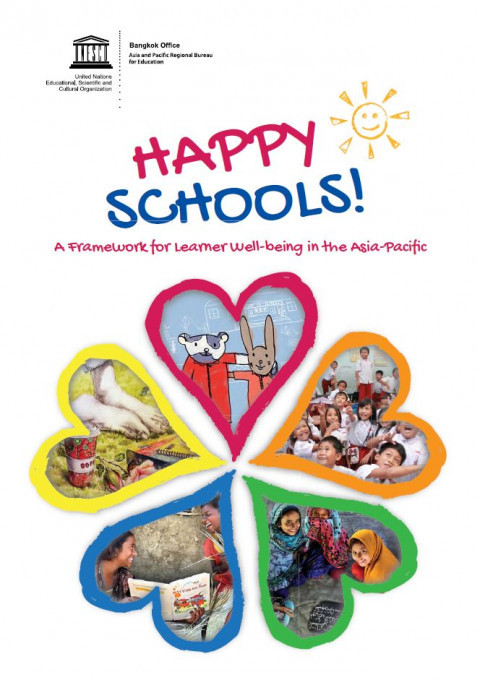 Happy Schools!: A Framework for Learner Well-being in the Asia-Pacific Année de publication: 2016 Auteur institutionnel: UNESCO Bangkok The Happy Schools Project was launched in June 2014 in the aim of promoting learner well-being and holistic development. It follows on the findings of UNESCO Bangkok’s research on ‘Learning to Live Together’, which examined the ways in which education systems can promote peace through education in the Asia-Pacific region. While the concept of ‘Learning to Live Together’ is often reflected at policy level, there is little evidence as to how it is implemented in practice. Therefore, the Happy Schools Project aims to identify and recognize proven practices at school level that integrate this concept.