
Ressources
Explorez une large gamme de ressources sur le GCED afin d’approfondir votre compréhension et de renforcer vos activités de recherche, de plaidoyer, d’enseignement et d’apprentissage.
91 résultats trouvés
 The Conceptualization of competencies related to sustainable development and sustainable lifestyles Année de publication: 2017 Auteur: Irmeli Halinen Auteur institutionnel: UNESCO International Bureau of Education (IBE) The education system of Finland has been developed soundly and steadily during the past 40 years. The guiding principles have been equity and equality in education as going hand in hand with the view to promote every individual’s life-long learning. Following these principles, it has strengthened the sustainability of the system itself. This report describes the role of sustainable development and the importance of learning a sustainable lifestyle in Finnish basic (primary and lower secondary) education. It highlights the goals, values, tasks, and the conceptualization of the competencies related to sustainability in the 2014 National Core Curriculum for basic education. In addition, it describes the sustainable nature of the curriculum reform process itself. The report examines the role and the contribution of various school subjects and key aspects, such as the school culture and the learning environment, in creating a strong knowledge base on which to build the values, attitudes, skills and the will needed for sustainable lifestyle, and in promoting sustainable ways of living. The report concludes with lessons drawn from the Finnish way of enhancing sustainability in education.
 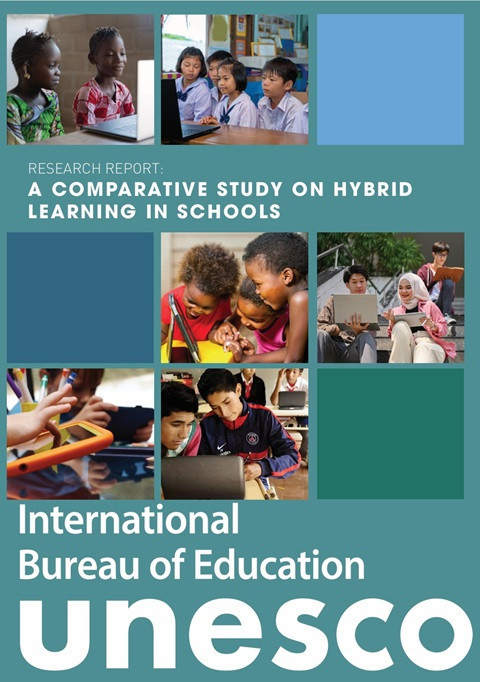 Research Report: A Comparative Study on Hybrid Learning in Schools Année de publication: 2024 Auteur institutionnel: UNESCO International Bureau of Education (IBE) During the COVID-19 lockdown, policymakers and educators faced an unprecedented challenge disrupting all levels of education. The initial optimism about replacing physical classes with virtual lessons diminished as complex interconnected issues emerged. To address the need for continuous and sustainable learning, school systems implemented variations of hybrid learning during the pandemic, seeking to integrate physical and virtual classes. These approaches prompted this comparative study led by UNESCO-IBE. The initial phase of this study involved collecting and analysing data on hybrid strategies from six countries. The research aimed to examine factors influencing hybrid learning implementation during the lockdown, with a subsequent focus on developing and validating a practical Hybrid Learning Framework for Schools. The cross-case analysis was designed not to rank or compare, but to understand and connect different scenarios and contexts. Phase I focuses on current hybrid learning practices and influencing factors, while Phases II and III will concentrate on using the information gathered to create and validate a Hybrid Learning Framework for Schools. Hybrid learning is not just a response to pandemics but also serves as a viable solution for other scenarios where full school attendance is difficult. Aligned with UNESCO-IBE’s overarching vision of a comprehensive, personalized, and democratized curriculum accessible to all, hybrid learning facilitates inclusive education across diverse regions, overcoming geographical and temporal limitations. The approach aims to unlock the unique potential of every learner, fostering a more flexible educational environment.Published in February 2024 by the UNESCO International Bureau of Education (IBE) with support from the European Union.
 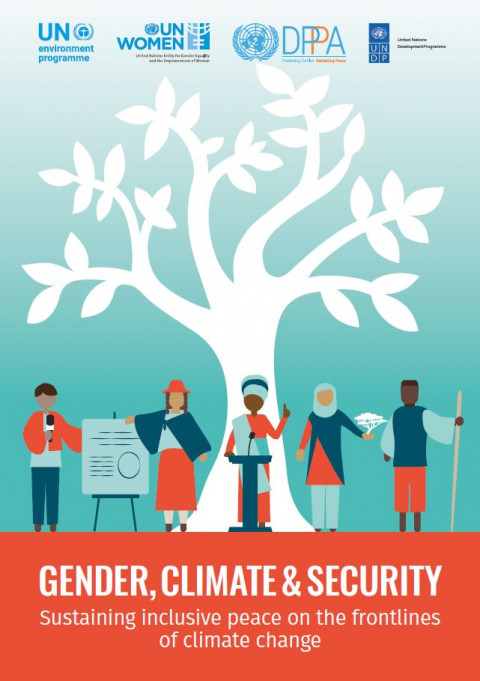 Gender, Climate & Security: Sustaining Inclusive Peace on the Frontlines of Climate Change Année de publication: 2020 Auteur institutionnel: United Nations Environment Programme (UNEP) | United Nations Entity for Gender Equality and the Empowerment of Women (UN Women) | United Nations Development Programme (UNDP) Climate change is a defining threat to peace and security in the 21st century – its impacts felt by everyone, but not equally. Gender norms and power dynamics shape how women and men of different backgrounds experience or contribute to insecurity in a changing climate. Grounded in a series of case studies from research and programming experience, this report offers a comprehensive framework for understanding how gender, climate and security are inextricably linked. The report assesses entry points for action across existing global agendas and suggests concrete recommendations for how policymakers, development practitioners and donors can advance three inter-related goals: peace and security, climate action and gender equality.
 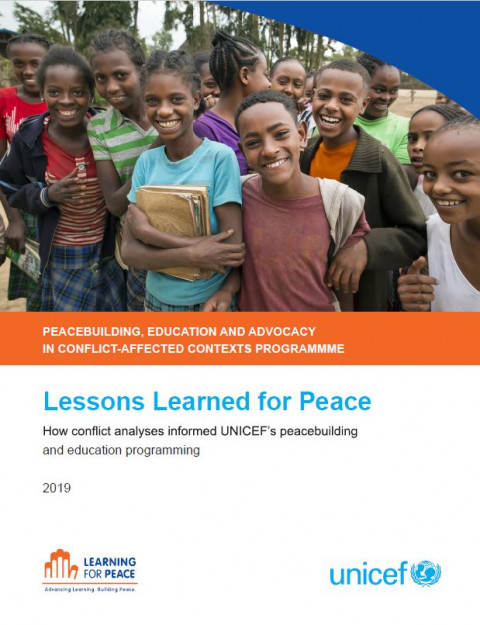 Lessons Learned for Peace Année de publication: 2019 This resource is part of a collection of resources compiled by UNICEF’s 2012-2016 Peacebuilding, Education and Advocacy Programme (PBEA), known as Learning for Peace, which was funded by the Government of the Netherlands. The purpose of Lessons Learned for Peace is to share UNICEF’s experience in conducting conflict analyses as a prerequisite for social services programming in fragile and conflict-affected contexts. As part of UNICEF’s Peacebuilding, Education and Advocacy programme, supported by the Government of the Netherlands from 2012-2016, UNICEF commissioned conflict analyses in 14 countries that informed education and other social services interventions at the system, institutional, community and individual levels. The challenges, opportunities and lessons-learned of conflict analysis research in fragile and post-conflict contexts are illustrated and discussed.
  Citizenship, identity and education: examining the public purposes of schools in an age of globalization Année de publication: 2006 Auteur: Fernando Reimers Auteur institutionnel: UNESCO International Bureau of Education (IBE) Educational institutions exist to achieve public purposes. One of those purposes is to develop citizenship. In the 21st century, citizenship includes global citizenship. In an era of globalization effective citizenship includes the knowledge, ability and disposition to engage peacefully and constructively across cultural differences for purposes of addressing personal and collective needs and of achieving sustainable human–environmental interactions, this requires internalizing global values. Addressing these challenges of globalization will require making citizenship education and the development of global values an explicit objective of efforts to improve quality throughout the world, critically examining theories and evidence about the effectiveness of various approaches to developing citizenship and global citizenship and supporting activities aligned with this public purpose. This public purpose should support the development of a political culture that fosters the rule of national and international law and respect of human rights, the development of understanding to support trade and economic and peaceful bilateral and international diplomacy as the preferred means to solve international disputes, the development of the capability to understand and address the serious environmental challenges facing humanity and to collaborate across national boundaries in the creation of sustainable forms of human–environmental interactions and in the development of the skills to promote rationality in deliberation and action, and to advance science and technology as means to improve human health and well-being. At present, however, many education systems and reforms are insufficiently focused on quality, or focus instead on a very narrow and self-referenced definition of quality. It is possible to educate people to understand and appreciate cultural differences and to understand and accept human rights in a framework of global values that includes compassion and caring, concern for others, respect and reciprocity. These values, dispositions, knowledge and skills can be developed in a range of institutions that societies have to pass on what they value to the young, and to re-create culture: families, religious institutions, the media, workplaces, political institutions and also schools. While there is no reason to assume that schools can be more effective in this task than any of these other institutions, they have greater potential to be aligned with transnational efforts to promote global civility. They are a public space, and consequently also a globally public space, in ways in which families and religious institutions are not. If schools actively engage in teaching hatred or intolerance, or if they fail to prepare students adequately for global civility, these failures can be noted by international institutions that can potentially mobilize resources to support national and local efforts to prepare students for global citizenship. There is not a similar network linking national and transnational institutions, public and private, governmental and non-governmental, that attends to the dynamics of families and other ‘‘private’’ spaces. Citoyenneté, identité et de l'éducation: l'examen des fins publiques des écoles à l'ère de la mondialisation Année de publication: 2006 Auteur: Fernando Reimers Auteur institutionnel: UNESCO International Bureau of Education (IBE) Les établissements d'enseignement existent pour parvenir à des fins publiques. L'un de ces objectifs est de développer la citoyenneté. Au 21e siècle, la citoyenneté comprend la citoyenneté mondiale. Dans une ère de mondialisation citoyenneté effective comprend les connaissances, la capacité et la disposition à engager pacifique et constructive entre les différences culturelles aux fins de répondre aux besoins personnels et collectifs et de réaliser des interactions humaines-environnementales durables, ce qui nécessite l'intériorisation des valeurs globales. Pour relever ces défis de la mondialisation, il faudra faire de l'éducation à la citoyenneté et le développement des valeurs mondiales un objectif explicite des efforts pour améliorer la qualité dans le monde entier, l'examen critique des théories et des preuves sur l'efficacité des différentes approches pour développer la citoyenneté et la citoyenneté mondiale et soutenir les activités alignées cet effet public. Cet objectif public devrait soutenir le développement d'une culture politique qui favorise la primauté du droit national et international et le respect des droits de l'homme, le développement de la compréhension pour soutenir le commerce et la diplomatie bilatérale et internationale économique et pacifique comme le moyen privilégié pour résoudre les conflits internationaux, le développement de la capacité à comprendre et à relever les défis environnementaux humanité face à de graves et de collaborer à travers les frontières nationales dans la création de formes durables d'interactions homme-environnement et dans le développement des compétences pour promouvoir la rationalité dans la délibération et de l'action, et de faire avancer la science et la technologie comme moyen d'améliorer la santé humaine et le bien-être. À l'heure actuelle, cependant, de nombreux systèmes d'éducation et les réformes ne sont pas suffisamment axées sur la qualité, ou se concentrent plutôt sur une définition très étroite et auto-référencé de la qualité. Il est possible d'éduquer les gens à comprendre et à apprécier les différences culturelles et à comprendre et à acept droits de l'homme dans un cadre de valeurs globales qui comprend la compassion et la compassion, le souci des autres, le respect et la réciprocité. Ces valeurs, les dispositions, les connaissances et les compétences peuvent être développées dans un éventail d'institutions que les sociétés doivent passer sur ce qu'ils apprécient le jeune, et de recréer la culture: les familles, les institutions religieuses, les médias, les milieux de travail, les institutions politiques et aussi écoles. Bien qu'il n'y ait aucune raison de supposer que les écoles peuvent être plus efficaces dans cette tâche que l'une de ces autres institutions, ils ont un plus grand potentiel pour être aligné avec les efforts transnationaux visant à promouvoir la civilité mondiale. Ils sont un espace public, et par conséquent aussi un espace public à l'échelle mondiale, dans les façons dont les familles et les institutions religieuses ne sont pas. Si les écoles participent activement à l'enseignement à la haine ou l'intolérance, ou si elles ne parviennent pas à préparer les étudiants de manière adéquate pour la civilité mondiale, ces échecs peuvent être notées par les institutions internationales qui peuvent potentiellement mobiliser des ressources pour soutenir les efforts nationaux et locaux pour préparer les élèves à la citoyenneté mondiale. Il n'y a pas un réseau similaire reliant les institutions nationales et transnationales, publiques et privées, gouvernementales et non-gouvernementales, qui assiste à la dynamique des familles et d'autres «espaces» «privés».
  Global Citizenship: Lessons from the Ancients (Curriculum on the Move Global, Thematic Notes No.5) Année de publication: 2022 Auteur: Conrad Hughes Auteur institutionnel: UNESCO International Bureau of Education (IBE) "Curriculum On The Move" is a new UNESCO-IBE Series aim at reflecting, debating, producing and disseminating knowledge and ways forward on emerging issues in curriculum-related aspects. The Series emerges from a bottom-up approach, with teachers and students providing their perspectives and experiences on the curriculum.The goal is to rethink the way curriculum is understood and practiced via Webinars, Concept Notes and Global Debates (via Blogs, Twitter, etc.) by involving in a participatory way youth and school practitioners.Right at the centre of the mission statement of many schools, universities and organisations is the phrase “global citizen”. But what does it mean to be a global citizen?
  Preparing teachers for inclusive education in Latin America (Prospect: quarterly review of comparative education) Année de publication: 2011 Auteur: Denise Vaillant Auteur institutionnel: UNESCO International Bureau of Education (IBE) This article analyzes the current challenges facing inclusive education in Latin America and explores some possible solutions. The author suggests that teachers play a key role in providing education that is inclusive for all. In Latin America, today, however, inclusive education often does not respond to the needs of children and young people, and teachers often finish their professional training without acquiring the skills they need to work with children and young people living in difficult circumstances. Teachers also need incentives to work in remote or difficult geographical areas, and they benefit from national efforts to improve their status, including awards for innovative work. Much remains to be done, but the training of teachers for a more inclusive education system is gradually being incorporated as part of the educational policy agenda in Latin America. Préparer les enseignants pour l'éducation inclusive en Amérique latine (Perspectives: la revue trimestrielle d'éducation comparée) Année de publication: 2011 Auteur: Denise Vaillant Auteur institutionnel: UNESCO International Bureau of Education (IBE) Cet article analyse les défis actuels éducation inclusive en Amérique latine et explore des solutions possibles. L'auteur suggère que les enseignants jouent un rôle clé dans l'éducation inclusive pour tous. En Amérique latine, aujourd'hui, cependant, l'éducation inclusive souvent ne répond pas aux besoins des enfants et des jeunes, et les enseignants finir souvent leur formation professionnelle sans acquérir les compétences dont ils ont besoin pour travailler avec les enfants et les jeunes vivant dans des circonstances difficiles. Les enseignants ont également besoin d'incitations à travailler dans des zones géographiques éloignées ou difficiles, et ils bénéficient des efforts nationaux pour améliorer leur statut, y compris des prix pour des travaux novateurs. Il reste encore beaucoup à faire, mais la formation des enseignants pour un système éducatif plus inclusif est progressivement intégré dans le cadre de l'ordre du jour de la politique éducative en Amérique latine.
  IBE-UNESCO preparatory report for the 48th ICE on inclusive education Année de publication: 2007 Auteur institutionnel: UNESCO International Bureau of Education (IBE) The International Conference on Education (ICE) is a major international forum for educational policy dialogue among Ministers of Education and other stakeholders (researchers, practitioners, representatives of intergovernmental organizations and NGOs). The ICE is organized by the International Bureau of Education (IBE), the UNESCO institute specialized in assisting Member States in curriculum development to achieve quality Education For All. The IBE Council, composed of 28 UNESCO Member States, has proposed in January 2007 that the 48th ICE session, to be held in Geneva in November 2008, should focus on the theme “Inclusive Education: the Way of the Future”. The 48th ICE will focus on broadening the understanding of the theory and practice of inclusive education while discussing how governments can develop and implement policies on inclusive education. The IBE is hosting a series of regional preparatory workshops dedicated to exploring and advancing inclusive education in preparation for the ICE 2008. The Regional Preparatory Workshop "International Workshop on Inclusive Education, Andean and Southern Cone Regions” was held in Buenos Aires, Argentina on the 11-14 September 2007. This event was organized by the International Bureau of Education (IBE/UNESCO), the Division for the Promotion of Basic Education (ED/BAS, UNESCO Paris), the Regional Bureau of Education for Latin America and the Caribbean (OREALC/UNESCO); University of de San Andrés, Ministry of Science, Technology and Education, in collaboration with the Community of Practice - Southern Cone and Andean Regions; it had the participation of ten countries from the Southern Cone and Andean Regions. This report is based on the workshop’s country reports and presentations on the conception and status of inclusive education in participating countries, and on the ideas proposed by participants on what the next steps should be on how to advance inclusive education policy and implementation in the region.