
Ressources
Explorez une large gamme de ressources sur le GCED afin d’approfondir votre compréhension et de renforcer vos activités de recherche, de plaidoyer, d’enseignement et d’apprentissage.
8 résultats trouvés
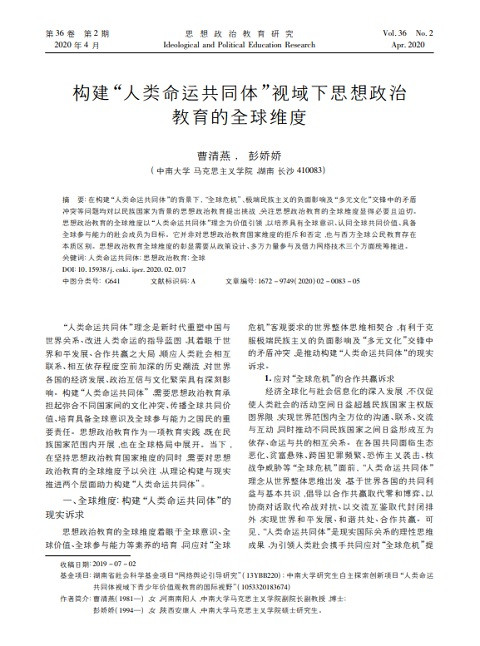 Constructing the Global Dimension of Ideological and Political Education From the Perspective of “Community With a Shared Future for Mankind” (Ideological and Political Education Research; Vol. 36, No. 2) Année de publication: 2020 Auteur: Cao Qingyan | Peng Jiaojiao Auteur institutionnel: Harbin University of Science and Technology In the context of building a community with a shared future for mankind, issues such as “global crisis”, the negative impact of ultra-nationalism and the conflicts in the confrontation of “multi-cultures” all challenge the ideological and political education in the context of nation-states. Therefore, it is necessary and urgent to pay attention to the global dimension of ideological and political education. The global dimension of ideological and political education is guided by the concept of “a community with a shared future for mankind” and aims to cultivate social members with global awareness, recognition of global common values and global participation ability. It is not the rejection and denial of the national dimension of ideological and political education, and it is also different from the western global citizenship education in essence. The global dimension of ideological and political education needs to be promoted from three aspects: policy design, multi-force participation and network technology. 构建“人类命运共同体”视域下思想政治 教育的全球维度 (思想政治教育研究; Vol. 36, No. 2) Année de publication: 2020 Auteur: Cao Qingyan | Peng Jiaojiao Auteur institutionnel: Harbin University of Science and Technology 在构建“人类命运共同体”的背景下,“全球危机”、极端民族主义的负面影响及“多元文化”交锋中的矛盾 冲突等问题均对以民族国家为背景的思想政治教育提出挑战,关注思想政治教育的全球维度显得必要且迫切。 思想政治教育的全球维度以“人类命运共同体”理念为价值引领,以培养具有全球意识、认同全球共同价值、具备 全球参与能力的社会成员为目标。它并非对思想政治教育国家维度的拒斥和否定,也与西方全球公民教育存在 本质区别。思想政治教育全球维度的彰显需要从政策设计、多方力量参与及借力网络技术三个方面统筹推进。
 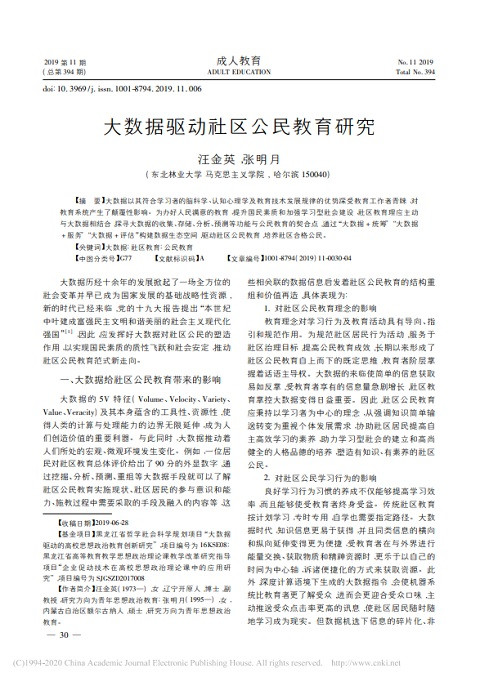 Research on Community Education and Citizenship Education Driven by Big Data (Journal of Hubei Adult Education Institute; No.11) Année de publication: 2019 Auteur: Wang Jinying | Zhang Mingyue Auteur institutionnel: Heilongjiang Education College Big data is favored by educators in line with the advantages of learners’ brain science, cognitive psychology and educational technology development rules. It has had a subversive impact on the education system and is satisfactory for people. To do a good job in education, improve the quality of the people and strengthen the construction of a learning society, community education should take the initiative to combine with big data to explore the convergence of big data collection, storage, analysis, forecasting and other functions with civic education, build a data ecological space and drive community civic education and cultivate qualified citizens in the community through “ Big Data + Co-ordination” “ Big Data + Services” and “ Big Data + Evaluation ”. 大数据驱动社区公民教育研究 (湖北成人教育学院学报; No. 11) Année de publication: 2019 Auteur: Wang Jinying | Zhang Mingyue Auteur institutionnel: Heilongjiang Education College 大数据以其符合学习者的脑科学、认知心理学及教育技术发展规律的优势深受教育工作者青睐,对 教育系统产生了颠覆性影响。为办好人民满意的教育,提升国民素质和加强学习型社会建设,社区教育理应主动 与大数据相结合,探寻大数据的收集、存储、分析、预测等功能与公民教育的契合点,通过“大数据 + 统筹”“大数据 + 服务”“大数据 + 评估”构建数据生态空间,驱动社区公民教育,培养社区合格公民。
 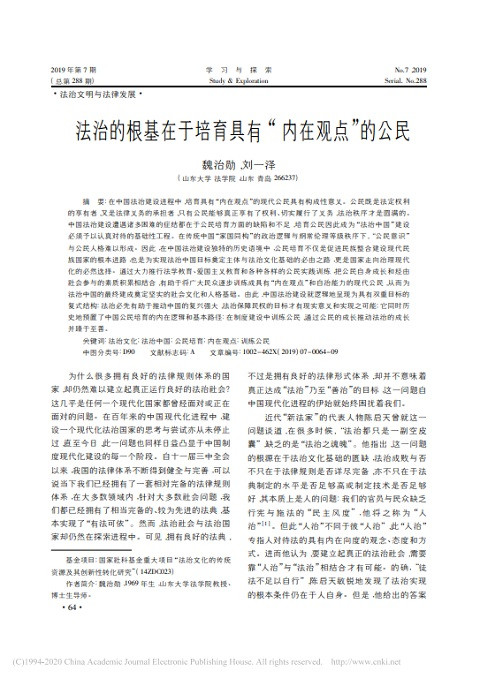 The Foundation of the Rule of Law Consisting in Cultivating Citizens with ‘Inner Views’ (Study & Exploration; No. 7) Année de publication: 2019 Auteur: Wei Zhixun | Lliu Yize Auteur institutionnel: Heilongjiang Academy of Social Sciences In the process of building the rule of law in China, it is of constitutive significance to cultivate modern citizens with “inner views”. Citizens are both the beneficiaries of legal rights and the bearers of legal obligations. Only when citizens truly enjoy their rights and fulfill their obligations can the rule of law be complete. Some of the difficulties encountered in the construction of China’s rule of law lie in the defects and deficiencies in the cultivation of citizens. Under the traditional Chinese political logic and ethical hierarchy order of family-country isomorphism, civic consciousness and civic personality must be difficult to develop. Therefore, in the unique historical context of China’s rule of law construction, citizen cultivation is not only the fundamental way to promote ethnic integration and build a modern nation state, but also the only way to lay the main body and cultural foundation for the realization of the goal of rule of law, and also the inevitable choice for the country to move towards system modernization. Carrying out legal education, patriotism education and all kinds of civil practice training vigorously, with the growth of citizen’s spirits and the accumulation of social participation will contribute to training the general public gradually to be modern citizens with internal points of view and autonomy ability so as to lay a solid social cultural foundations for the rule of law in China. Therefore, the construction of the rule of law in China is logically presented as a dual structure with dual goals: the rule of law must first help to promote the revival and strength of China, and then the goal to protect civil rights earns its meaning and possibility. At the same time, it presets the inherent logic and basic path of Chinese citizens’ cultivation: training citizens in the process of system construction promotes the growth of the rule of law through citizens’ growth so as to achieve perfection. 法治的根基在于培育具有‘内在观点’的公民 (学习与探索; No. 7) Année de publication: 2019 Auteur: Wei Zhixun | Lliu Yize Auteur institutionnel: Heilongjiang Academy of Social Sciences 在中国法治建设进程中,培育具有“内在观点”的现代公民具有构成性意义。公民既是法定权利 的享有者,又是法律义务的承担者,只有公民能够真正享有了权利、切实履行了义务,法治秩序才是圆满的。 中国法治建设遭遇诸多困难的症结都在于公民培育方面的缺陷和不足,培育公民因此成为“法治中国”建设 必须予以认真对待的基础性工程。在传统中国“家国同构”的政治逻辑与纲常伦理等级秩序下,“公民意识” 与公民人格难以形成。因此,在中国法治建设独特的历史语境中,公民培育不仅是促进民族整合建设现代民 族国家的根本进路,也是为实现法治中国目标奠定主体与法治文化基础的必由之路,更是国家走向治理现代化的必然选择。通过大力推行法学教育、爱国主义教育和各种各样的公民实践训练,把公民自身成长和经由社会参与的素质积累相结合,有助于将广大民众逐步训练成具有“内在观点”和自治能力的现代公民,从而为法治中国的最终建成奠定坚实的社会文化和人格基础。由此,中国法治建设就逻辑地呈现为具有双重目标的复式结构: 法治必先有助于推动中国的复兴强大,法治保障民权的目标才有现实意义和实现之可能; 它同时历 史地预置了中国公民培育的内在逻辑和基本路径: 在制度建设中训练公民,通过公民的成长推动法治的成长 并臻于至善。
 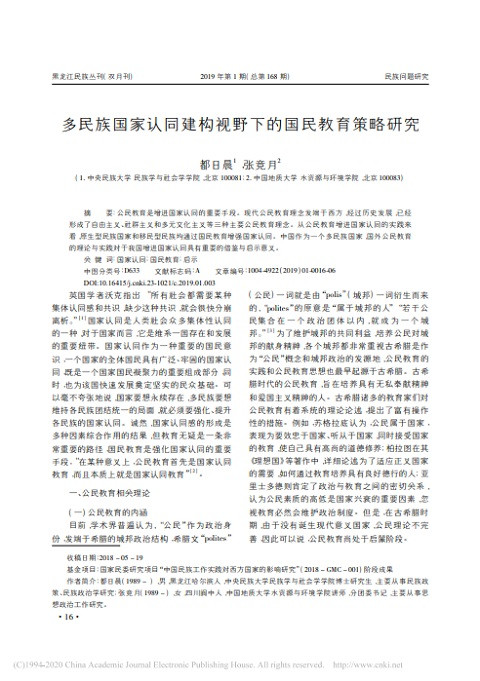 Research on National Education Strategies From the Perspective of Multi-Ethnic National Identity Construction (Heilongjiang National Series; No.1) Année de publication: 2019 Auteur: Du Richen | Zhang Jingyue Auteur institutionnel: Heilongjiang National Research Institute Civic education is an important means to enhance national identity. The idea of modern civic education originated in the West, and after historical development, it has formed three main ideas of civic education, liberalism, communitarianism and multiculturalism. In terms of the practice of enhancing national identity through civic education, both native and immigrant ethnic groups enhance national identity through national education. As China is a multi-ethnic country, the theory and practice of foreign citizenship education have important reference and enlightenment significance for our country to enhance national identity. 多民族国家认同建构视野下的国民教育策略研究 (黑龙江民族丛刊; No. 1) Année de publication: 2019 Auteur: Du Richen | Zhang Jingyue Auteur institutionnel: Heilongjiang National Research Institute 公民教育是增进国家认同的重要手段。现代公民教育理念发端于西方,经过历史发展,已经 形成了自由主义、社群主义和多元文化主义等三种主要公民教育理念。从公民教育增进国家认同的实践来 看,原生型民族国家和移民型民族均通过国民教育增强国家认同。中国作为一个多民族国家,国外公民教育 的理论与实践对于我国增进国家认同具有重要的借鉴与启示意义。