
Ressources
Explorez une large gamme de ressources sur le GCED afin d’approfondir votre compréhension et de renforcer vos activités de recherche, de plaidoyer, d’enseignement et d’apprentissage.
28 résultats trouvés
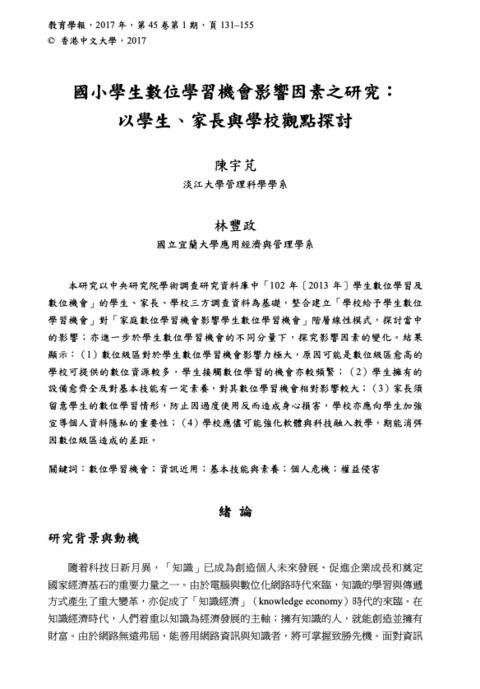 A Study on the Influential Factors of E-learning Opportunity for Elementary School Students: Perspectives from Students, Parents and Schools (Educational Journal ; Vol.45, No.1) Année de publication: 2017 Auteur: 陈宇芃 | 林丰政 Based on the data from students, parents and schools of the 2013 Survey of Student Digital Ability and e-Learning Opportunity from the Academia Sinica’s Survey Research Data Archive, this article constructed a hierarchical linear model to analyze how students’ e-learning opportunity is related to the multilevel influence effects of school- and parent-level covariates. Quantile regression was also used to study different covariate effects at different quantile levels of student e-learning opportunity. Results indicate that: (1) Digital Level Area is a very important influential factor for students’ e-learning opportunity due to the reason that schools in higher Digital Level Area have more digital resources, and students are likely to have more opportunity for access to and frequent use of e-learning; (2) the more IT equipment or IT literacy students have can greatly affect their possession of e-learning opportunity; (3) parents should pay special attention to problems of their children resulting from overuse of e-learning resources which could cause harm to their children both mentally and physically; moreover, schools should widely promote the awareness of personal information security to students; (4) in order to eliminate the digital divide caused by Digital Level Area, schools need to strengthen the integration of software and information technology into instruction as far as possible. 国小学生数位学习机会影响因素之研究: 以学生、家长与学校观点探讨 (教育学报; Vol. 45, No.1) Année de publication: 2017 Auteur: 陈宇芃 | 林丰政 本研究以中央研究院学术调查研究资料库中「102年[2013年]学生数位学习及数位机会」的学生、家长、学校三方调查资料为基础,整合建立「学校给予学生数位学习机会」对「家庭数位学习机会影响学生数位学习机会」阶层线性模式,探讨当中的影响;亦进一步于学生数位学习机会的不同分量下,探究影响因素的变化。结果显示:(1)数位级区对于学生数位学习机会影响力极大,原因可能是数位级区愈高的学校可提供的数位资源较多,学生接触数位学习的机会亦较频繁;(2)学生拥有的设备愈齐全及对基本技能有一定素养,对其数位学习机会相对影响较大;(3)家长须留意学生的数位学习情形,防止因过度使用反而造成身心损害,学校亦应向学生加强宣导个人资料隐私的重要性;(4)学校应尽可能强化软体与科技融入教学,期能消弭因数位级区造成的差距。
  Are we all global citizens now? Reflections on citizenship and citizenship education in a globalising world (with special reference to Singapore) Année de publication: 2012 Auteur: Saravanan Gopinathan Auteur institutionnel: Centre for Governance and Citizenship | Hong Kong Institute of Education Research into citizenship education has traditionally focused on citizenship curricula within the context of the nation-state. More recently, as a response to globalization trends, it has been suggested that citizenship research must embrace the concept of the 'global citizen.' Such perspectives draw principally on Anglo-Saxon perspectives on the evolution of the nation-state and citizen-state relations. This perspective is critiqued from the context of a post-colonial developing state, Singapore, and an argument made that a nation-centric perspective is still viable. Sommes-nous tous les citoyens du monde maintenant? Réflexions sur la citoyenneté et l'éducation à la citoyenneté dans un monde globalisé (avec référence spéciale à Singapour) Année de publication: 2012 Auteur: Saravanan Gopinathan Auteur institutionnel: Centre for Governance and Citizenship | Hong Kong Institute of Education La recherche sur l'éducation à la citoyenneté est traditionnellement concentrée sur les programmes de la citoyenneté dans le cadre de l'État-nation. Plus récemment, en réponse aux tendances de la mondialisation, il a été suggéré que la recherche sur la citoyenneté doit embrasser le concept de «citoyen du monde». Ces perspectives attirent principalement sur les perspectives anglo-saxons sur l'évolution des relations de l'État-nation et de l'Etat-citoyen. Cette perspective est critiquée dans le cadre d'un post-colonial en développement état, Singapour, et un argument fait que la perspective de la nation centrée est toujours viable. Global citizenship curriculum in higher education: evolving policy and practice and a future research agenda; proceedings of a symposium held on 9-10 December 2013 in Hong Kong Année de publication: 2013 Auteur institutionnel: Bath Spa University | General Education Centre (Hong Kong) | Polytechnic University This symposium was an outgrowth of a UK Economic and Social Research Council (ESRC) funded International Networking Project. A collaboration between academics in the United Kingdom/Europe, North America, and Asia, this project responds to the fact that there is an increasing interest in understanding how universities can educate students to become more engaged and globally-minded citizens. The premise is that higher education should contribute to the public good by training more global citizens with cultural awareness, a strong sense of civic responsibility and skills to participate in a knowledge-based global economy. The following report documents the symposium proceedings, summarises the presentations and provides key insights drawn from presentations. Comments made by individuals are paraphrased and/or synthesized. Programme de Citoyenneté Mondiale dans l'enseignement supérieur: la politique et la pratique en évolution et un futur programme de recherche; actes d'un colloque tenu les 9-10 Décembre 2013 à Hong Kong Année de publication: 2013 Auteur institutionnel: Bath Spa University | General Education Centre (Hong Kong) | Polytechnic University Ce symposium était une excroissance du Conseil de la recherche économique et sociale du Royaume-Uni (en. ESRC) financé Projet international de réseautage. Une collaboration entre les universitaires au Royaume-Uni / Europe, Amérique du Nord, et en Asie, ce projet répond au fait qu'il ya un intérêt croissant pour comprendre comment les universités peuvent éduquer les élèves à devenir des citoyens plus engagés et ouverts sur le monde. La prémisse est que l'enseignement supérieur doit contribuer au bien public par la formation des citoyens plus globales avec la conscience culturelle, un fort sentiment de responsabilité et les compétences civiques de participer à une économie mondiale fondée sur le savoir. Le rapport suivant documente les actes du colloque, résume les présentations et fournit des informations clés tirées des présentations. Commentaires formulés par les individus sont paraphrasés et / ou synthétisés.
 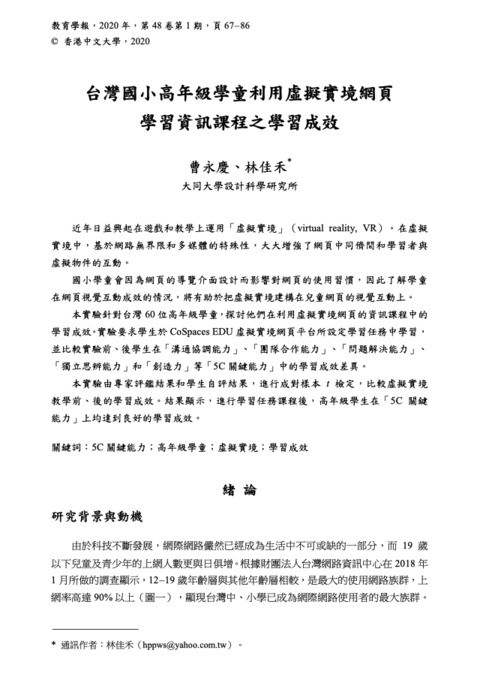 Learning Outcomes of Fifth and Sixth Graders in a Computer Course Using a Virtual Reality Website for Learning (Educational Journal ; Vol.48, No.1) Année de publication: 2020 Auteur: 曹永庆 | 林佳禾 In recent years, the use of virtual reality (VR) in games and teaching has become increasingly popular. The boundless nature of the Web and the uniqueness of multimedia in VR greatly enhance peer interaction as well as the interaction between learners and virtual objects on Webpages.Elementary schoolchildren’s habits of using Webpages depends upon the navigation interface design of the Webpages. Therefore, understanding the effectiveness of schoolchildren’s visual interaction with Webpages will help implement VR into Websites for schoolchildren.The purpose of this experiment was to explore the learning outcomes of 60 Taiwanese fifth and sixth graders in a computer course using VR Webpages. The experiment involved students learning through the tasks set on the VR Web platform “CoSpaces EDU.” The differences in their learning outcomes on the “5C key competencies” (i.e., communication and coordination skills, teamwork capabilities, problem-solving skills, independent thinking capabilities, and creativity) before and after the experiment were compared.Based on the results of expert assessment and students’ self-evaluation, paired-samples t test was conducted to compare the learning outcomes before and after implementing the VR teaching. Results show that the fifth and sixth graders were found to exhibit excellent 5C competencies after the experiment. 台湾国小高年级学童利用虚拟实境网页学习资讯课程之学习成效 (教育学报; Vol.48, No.1) Année de publication: 2020 Auteur: 曹永庆 | 林佳禾 近年日益兴起在游戏和教学上运用「虚拟实境」(virtual reality, vr)。在虚拟实境中,基于网路无界限和多媒体的特殊性,大大增强了网页中同侪间和学习者与虚拟物件的互动。 国小学童会因为网页的导览介面设计而影响对网页的使用习惯,因此了解学童在网页视觉互动成效的情况,将有助于把虚拟实境建构在儿童网页的视觉互动上。本实验针对台湾60位高年级学童,探讨他们在利用虚拟实境网页的资讯课程中的学习成效。实验要求学生于cospaces edu虚拟实境网页平台所设定学习任务中学习,并比较实验前、后学生在「沟通协调能力」、「团队合作能力」、「问题解决能力」、「独立思辨能力」和「创造力」等「5c关键能力」中的学习成效差异。本实验由专家评监结果和学生自评结果,进行成对样本t检定,比较虚拟实境教学前、后的学习成效。结果显示,进行学习任务课程后,高年级学生在「5c关键能力」上均达到良好的学习成效。
 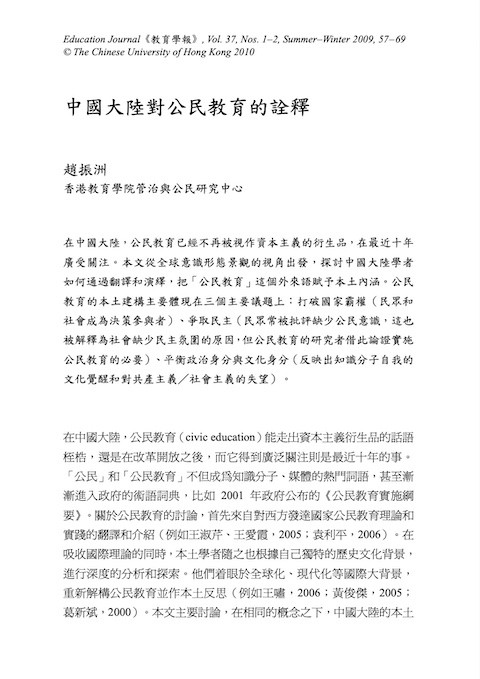 Conceptualization of Citizenship Education in the Chinese Mainland (Education Journal 《教育學報》; Vol. 37) Année de publication: 2010 Auteur: Zhao Zhengzhou Auteur institutionnel: Chinese University of Hong Kong This paper discusses how Chinese academics conceptualised Citizenship Education. It provides a local perspective on this issue, including breaking state hegemony, struggling for democracy and balancing political identity and cultural identity. 中国大陆对公民教育的诠释 (教育學報; Vol. 37) Année de publication: 2010 Auteur: Zhao Zhengzhou Auteur institutionnel: Chinese University of Hong Kong 该文讨论了中国大陆的研究者如何探讨公民教育议题,并赋予公民教育以本土意义,包含,打破国家霸权,争取民主,平衡政治身份与文化身份等。