
Ressources
Explorez une large gamme de ressources sur le GCED afin d’approfondir votre compréhension et de renforcer vos activités de recherche, de plaidoyer, d’enseignement et d’apprentissage.
8 résultats trouvés
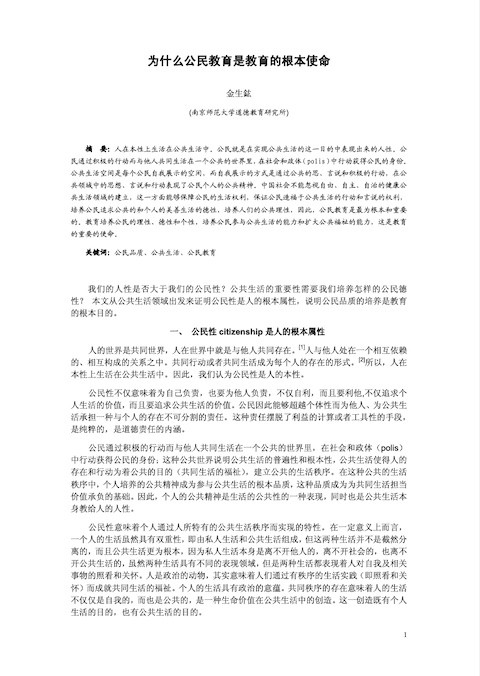 Why the Fundamental Vision of Education Is Civil Education Année de publication: 2007 Auteur: Jin Shenghong Auteur institutionnel: NanJing Normal University This paper discusses the importance of citizenship in modern world. It also stresses the unique role of education in cultivating citizens. 为什么公民教育是教育的根本使命 Année de publication: 2007 Auteur: Jin Shenghong Auteur institutionnel: NanJing Normal University 本文讨论了公民身份对于现代生活的重要意义,并强调了公民教育在培养公民上的重要使命。
 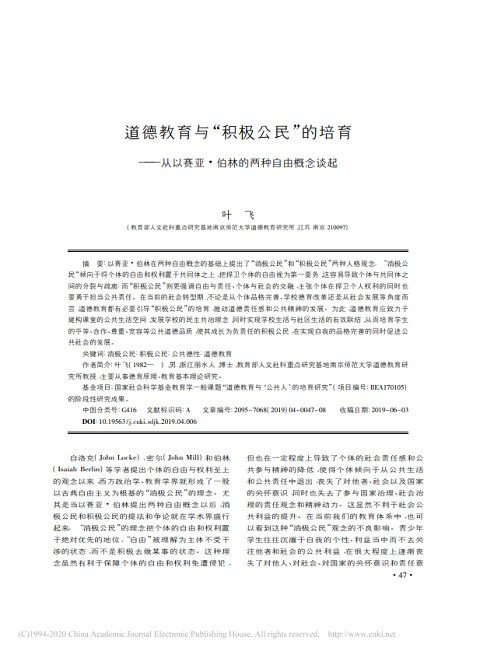 Moral Education and the Cultivation of Positive Citizen: Insights from Isaiah Berlin’s Conceptualization of Two Types of Freedom Année de publication: 2019 Auteur: Ye Fei Auteur institutionnel: 苏州大学 On the basis of a binary model of freedom, Isaiah Berlin distinguished two types of citizenship: “negative citizen” and “active citizen”. “Negative citizens” tend to place individual freedom and rights above the community, and to defend the individual freedom as the top priority, which readily leads to the division and alienation between the individual and the community. “Active citizens”, on the other hand, tend to place a greater emphasis on the close relationship between freedom and responsibility and the integration of individual and the society, advocating that individuals shall have the courage to assume public responsibility while defending their individual rights. In the ongoing social transformation, moral education shall guide the cultivation of “active citizens” and promote the development of moral responsibility and public spirit, which is valid practice with relation to individual personality improvement, school moral education reform, and social development. To this end, moral education should be devoted to constructing a public living space in the classroom, developing the concept of democratic co-governance in schools, and meanwhile establishing an effective connection between schools and communities. Thus, students can be expected to become responsible and positive citizens who treasure such public virtues as equality, cooperation, respect, and tolerance, and who shall contribute to the progress of public life in building a respectable character. 道德教育与“积极公民”的培育—从以赛亚・伯林的两种自由概念谈起 Année de publication: 2019 Auteur: Ye Fei Auteur institutionnel: Soochow University 以赛亚·伯林在两种自由概念的基础上提出了“消极公民”和“积极公民”两种人格观念。“消极公民”倾向于将个体的自由和权利置于共同体之上,把捍卫个体的自由视为第一要务,这容易导致个体与共同体之 间的分裂与疏离; 而“积极公民”则更强调自由与责任、个体与社会的交融,主张个体在捍卫个人权利的同时也要勇于担当公共责任。在当前的社会转型期,不论是从个体品格完善、学校德育改革还是从社会发展等角度而言,道德教育都有必要引导“积极公民”的培育,推动道德责任感和公共精神的发展。为此,道德教育应致力于建构课堂的公共生活空间,发展学校的民主共治理念,同时实现学校生活与社区生活的有效联结,从而培育学生的平等、合作、尊重、宽容等公共道德品质,使其成长为负责任的积极公民,在实现自我的品格完善的同时促进公共社会的发展。
 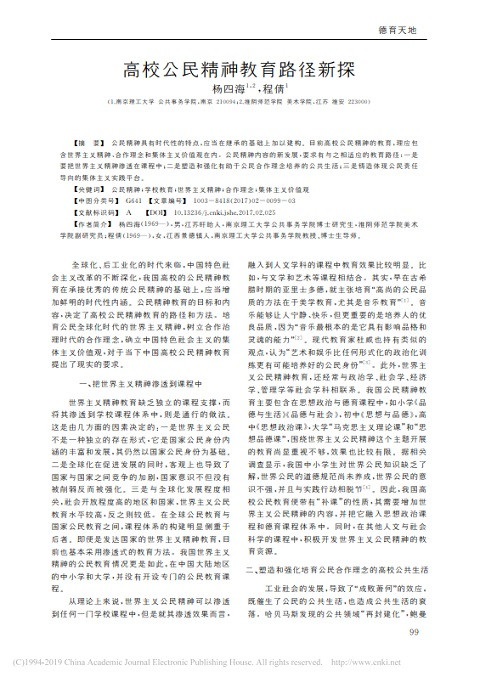 A New Approach to Civic Spirit Education in Universities (Jiangsu Higher Education; No. 2) Année de publication: 2017 Auteur: Yang Sihai | Cheng Qian Auteur institutionnel: Jiangsu Education Press The civic spirit has the characteristics of The Times and should be constructed on the basis of inheritance. At present, the education of civic spirit in universities should include the spirit of cosmopolitanism, the idea of cooperation and the value of collectivism. The new development of civic spirit requires the corresponding educational path: First, the spirit of cosmopolitanism should be infiltrated into the curriculum; Second, to shape and strengthen the public life conducive to the cultivation of the concept of citizen cooperation; Thirdly, casting the collectivism practice platform that embodies the orientation of civic responsibility. 高校公民精神教育路径新探 (江苏高教; No. 2) Année de publication: 2017 Auteur: Yang Sihai | Cheng Qian Auteur institutionnel: Jiangsu Education Press 公民精神具有时代性的特点,应当在继承的基础上加以建构。目前高校公民精神的教育,理 应 包 含世界主义精神、合作理念和集体主义价值观在内。公民精神内容的新发展,要求有与之相适应的教育路径:一是 要把世界主义精神渗透在课程中;二是塑造和强化有助于公民合作理念培养的公共生活;三是铸造体现公民责任 导向的集体主义实践平台。
  On the Value Orientation of Global Citizenship Education in Chinese Colleges and Universities from the Perspective of Globalization Année de publication: 2016 Auteur: Feng Qi | Zhang Wanhong Civic education is not only an educational issue, but also the foundation and development of the country. With the advent of the era of globalization, global civic education has gradually become an inevitable trend in the development of civic education, and it is also the pursuit of modernity in civic education. College students are in the important period of the transformation of their identity relationship. They are experiencing the transformation from “school citizenship” to “social citizenship”. The value orientation of global citizenship education in China's colleges and universities is directly related to the future development of global civil society. Under the background of globalization, global civic education in China's colleges and universities attempts to explore and summarize the five values of orientation based on fairness and justice, guided by democratic rationality, with respect for tolerance, national characteristics and sustainable development. 论全球化视域下我国高校全球公民教育的价值取向 Année de publication: 2016 Auteur: Feng Qi | Zhang Wanhong 公民教育不仅是一个教育问题,也是国家稳定之基和发展之本。随着全球化时代的到来,全球公民教育逐渐成为公民教育发展的必然趋势,也是公民教育现代性的追求。高校学生处于身份关系转变的重要时期,正经历由“学校公民”向“社会公民”的身份转换,我国高校全球公民教育的价值取向直接关乎未来全球公民社会的发展。全球化背景下我国高校全球公民教育试图探索和总结以公平正义为准则、以民主理性为导向、以尊重包容为态度、以民族本土为特色和以可持续发展为目的的五大价值取向,旨在为我国高校的全球公民教育明确发展方向,提供有益借鉴。