
Ressources
Explorez une large gamme de ressources sur le GCED afin d’approfondir votre compréhension et de renforcer vos activités de recherche, de plaidoyer, d’enseignement et d’apprentissage.
89 résultats trouvés
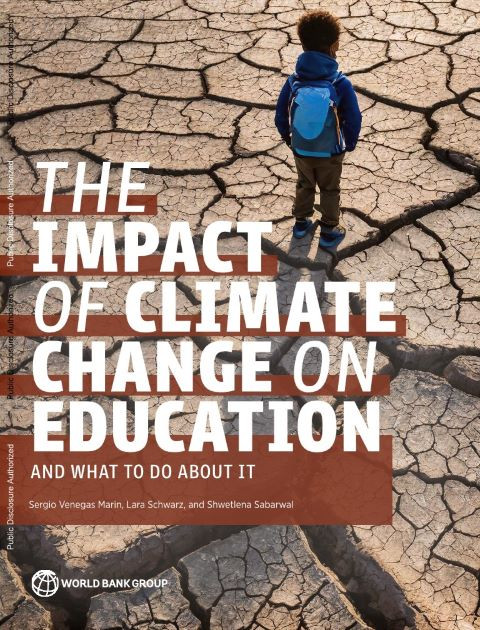 The Impact of Climate Change on Education and What to Do about It Année de publication: 2024 Auteur: Sergio Venegas Marin | Lara Schwarz | Shwetlena Sabarwal Auteur institutionnel: International Bank for Reconstruction and Development | World Bank Education can be the key to ending poverty in a livable planet, but governments must act now to protect it. Climate change is increasing the frequency and intensity of extreme weather events such as cyclones, floods, droughts, heatwaves and wildfires. These extreme weather events are in turn disrupting schooling; precipitating learning losses, dropouts, and long-term impacts. Even if the most drastic climate mitigation strategies were implemented, extreme weather events will continue to have detrimental impacts on education outcomes.
 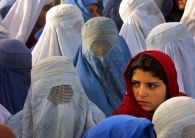 Women’s Education: Promoting Development, Countering Radicalism Année de publication: 2014 Auteur: Hedieh Mirahmadi Auteur institutionnel: World Organization for Resource Development and Education (WORDE) Increasing access to quality secular education can create better jobs for women and reduce some of the economic drivers of radicalization. Educated women can in turn play a pivotal role in inoculating their children and communities against the radical narratives used to recruit followers. Women’s Education: Promoting Development, Countering Radicalism Année de publication: 2014 Auteur: Hedieh Mirahmadi Auteur institutionnel: World Organization for Resource Development and Education (WORDE) Améliorer l'accès à une éducation laïque de qualité peut contribuer à la création de meilleurs emplois pour les femmes et réduire certains facteurs économiques de la radicalisation. Les femmes éduquées peuvent à leur tour jouer un rôle essentiel en protégeant leurs enfants et les communautés contre les récits radicaux utilisés pour recruter des adeptes.
 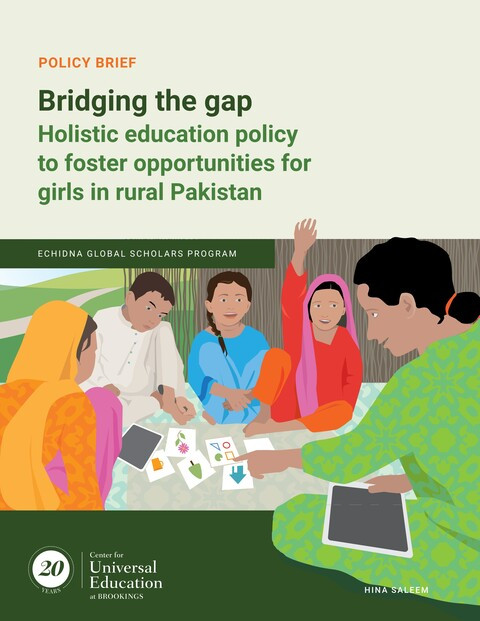 Bridging the Gap: Holistic Education Policy to Foster Opportunities for Girls in Rural Pakistan Année de publication: 2023 Auteur: Hina Saleem Auteur institutionnel: Center for Universal Education at Brookings Seven out of ten girls in rural Sindh are excluded from schooling. This happens for a myriad of reasons and occurs both in the presence and absence of operational school buildings. When schools are present, the challenges that children—especially girls—face due to their economic and social context often go unaddressed; children who are able to enroll in school often find their learning affected by classroom design and practices and experiences that mirror the exclusion they experience outside of school. At the broader level, this exclusion is reflected in limited representation of the needs and aspirations of sizable rural populations in Pakistan’s formal education system and the pathways beyond it. This policy brief presents findings from on-the-ground research in rural settlements in Sindh province that explores the disparities between boys and girls in enrollment and continuation of schooling in addition to overall inadequate education outcomes. It also provides policy recommendations to support all children and particularly girls in meeting their education needs and aspirations. Education policy must respond to these challenges of unmet education needs and aspirations by taking a holistic, welfare-based approach that supports children to overcome the effects of exclusionary conditions to meet their education needs. However, the benefits of such an approach can only be realized if teaching practices and learning experiences are contextualized, build a connection with local knowledge, question root causes of exclusion and support and prepare all children in negotiating pathways beyond education.
  Education for citizenship in the Arab World: key to the future Année de publication: 2011 Auteur: Muhamman Faour | Marwan Muasher Auteur institutionnel: Carnegie Middle East Center Reforming education to foster citizenship is urgently needed if democracy is to take hold in the Arab world. Under authoritarian rule, students were primarily taught to be docile subjects of the state—creative thinking was discouraged and information was treated as indisputable. Instead, students must learn from a very early age what it means to be citizens who seek and produce knowledge, question, and innovate. Only by teaching youth to think critically and respect different points of view will Arab countries become economically competitive and reliably democratic.
  Education for citizenship in the Arab World: key to the future Année de publication: 2011 Auteur: Muhamman Faour | Marwan Muasher Auteur institutionnel: Carnegie Middle East Center Reforming education to foster citizenship is urgently needed if democracy is to take hold in the Arab world. Under authoritarian rule, students were primarily taught to be docile subjects of the state—creative thinking was discouraged and information was treated as indisputable. Instead, students must learn from a very early age what it means to be citizens who seek and produce knowledge, question, and innovate. Only by teaching youth to think critically and respect different points of view will Arab countries become economically competitive and reliably democratic. التربية من أجل المواطنة في العالم العربي: مفتاح المستقبل Année de publication: 2011 Auteur: Muhamman Faour | Marwan Muasher Auteur institutionnel: Carnegie Middle East Center La réforme de l'éducation pour favoriser la citoyenneté est nécessaire de toute urgence si la démocratie est de prendre la main dans le monde arabe. Sous un régime autoritaire, les étudiants ont été principalement appris à être des sujets dociles de la pensée créatrice de l'État a été découragé et de l'information a été traitée comme indiscutable. Au lieu de cela, les élèves doivent apprendre à partir d'un très jeune âge ce que cela signifie d'être des citoyens qui cherchent et produisent la connaissance, question, et innovent. Seulement en enseignant les jeunes à penser de façon critique et respecter différents points de vue seront les pays arabes devenir économiquement compétitive et fiable démocratique. التربية من أجل المواطنة في العالم العربي: مفتاح المستقبل Année de publication: 2011 Auteur: Muhamman Faour | Marwan Muasher Auteur institutionnel: Carnegie Middle East Center Reforming education to foster citizenship is urgently needed if democracy is to take hold in the Arab world. Under authoritarian rule, students were primarily taught to be docile subjects of the state—creative thinking was discouraged and information was treated as indisputable. Instead, students must learn from a very early age what it means to be citizens who seek and produce knowledge, question, and innovate. Only by teaching youth to think critically and respect different points of view will Arab countries become economically competitive and reliably democratic. Education for citizenship and democracy in a globalized world: a comparative perspective Année de publication: 2005 Auteur institutionnel: Inter-American Development Bank The present document, Education for Citizenship and Democracy in a Globalized World: A Comparative Perspective, was developed in response to a request from the members of the Regional Policy Dialogue/Education Network. The studies in this document were presented and discussed during the VII Regional Policy Dialogue meeting held in January 2005 at the Inter-American Development Bank ’s headquarters in Washington, D.C. Within the general context of recent economic and political developments in Latin America and the Caribbean, experts regard free market and democracy as the fundamental economic and political paradigm leading to modernization and development in the global market. There is a concern in a number of democratic nation-states about levels of political engagement, particularly among the youths. This is cited as a reason for strengthening citizenship education.The studies presented in this document discuss Education for Citizenship and Democracy and the role of schools as systematic providers of the civic knowledge and the participatory practices that are the foundation of democracy. Among all of the institutions that facilitate the acquisition and development of skills for democratic participation, the school is the one that provide students with the competencies to effectively participate as citizens in a democracy. There has been an increasing interest in citizenship education both in the national and international contexts. At the national level, the aim is to pursue commitment and political participation, particularly from youth. In the international sphere, the objective is to find answers to the challenges such as immigration, global communications and trade across international borders and to a new level of awareness and appreciation for human rights. By providing a comprehensive overview of progress made by industrialized countries in the field of citizenship education, this study intents to share lessons learnt and effective practices which may be applied in the context of Latin America and the Caribbean. In addition, this study includes three experiences from Latin American countries (Chile, Colombia and Mexico) that were presented during the VII Regional Policy Dialogue. The three experiences show a practical and positive approach to the feasibility of introducing citizenship education in the schools of the Region. The cases present examples of reforms that evolved from the traditional civic education into an engaging education for citizenship and democracy. The Inter American Development Banks trusts that this publication will contribute to the discussions among member countries and create alternatives for the strengthening of democracy in the Region through education and citizenship. Education à la citoyenneté et de la démocratie dans un monde globalisé: une perspective comparative Année de publication: 2005 Auteur institutionnel: Inter-American Development Bank Le présent document, Éducation à la Citoyenneté et la Démocratie dans un monde globalisé: une perspective comparative, a été développé en réponse à une demande des membres du Dialogue Politique Régionale / Réseau Education. Les études présentées dans ce document ont été présentés et discutés lors de la réunion de dialogue politique régionale VII tenue en Janvier 2005 au siège de l'Organisation interaméricaine de la Banque de développement à Washington, DC Dans le contexte général des développements économiques et politiques récents en Amérique latine et dans les Caraïbes , les experts considèrent le marché libre et la démocratie comme le paradigme économique et politique fondamentale qui a conduit à la modernisation et le développement sur le marché mondial. Il y a une préoccupation dans un certain nombre d'Etats-nations démocratiques sur les niveaux d'engagement politique, en particulier chez les jeunes. Elle est citée comme une raison pour le renforcement de l'éducation civique. Les études présentées dans ce document discutent éducation à la citoyenneté et la démocratie et le rôle des écoles en tant que prestataires systématiques des connaissances civiques et les pratiques participatives qui sont le fondement de la démocratie. Parmi toutes les institutions qui facilitent l'acquisition et le développement des compétences pour la participation démocratique, l'école est celle qui fournit aux étudiants les compétences nécessaires pour participer efficacement en tant que citoyens dans une démocratie. Il y a eu un intérêt croissant pour l'éducation à la citoyenneté à la fois dans les contextes nationaux et internationaux. Au niveau national, l'objectif est de poursuivre l'engagement et la participation politique, en particulier des jeunes. Sur le plan international, l'objectif est de trouver des réponses aux défis tels que l'immigration, les communications mondiales et le commerce à travers les frontières internationales et à un nouveau niveau de conscience et l'appréciation des droits de l'homme. En fournissant une vue d'ensemble des progrès réalisés par les pays industrialisés dans le domaine de l'éducation civique, cette étude des intentions de partager les leçons apprises et les pratiques efficaces qui peuvent être appliquées dans le contexte de l'Amérique latine et les Caraïbes. En outre, cette étude comprend trois expériences des pays d'Amérique latine (Chili, Colombie et Mexique) qui ont été présentées lors du Dialogue Politique Régionale VII. Les trois expériences montrent une approche pratique et positive à la possibilité d'introduire l'éducation à la citoyenneté dans les écoles de la région. Les cas présentent des exemples de réformes qui ont évolué à partir de l'éducation civique traditionnelle en une éducation engageante pour la citoyenneté et la démocratie. Les banques de développement américaines Inter veut croire que cette publication contribuera aux discussions entre les pays membres et de créer des solutions de rechange pour le renforcement de la démocratie dans la région par l'éducation et la citoyenneté.