
Ressources
Explorez une large gamme de ressources sur le GCED afin d’approfondir votre compréhension et de renforcer vos activités de recherche, de plaidoyer, d’enseignement et d’apprentissage.
1,450 résultats trouvés
 Neuroscience Applied to Everyday Life: David del Rosario, Neuroscience Researcher (Full Version) Année de publication: 2022 Auteur: David del Rosario Auteur institutionnel: Banco Bilbao Vizcaya Argentaria (BBVA) Why are we unhappy even when everything is going well? What is thought? Do we know how our mind and body works? "Knowledge, if not applied, is useless," says scientist David del Rosario. In this video, the researcher analyzes different experiments and questions our relationship with what we think to address what he calls "everyday neuroscience". Neurociencia aplicada al día a día: David del Rosario, investigador en neurociencia (Versión Completa) Année de publication: 2022 Auteur: David del Rosario Auteur institutionnel: Banco Bilbao Vizcaya Argentaria (BBVA) ¿Por qué somos infelices incluso cuando todo va bien? ¿Qué es el pensamiento? ¿Conocemos cómo funciona nuestra mente y nuestro organismo? "El conocimiento, si no se aplica, no sirve para nada", asegura el científico David del Rosario. En este vídeo, el investigador analiza diferentes experimentos y cuestiona nuestra relación con lo que pensamos para abordar lo que él llama "neurociencia del día a día".
  The Conceptualization of competencies related to sustainable development and sustainable lifestyles Année de publication: 2017 Auteur: Irmeli Halinen Auteur institutionnel: UNESCO International Bureau of Education (IBE) The education system of Finland has been developed soundly and steadily during the past 40 years. The guiding principles have been equity and equality in education as going hand in hand with the view to promote every individual’s life-long learning. Following these principles, it has strengthened the sustainability of the system itself. This report describes the role of sustainable development and the importance of learning a sustainable lifestyle in Finnish basic (primary and lower secondary) education. It highlights the goals, values, tasks, and the conceptualization of the competencies related to sustainability in the 2014 National Core Curriculum for basic education. In addition, it describes the sustainable nature of the curriculum reform process itself. The report examines the role and the contribution of various school subjects and key aspects, such as the school culture and the learning environment, in creating a strong knowledge base on which to build the values, attitudes, skills and the will needed for sustainable lifestyle, and in promoting sustainable ways of living. The report concludes with lessons drawn from the Finnish way of enhancing sustainability in education.
  Curriculum development and review for democratic citizenship and human rights education Année de publication: 2015 Auteur: Felisa Tibbitts Auteur institutionnel: Council of Europe Education for democratic citizenship and human rights education (EDC/HRE) are educational areas that contribute fundamentally to our ability to live together in communities, in countries and as neighbours across national borders. They also help to enable a flourishing global community. The wider aim of EDC/HRE is the establishment of sustainable and participative forms of democracy based on respect for human rights and good governance. As such, EDC/HRE is a public good and an ongoing investment for producing societies characterised by human rights principles such as non-discrimination, inclusion and participation, and the rule of law. The central purpose of this resource is to support the development of education policies and curricula in schools that support and promote young people’s participation in democratic life. As such, EDC/HRE is inevitably in an ongoing state of development and review. This resource aims to support the work of education leaders and curriculum developers in integrating EDC/HRE within curriculum systems and to encourage the engagement of stakeholders in supporting such efforts. Élaboration et examen d'un curriculum pour la citoyenneté démocratique et l'éducation aux droits de l'homme Année de publication: 2015 Auteur: Felisa Tibbitts Auteur institutionnel: Conseil de l'Europe La plupart des jeunes grandissent en apprenant les leçons de vie des soins, de la solidarité, de la responsabilité et de la justice en s'engageant quotidiennement auprès des familles, des amis, des écoles et des institutions communautaires. L'éducation à la citoyenneté démocratique et l'éducation aux droits de l'homme (EDC / EDH) sont des domaines éducatifs qui contribuent fondamentalement à notre capacité à vivre ensemble dans les communautés, dans les pays et comme voisins à travers les frontières nationales. Ils aident également à favoriser une communauté mondiale florissante. L'objectif plus large d'EDC / EDH est l'instauration de formes de démocratie durables et participatives fondées sur le respect des droits de l'homme et la bonne gouvernance. À ce titre, l'EDC / EDH est un bien public et un investissement permanent pour des sociétés productrices caractérisées par des principes relatifs aux droits de l'homme tels que la non-discrimination, l'inclusion et la participation et l'état de droit. L'objectif central de cette ressource est d'appuyer l'élaboration de politiques et de programmes éducatifs dans les écoles qui soutiennent et encouragent la participation des jeunes à la vie démocratique. À ce titre, EDC / EDH est inévitablement dans un état de développement et d'examen permanent. Cette ressource vise à appuyer le travail des leaders de l'éducation et des concepteurs de programmes d'études pour intégrer EDC / EDH dans les systèmes curriculaires et encourager l'engagement des parties prenantes à soutenir ces efforts. Разработка и пересмотр учебных программ по воспитанию демократической гражданственности и образованию в области прав человека Année de publication: 2015 Auteur: Felisa Tibbitts Auteur institutionnel: Council of Europe Воспитание демократической гражданственности и образование в об-ласти прав человека необходимы для построения мирного, устойчивого и инклюзивного общеcтва, основанного на уважении прав человека каждой личности. Повышение качества образовательной политики в сфере воспитания демократической гражданственности и образования в области прав человека является важнейшим направлением работы Совета Европы, Организации Объединенных Наций по вопросам образования, науки и культуры, Бюро по демократическим институтам и правам человека Организации по бе-зопасности и сотрудничеству в Европе и Организации американских государств. Эти организации совместно подготовили настоящую публикацию, с тем чтобы оказать поддержку государствам-членам и государствам-участникам в выпол-нении ими своих обязательств, касающихся содействия образованию в области прав человека и демократической гражданственности и улучшения доступа к качественному образованию для всех лиц. Помимо этого, данная публикация является вкладом в глобальную инициативу Генерального секретаря ООН Пан Ги Муна «Образование прежде всего», начатую в 2012 году. Эта инициатива определила содействие воспитанию глобальной гражданственности как один из трех важнейших приоритетов образования, тем самым создав дополнитель-ный стимул для действий в данной области и послав ясный сигнал о поддержке работникам сферы образования во всем мире.
  Présentation de l'assurance de la qualité de l'éducation à la citoyenneté démocratique dans les écoles - étude comparative de 10 pays Année de publication: 2009 Auteur institutionnel: Conseil de l'Europe (Recommandation Rec (2002) 12). Selon cette recommandation, les gouvernements européens ont reconnu leur responsabilité de veiller à la base culturelle de la démocratie par l'éducation. Cependant, la politique est pas si simple que les recommandations supranationales sont immédiatement traduites en politique dans les Etats nationaux. Cet écart entre les politiques convenues et réalisés a été appelé un «écart de conformité». Une des raisons les plus logiques pour la non-conformité provient d'un manque de sensibilisation ou de compétences. Par conséquent, le Conseil de l'Europe concentrée sur la production de matériaux qui pourraient aider à sensibiliser et développer les compétences. Les principaux produits résultant de cet effort ont été collectées comme un «ECD / EDH Pack » depuis 2005. Cette collection couvre les domaines de l'élaboration des politiques, la gouvernance démocratique des établissements d'enseignement, la formation des enseignants et l'assurance qualité. Le «Outil pour l'assurance qualité de l'éducation à la citoyenneté démocratique dans les écoles» (Bîrzea et al., 2005), qui est l'un de ces matériaux, constitue le document de référence pour cette étude. Cette étude analyse les conditions pertinentes et les activités possibles en ce qui concerne la mise en œuvre de l'outil dans 10 systèmes éducatifs nationaux. Comme les conditions pertinentes, l'étude considère les tentatives existantes pour offrir une qualité d'enseignement au sein des pays, ainsi que les programmes de formation des enseignants qui accompagnent ces tentatives. Comme les activités possibles, les adaptations nationales de l'outil, et diverses façons de travailler avec différents groupes cibles, sont également pris en compte. Les sections suivantes fournissent des informations de base concernant le projet. Cela aidera le lecteur à comprendre pourquoi l'outil doit être adapté dans des circonstances différentes. La section 2 présente des points de référence qui ouvrent des perspectives théoriques sur le travail présenté. Section 3 fournit une justification pour la sélection des pays participants et donne et décrit la méthodologie utilisée lors de la réalisation de cette étude. Enfin, la section 4 donne un aperçu du reste du contenu de ce livre.
  COUNCIL OF EUROPE CONTRIBUTION TO THE UNITED NATIONS 2030 AGENDA FOR SUSTAINABLE DEVELOPMENT Auteur institutionnel: Council of Europe On 1 January 2016, the World started implementing the “UN 2030 Agenda for Sustainable Development”, an ambitious and universal vision, based on 17 Sustainable Development Goals (SDGs) and 169 associated targets, which are all integrated, indivisible and interlinked. They apply universally to all and are highly relevant for the Council of Europe; countries are expected to take ownership and establish national frameworks for the achievement of the 17 goals. Most, if not all, of the Council of Europe’s activities are relevant and contribute to the implementation of the UN 2030 Agenda and the achievement of the SDGs. Recognising the intrinsic links between sustainable development and the protection of human rights, the Council of Europe is committed to working with and supporting its 47 member states in implementing the UN 2030 Agenda through a wide range of actions. CONTRIBUTION DU CONSEIL DE L'EUROPE AU PROGRAMME DE DÉVELOPPEMENT DURABLE A L’HORIZON 2030 DE L’ONU Auteur institutionnel: Conseil de l'Europe Le 1er janvier 2016, le monde a entrepris la mise en œuvre du «Programme de développement durable de l’ONU à l’horizon 2030», vision ambitieuse et universelle axée sur 17 Objectifs de Développement Durable (ODD) assortis de 169 cibles intégrées, indissociables et intimement liées. Les objectifs ont une application universelle et sont très pertinents pour le Conseil de l'Europe ; les États s’engagent à se les approprier et à définir des cadres nationaux de réalisation des 17 objectifs. La plupart des activités du Conseil de l'Europe, sinon toutes, peuvent contribuer à la mise en œuvre du Programme 2030 de l’ONU et à la réalisation des ODD. Reconnaissant les liens intrinsèques entre développement durable et protection des droits de l’homme, le Conseil de l'Europe s’attache à travailler avec ses 47 États membres et à les soutenir dans la mise en œuvre du Programme 2030 pour toute une série de mesures.
 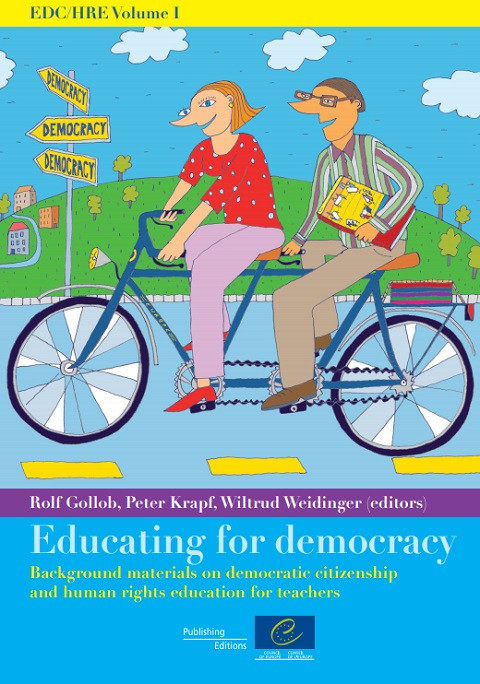 Educating for Democracy: Background Materials on Democratic Citizenship and Human Rights Education for Teachers Année de publication: 2010 Auteur: Rolf Gollob | Peter Krapf | Ólöf Ólafsdóttir | Wiltrud Weidinger Auteur institutionnel: Council of Europe The objective of this manual is to support teachers and practitioners in Education for Democratic Citizenship and Human Rights Education (EDC/HRE). It addresses key questions about EDC and HRE, including competences for democratic citizenship, the objectives and basic principles of EDC/HRE, and a whole school approach to education for democracy and human rights. The manual consists of three parts. Part I outlines the basic principles of EDC/HRE as far as they are helpful and meaningful for the practitioner. Part II gives guidelines and tools to design, support and assess the students’ processes of constructivist and interactive learning. Part III provides toolboxes for teachers and students in EDC/HRE. The other volumes in this series offer concrete teaching models and materials in EDC/HRE for pupils from elementary to upper secondary level.