
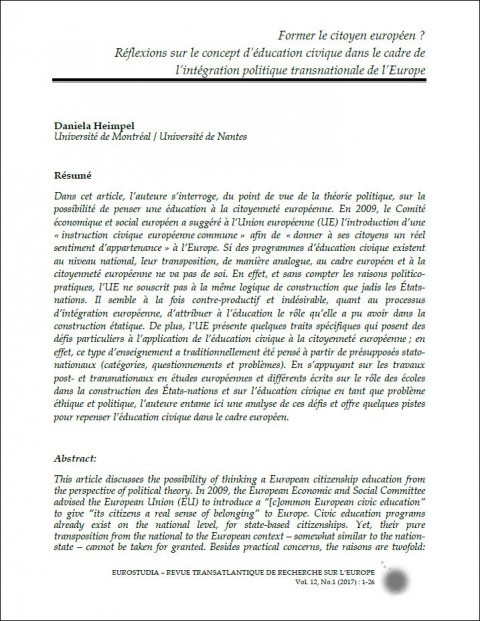
Training the European Citizen? Reflections on the Concept of Civic Education within the Framework of the European Transnational Integration Policy
- 단체 저자
- Eurostudia
- ISBN
- ISSN 1718-8946 (numérique)
- 형태사항
- p. 1-26
- 원래 언어
- 프랑스어
- 발행 연도
- 2017
This article discusses the possibility of thinking a European citizenship education from the perspective of political theory. In 2009, the European Economic and Social Committee advised the European Union (EU) to introduce a “[c]ommon European civic education” to give “its citizens a real sense of belonging” to Europe. Civic education programs already exist on the national level, for state-based citizenships. Yet, their pure transposition from the national to the European context – somewhat similar to the nation-state – cannot be taken for granted. Besides practical concerns, the raisons are twofold: first, the EU does not follow the same logic of construction which once characterized the nation-state. It seems thus neither productive nor desirable to attribute education in the European integration process the same role it played in nation-building. Secondly, the EU has some specific features which pose challenges when civic education is applied to European citizenship; indeed, the concept of civic education has traditionally been thought on nation-state assumptions (categories, issues, problems). In this article, the author proposes an analysis of these challenges and indicates routes for re-thinking civic education in the framework of the EU. To do this, she relies on post- and transnational writings in European studies as well as on different studies on the role of schools in nation-state construction and research on civic education as a political and ethical problem.
관련 자료
-
 IIEP-UNESCO 12th Medium-Term Strategy: 2026–2029
 -
 Youth Lens on the Silk Roads: Best Photos from the International Silk Roads Photo Contest; 6th Edition
 -
 Advancing Intergenerational Learning: Identifying Challenges and Opportunities for Older Adults; Integrated Case Study Report
 -
 Digital Empowerment for Lifelong Learning and Transformative Andragogy (DELTA) for Adult Educators: Introduction to the DELTA Framework and Resources