
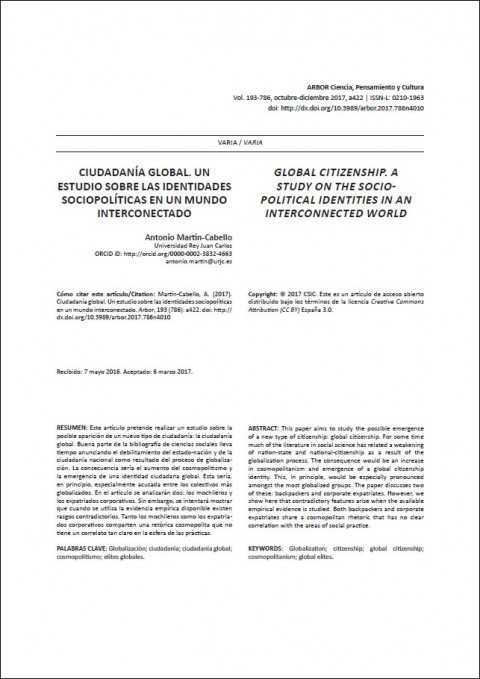
Global Citizenship: A Study on the Socio-political Identities in an Interconnected World
This paper aims to study the possible emergence of a new type of citizenship: global citizenship. For some time much of the literature in social science has related a weakening of nation-state and national-citizenship as a result of the globalization process. The consequence would be an increase in cosmopolitanism and emergence of a global citizenship identity. This, in principle, would be especially pronounced amongst the most globalized groups. The paper discusses two of these: backpackers and corporate expatriates. However, we show here that contradictory features arise when the available empirical evidence is studied. Both backpackers and corporate expatriates share a cosmopolitan rhetoric that has no clear correlation with the areas of social practice.
관련 자료
-
 IIEP-UNESCO 12th Medium-Term Strategy: 2026–2029
 -
 Youth Lens on the Silk Roads: Best Photos from the International Silk Roads Photo Contest; 6th Edition
 -
 Advancing Intergenerational Learning: Identifying Challenges and Opportunities for Older Adults; Integrated Case Study Report
 -
 Digital Empowerment for Lifelong Learning and Transformative Andragogy (DELTA) for Adult Educators: Introduction to the DELTA Framework and Resources