
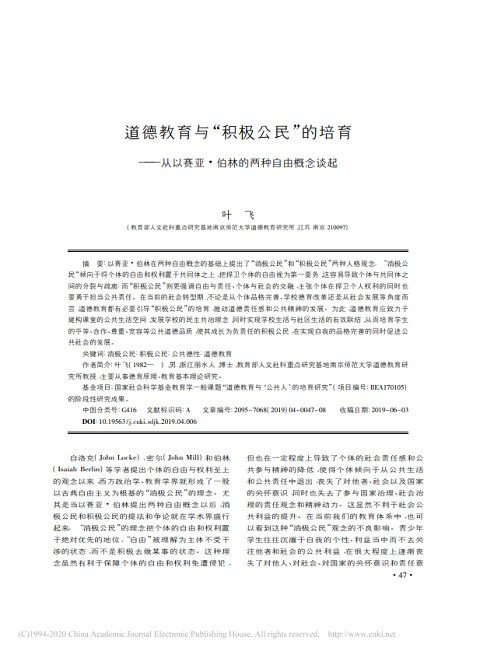
Moral Education and the Cultivation of Positive Citizen: Insights from Isaiah Berlin’s Conceptualization of Two Types of Freedom
On the basis of a binary model of freedom, Isaiah Berlin distinguished two types of citizenship: “negative citizen” and “active citizen”. “Negative citizens” tend to place individual freedom and rights above the community, and to defend the individual freedom as the top priority, which readily leads to the division and alienation between the individual and the community. “Active citizens”, on the other hand, tend to place a greater emphasis on the close relationship between freedom and responsibility and the integration of individual and the society, advocating that individuals shall have the courage to assume public responsibility while defending their individual rights. In the ongoing social transformation, moral education shall guide the cultivation of “active citizens” and promote the development of moral responsibility and public spirit, which is valid practice with relation to individual personality improvement, school moral education reform, and social development. To this end, moral education should be devoted to constructing a public living space in the classroom, developing the concept of democratic co-governance in schools, and meanwhile establishing an effective connection between schools and communities. Thus, students can be expected to become responsible and positive citizens who treasure such public virtues as equality, cooperation, respect, and tolerance, and who shall contribute to the progress of public life in building a respectable character.
관련 자료
-
 IIEP-UNESCO 12th Medium-Term Strategy: 2026–2029
 -
 Advancing Intergenerational Learning: Identifying Challenges and Opportunities for Older Adults; Integrated Case Study Report
 -
 Digital Empowerment for Lifelong Learning and Transformative Andragogy (DELTA) for Adult Educators: Introduction to the DELTA Framework and Resources
 -
 Bridging the Grey Digital Divide: Enhancing ICT Learning for Older Adults; Research Report