
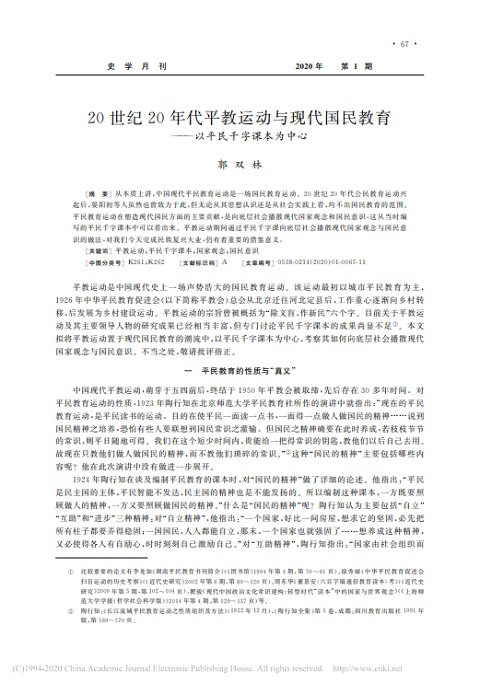
The Mass Education Movement and the Modern National Education in the 1920s: Centering on the Textbook of One Thousand Chinese Characters for Civilian
The Mass Education Movement was essentially a kind of national education movement in modern China. After the rise of the Civic Education Movement in the 1920s, James Yen and others had been devoted to the development of this movement. But no matter from the perspective of their ideological understanding or from the angle of their social practices, their civic education movement was undoubtedly within the scope of national education. The main contribution of the Mass Education Movement on shaping the modern nationals was to disseminate the concept of modern state and national consciousness to the lower level of the society, which could be seen from the compilation of the textbook of One Thousand Chinese Characters for Civilians at that time. Even today, the Mass Education Movement’s act of disseminating the concept of modern state and national consciousness to the lower level of the society through the textbook is One Thousand Chinese Character of Civilians still has important reference value for us to achieve the great rejuvenation of the Chinese nation.
관련 자료
-
 Study on the Historical Impact of the 1974 Recommendation concerning Education for International Understanding, Cooperation and Peace and Education relating to Human Rights and Fundamental Freedoms
 -
 IIEP-UNESCO 12th Medium-Term Strategy: 2026–2029
 -
 More than Welcome: Intercultural Integration of Migrants in and Through Higher Education
 -
 Advancing Intergenerational Learning: Identifying Challenges and Opportunities for Older Adults; Integrated Case Study Report