
자료
세계시민교육에 대한 이해를 넓히고 연구, 옹호 활동, 교수, 학습 등을 향상시킬 수 있는 다양하고 유용한 자료를 찾아보세요.
190 건의 결과가 검색되었습니다
 Establishing a Monitoring System for Global Citizenship Education in South Korea: A Preliminary Study with a Focus on Policy Area 발행 연도: 2019 단체 저자: APCEIU The Asia-Pacific Centre of Education for International Understanding published a report titled "Establishing a Monitoring System for Global Citizenship Education in South Korea: A Preliminary Study with a Focus on Policy Area." The purpose of this research report is to provide implications for the development of indicators for Global Citizenship Education (GCED) which is the target 4.7 of the Sustainable Development Goals (SDGs) and the establishment of a Korean monitoring system for data accumulation. It is difficult for GCED to set up common indicators to monitor the implementation of each country, as it comprehensively deals with the direction and contents of education, whereas other targets of SDG4 are relatively clear targets and goals such as guaranteeing educational opportunities and improving educational conditions. For this reason, this study proposed Korean indicators based on domestic and international trends and analysis of issues concerning the development of SDG4.7.1 indicators and reviewed the domestic status in implementation based on them, thereby contributing to the development and consolidation of global indicators development and monitoring systems in the future.
 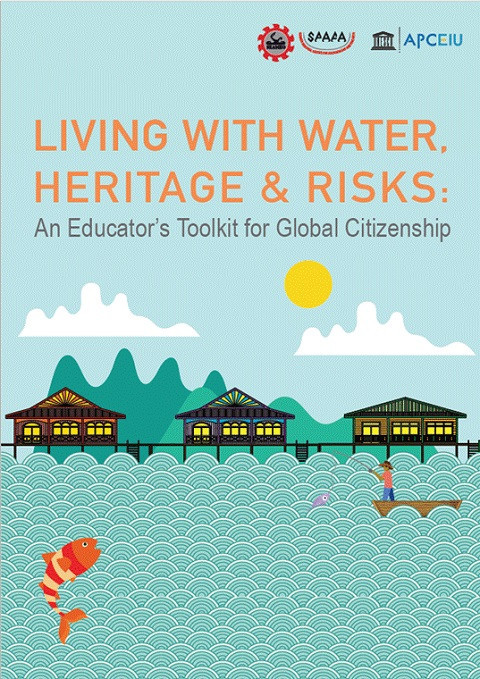 Living with Water, Heritage & Risks: An Educator’s Toolkit for Global Citizenship 발행 연도: 2019 단체 저자: APCEIU | SEAMEO. Regional Centre for Archeology and Fine Arts (SPAFA) Designed to help young global citizens gain an awareness of the culture-nature connection in heritage conservation, this toolkit provides visual learning aids and ideas to explore water heritage in Southeast Asia. It is composed of an Educator's Booklet, Activity Sheets, and Inquiry-Based and Self-Learning Photocards. Learners are encouraged to THINK, SHARE and ACT in ways that will enable them to become critical thinkers who can make compassionate and ethical decisions.
  Inaugural Meeting of the GCED Actors' Platform: Final Report 발행 연도: 2020 단체 저자: APCEIU This final report gives an overview of discussions and outcomes from the “Inaugural Meeting of the GCED Actors’ Platform” on 2 September 2019 in Seoul, Republic of Korea, held back-to-back with the 4th International Conference on GCED (3-4 September 2019, Seoul) In line with the call for closer collaboration on GCED inter-regionally, the GCED Actors’ Platform was launched by UNESCO Headquarters and APCEIU in 2019. Convening regional coordinators and different partners working on GCED, the “Inaugural Meeting of the GCED Actors’ Platform” provided an open space for the participants to discuss ways to coordinate activities and promote synergies.The regional representatives have imparted their own experiences and challenges on the ground and shared best practices of facilitating GCED.
 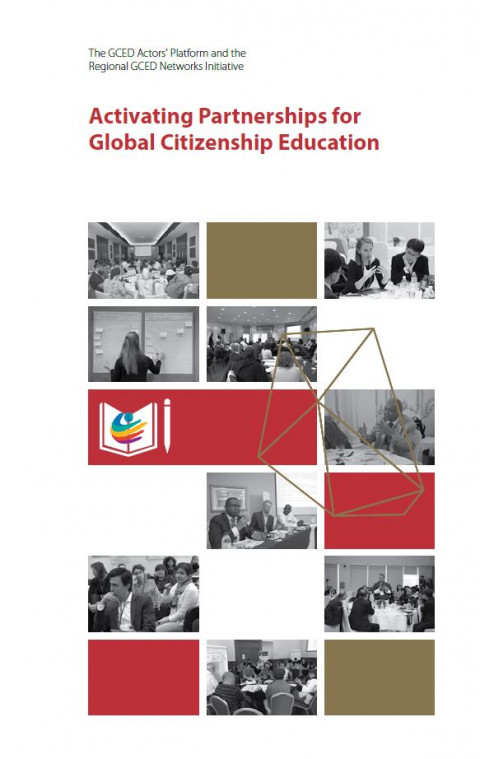 The GCED Actors' Platform and the Regional GCED Networks Initiative: Activating Partnerships for Global Citizenship Education 발행 연도: 2020 단체 저자: APCEIU This brief publication introduces and summarizes the flagship GCED Network initiatives supported by APCEIU implemented globally and regionally.UNESCO Headquarters and APCEIU co-convened the launch of the GCED Actors’ Platform in which gathered key partners across the globe and representing five Regional GCED Networks. These five Regional GCED Networks include Sub-Saharan Africa, Arab States, Asia-Pacific, Europe and North America, and Latin America and the Caribbean are formed to identify regional priorities and implement regional strategies to promote GCED. The publication also showcases successful independent activities by organizations part of the GCED Network initiative.
  Asia-Pacific Teacher Exchange for Global Education 발행 연도: 2019 단체 저자: APCEIU | Korea R. Ministry of Education Asia-Pacific Teacher Exchange for Global Education (APTE) is a bilateral teacher exchange programme between the Republic of Korea and Asia-Pacific partner countries, hosted by the Ministry of Education of the Republic of Korea and implemented by the Asia-Pacific Centre of Education for International Understanding under the auspices of UNESCO (APCEIU) in collaboration with the Ministries of Education of the partner countries. Launched with two partenr countries -- Mongolia and the Philippines -- in 2012, APTE has grown into a well-known regional programme, now working with seven partner countries in the Asia-Pacific region -- Cambodia, Indonesia, Malaysia, Mongolia, Philippines, Thailand, and Vietnam.
  Why Contextualization is Critical for Global Citizenship Education 발행 연도: 2019 저자: Waqar Shams 단체 저자: APCEIU This video is an interview on "Why contextualization is Critical for Global Citizenship Education". It is also under UNESCO's APCEIU "Meet the Global Citizens" series.Do you want to know why Contextualization is Critical for GCED? Check out what Waqar has to say. This is a story of Waqar Shams from Pakistan.In this video you will learn why Contextualization is Critical for GCED and through it, learn to think globally but act locally.
 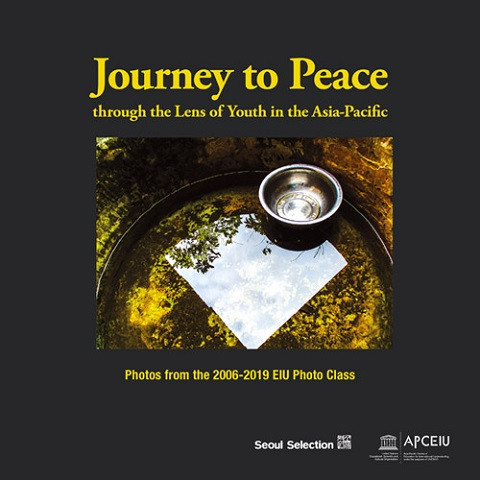 Journey to Peace Through the Lens of Youth in the Asia-Pacific: Photos From the 2006-2019 EIU Photo Class 발행 연도: 2020 단체 저자: APCEIU | Seoul Selection Commemorating the 20th Anniversary of APCEIU in 2020, APCEIU published this photography book to reflect on the memorable moments of the EIU (Education for International Understanding) Photo Class. The book contains photos taken by the students and photographers of Asia and the Pacific who have taken part in the Class from 2006 to 2019.
  Report of the Sub-Saharan Africa Regional GCED Network Meeting: Perspectives, Strategies and Actions for GCED 발행 연도: 2017 저자: Gertie Steukers | Carolyn Medel-Añonuevo | Abdoul Wahab Coulibaly 단체 저자: UNESCO Harare | APCEIU An increasingly globalized world has raised questions about what constitutes meaningful citizenship as well as about its global dimensions. Global Citizenship Education (GCED) aims to empower learners to assume active roles to face and resolve global challenges and to become proactive contributors to a more peaceful, tolerant, inclusive and secure world.Education is the most important tool for equipping young people, our future generation of leaders, with the knowledge, skills and attitudes to tackle prejudice and hostility, and to build more peaceful, tolerant and equitable societies. While there are different understandings and manifestations of GCED in different countries, GCED in its various forms is fast becoming an important and necessary component of education systems in sub-Saharan Africa and across the world.The commitment of actors around the world to promoting GCED has contributed highly to the development of GCED, including raising awareness and catalysing action. Furthermore, this has led to the incorporation of GCED in the Sustainable Development Goals (SDGs) through Target 4.7, which captures the clear call for an education that addresses the needs of the twenty-first century, empowering learners to act towards a more peaceful, just, inclusive and sustainable world.GCED reflects the aim of education to go beyond just access and ‘ensure inclusive and equitable quality education and promote lifelong opportunities for all’ in the next fifteen years.UNESCO Regional Office for Southern Africa (ROSA) and the Asia-Pacific Centre of Education for International Understanding (APCEIU) invited partners across Africa for the 2017 Sub-Saharan Africa GCED Regional Network Meeting on 6–7 April 2017 in Johannesburg. The meeting was designed to jumpstart the formation of the Africa Regional GCED Network, map different GCED programmes in the region, and explore areas of possible collaboration in light of solidifying regional action on GCED.
  Global Citizenship Education: A Guide for Policymakers 발행 연도: 2017 저자: Swee-Hin Toh | Gary Shaw | Danilo Padilla 단체 저자: APCEIU In order to assist UNESCO Member States to integrate and strengthen Global Citizenship Education (GCED) in national education policies, strategies and plans to achieve SDG Target 4.7 effectively, the Asia-Pacific Centre of Education for International Understanding (APCEIU) has developed and published Global Citizenship Education: A Guide for Policymakers (hereafter referred to as the Guide).The Guide is mainly divided into two parts. Part 1 provides an overview of GCED, including the following three sections: the background to GCED; the rationale for GCED; and the concept of GCED. In Part 2, various selection strategies which allow each country to incorporate GCED into its current education system aligned with its own priorities and context, were divided and suggested into five major policy areas as follow: policy review and development; curriculum review and development; capacity building; knowledge creation; sharing and dissemination; and monitoring and assessment.The Guide was first published in English and Korean and additional translations will be available in the future in other languages, including French and Arabic to provide access to more readers worldwide. We hope that the Guide will provide an opportunity for policymakers and practitioners to share their experiences and insights.
 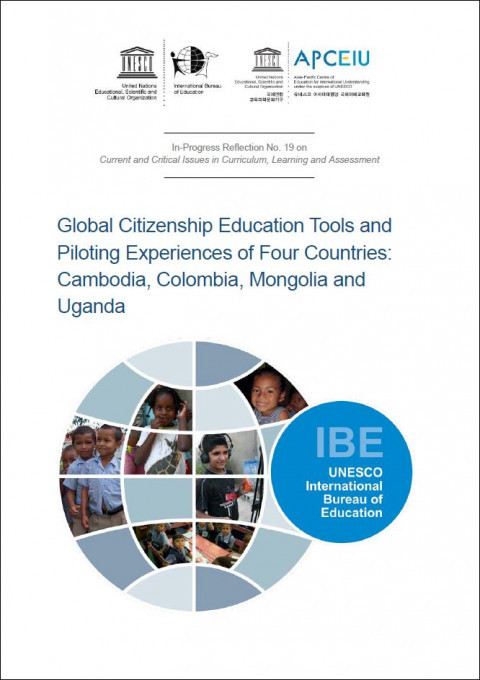 Global Citizenship Education Tools and Piloting Experiences of Four Countries: Cambodia, Colombia, Mongolia and Uganda 발행 연도: 2018 저자: Opertti Renato | Hyekyung Kang | Magni Giorgia 단체 저자: UNESCO International Bureau of Education (IBE) | APCEIU This report analyses the progresses made by Cambodia, Colombia, Mongolia and Uganda in the development and piloting of GCED tools, designed within the framework of UNESCO Asia-Pacific Centre of Education for International Understanding (APCEIU)’s and International Bureau of Education (IBE)’s three-year cooperation project, “Global Citizenship Education Curriculum Development and Integration”. Based on the needs identified through the situational analyses carried out during Phase I, the four countries have developed tailored tools to mainstream GCED in their own context and piloted them during Phase II. Through an in-depth analysis of the tools as well as of their piloting processes, this report aims at understanding the extent to which GCED concepts are embedded and integrated into these tools and the way in which these tools contribute to the overall GCED teaching and learning practices in each context. What results from the findings is that the four countries, despite some setbacks due mainly to the strict timeline, have made significant progress in developing innovative strategies to integrate GCED principles into their education policies and practices. Finally, this report concludes with the suggestions for these tools to be effectively implemented during Phase III, particularly for this project, and for any further initiative around GCED areas.