
자료
세계시민교육에 대한 이해를 넓히고 연구, 옹호 활동, 교수, 학습 등을 향상시킬 수 있는 다양하고 유용한 자료를 찾아보세요.
3,158 건의 결과가 검색되었습니다
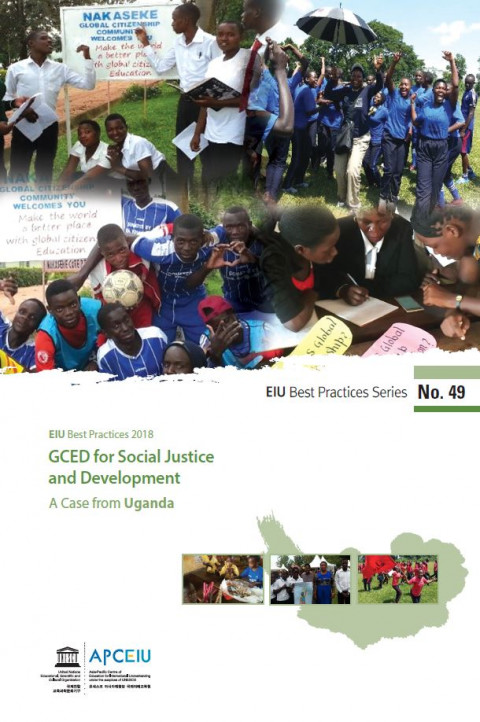 EIU Best Practices Series No. 49: GCED for Social Justice and Development; A Case from Uganda 발행 연도: 2018 단체 저자: APCEIU Creating a peaceful, trusting and supportive learning environment is a strong driver for a nation’s sustainable development. Any society whose citizens have no cognitive, socio-emotional and behavioral values like respect for self and humanity, is doomed for chaos. The concepts of Education for International Understanding(EIU) and Global Citizenship Education(GCED) in this programme emerge from the need for harmonious living in the society. Sustainable human and economic development is built upon the successful dissemination and implementation of EIU/GCED practices. To understand this better, let’s use the analogy of a bird that gains its momentum to fly from its feet, lungs and wings.The contributor uses this analogy to illustrate that EIU/GCED is the foundation that exerts momentum for social development.The contributor saw it necessary that for any sustainable development to flourish in Ugandan society, pragmatic values have to be perfectly blended with public awareness for they serve as the foundation of all economic, social, cultural and political efforts. The national value system should be based on a strong foundation on which all national efforts are rooted. The social aspirations of the citizens should be the ones that propel development needs and national priorities.To effect sustainable development, we need to see schools as strategic intervention points. Recent times have, however, witnessed that the level of discipline and value inculcation gradually declined to near extinction. The distortion of the social setting that inculcated the ethical values in the young generation has called for a need to remedy the gap. The EIU/GCED is strategically tailored to inculcate Table of Contents moral principles and values in the children through the direct contact and support of the teachers of Early Childhood Development (ECD), both primary and postprimary levels.The Nakaseke Core Primary Teachers’ College (PTC) is mandated to mainstream and promote the social uprightness of the community being a primary stakeholder in the integration of EIU/GCED in the Ugandan Primary Schools (PS) and Primary Teachers Education (PTE) Curriculum. Consequently, the training programmes were designed to enhance the capacity of PTC’s administrators, tutors and support staff, pre-service student teachers, district education officers and primary school teachers to inculcate the EIU/GCED moral values and principles among the learners. Students are then expected to apply EIU/GCED principles to their families and communities, and uphold the values of integrity, honesty, justice, responsibility, respect for humanity, hard work, unity and creativity.
 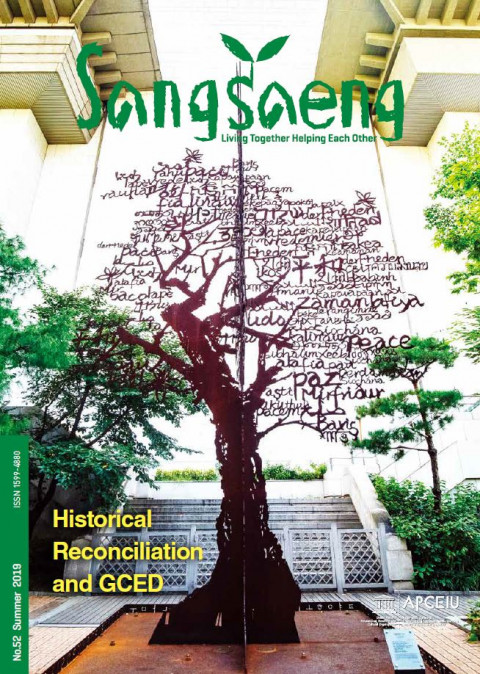 Historical Reconciliation and GCED (SangSaeng no. 52 Summer 2019) 발행 연도: 2019 단체 저자: APCEIU The 52th issue of SangSaeng has been published with the theme “Historical Reconciliation and GCED.” This issue explores various endeavours aimed at attaining historical reconciliation and peace, as well as the important role education plays to achieve this goal. How we teach and learn about our past and present conflicts is critical in shaping our future. It can help enhance global citizenship and lead us to peaceful reconciliation and peacebuilding, or it can intensify the hatred of others and build up more conflicts. 3 Editor’s Note4 Special ColumnToward Reconciliation in a Divided, Dangerous World / Jonathan Jansen8 Focus: Historical Reconciliation and GCED8 Historical Dialogue among Korea, China and Japan / Jeongin Kim12 Teaching Shared Histories in Southeast Asia / Doung Bich Hanh16 Learning about Europe’s Common History / Dominik Pick19 Dual Narrative to Teach History / Sami Adwan21 Mystic of ‘General History of Afica’ / Ali Moussa Iye 24 Best Practices24 The Power of Silence / Dylan Wray27 Mobile Library / Andri Nurcahyani31 Special Report31 Migration, Displacement and Education: Building Bridges, Not Walls / Manos Antoninis33 Harmonizing ‘Heart, Head and Hand’ in Hanoi / APCEIU37 InterviewFour Students for One Common Good / Sabine Detzel41 Understanding the Asia-Pacific RegionUniting Under Legends of Ghandhara / Nadeem Omar Tarar44 Youth NetworkHELP Nurtures Youth Citizenship through Collaboration / Nephtaly Pierre-Louis and Meaghan Balzer48 LetterSpeaking Silently in the Loud World / Elvira Sarsenova50 APCEIU in Action
  Reconciliation, Peace and Global Citizenship Education: Pedagogy and Practice 발행 연도: 2019 단체 저자: APCEIU The Asia-Pacific Centre of Education for International Understanding launched the publication entitled Reconciliation, Peace and Global Citizenship Education: Pedagogy and Practices. This book is the result of the fruitful discussions and presentations made during the 4th International Conference on Global Citizenship Education held on 3-4 September 2019 in Seoul, Republic of Korea.The intention of this publication is not only to continue and deepen the discourses made by the speakers of the Conference, but also to provide the readers with opportunity to explore how pedagogy and practices of Global Citizenship Education can contribute to building peace and reconciliation across the globe. Part. I Global Citizenship Education for peace and reconciliation: OverviewLearning to live together and a life worth livingHow GCED can contribute to peace, reconciliation and sustainable developmentTransformative pedagogy for building peacePromoting peace through mindfulness programmes in schoolsGlobal memory, global citizenship and reconciliationThe role of Media and Information Literacy Part. II Global Citizenship Education for peace and reconciliation: Putting it into practiceFacing History and Ourselves in South AfricaClassrooms in Peace in ColombiaPreparing young people to be global citizens through integrated schools in Northern Ireland Part. III Global Citizenship Education for peace and reconciliation: Supporting effective implementationPolicy development and implementationChallenges in curriculum and textbook development for low-and middle-income country
  Being and Becoming Global Citizens: Measuring Progress toward SDG 4.7 (Phase I: Monitoring teacher and school readiness to enact global citizenship in the Asia-Pacific region) 발행 연도: 2023 저자: Rachel Parker | Jennie Chainey | Payal Goundar | Sarah Richardson | Anna Dabrowski | Amy Berry | Claire Scoular 단체 저자: Australian Council for Educational Research (ACER) | APCEIU Since 2022, APCEIU and the Australian Council for Educational Research (ACER) have conducted a study to identify enhanced tools and resources for schools and systems in the Asia-Pacific region to monitor and evaluate GCED in line with SDG 4.7.The Report of the Research for Phase 1 is available in three forms: Full report; Summary; and Policy Brief.
 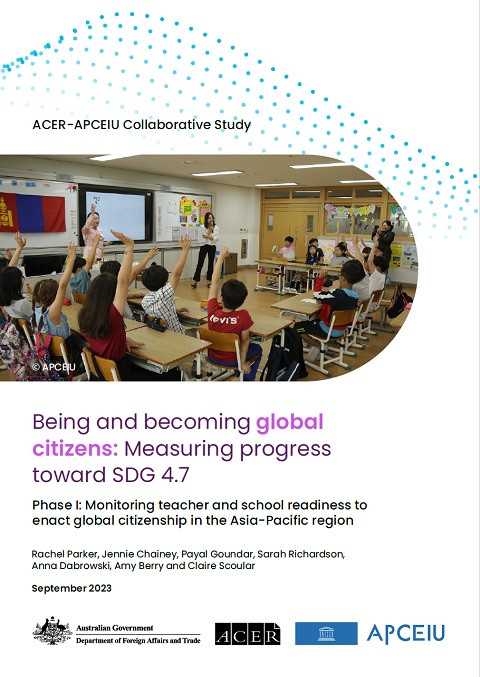 [Summary] Being and Becoming Global Citizens: Measuring Progress toward SDG 4.7 (Phase I: Monitoring teacher and school readiness to enact global citizenship in the Asia-Pacific region) 발행 연도: 2023 저자: Rachel Parker | Jennie Chainey | Payal Goundar | Sarah Richardson | Anna Dabrowski | Amy Berry | Claire Scoular 단체 저자: Australian Council for Educational Research (ACER) | APCEIU This is a summary report of the Being and Becoming Global Citizens: Measuring Progress toward SDG 4.7 (Phase I: Monitoring teacher and school readiness to enact global citizenship in the Asia-Pacific region), conducted by APCEIU and ACER in since 2022.
 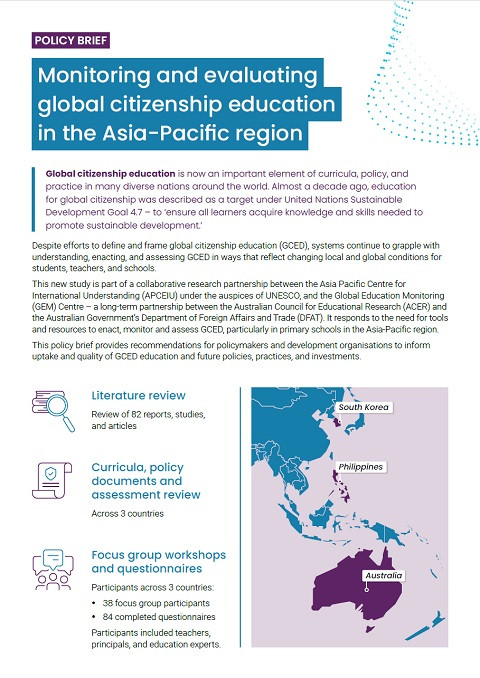 [Policy Brief] Monitoring and Evaluating Global Citizenship Education in the Asia-Pacific Region 발행 연도: 2023 저자: Payal Goundar | Rachel Parker 단체 저자: Australian Council for Educational Research (ACER) | APCEIU This is a policy brief version of the reserach report, Being and Becoming Global Citizens: Measuring Progress toward SDG 4.7 (Phase I: Monitoring teacher and school readiness to enact global citizenship in the Asia-Pacific region), conducted by APCEIU and ACER in since 2022.
  Global Citizenship Education: A Handbook for Parents, Community and Learners in Asia-Pacific 발행 연도: 2023 저자: Darla K. Deardorff | Seek Ling Tan 단체 저자: UNESCO Bangkok | APCEIU This handbook aspires to engage and involve parents, caregivers and the community to join the mission of developing every learner into a global citizen. To achieve this, parents, caregivers and the community will need to be empowered with the necessary GCED knowledge and skills too. In this handbook, GCED related concepts are introduced, alongside adaptable step-by-step action plans and best practices collected across the Asia-Pacific region to support parents and the community to take action in developing GCED competences in learners.
  2022 세계시민교육 국내 모니터링 체제 구축 연구 발행 연도: 2022 저자: 박환보 | 박경희 | 최원석 | 길혜지 | 조대훈 | 엄정민 단체 저자: 유네스코 아시아태평양 국제이해교육원 본 연구는 유네스코 아시아태평양 국제이해교육원(이하 유네스코 아태교육원)이 지속가능발전목표4.7(SDG4.7) 의 국내 이행 노력을 효과적으로 모니터링하기 위해 다년간 실시해온 연구의 일환으로, 국내 모니터링 체제 구축 방안 모색을 목적으로 한다. 특히 본 연구에서는 SDG4.7 목표 이행과 모니터링의 초점을 세계시민교육을 통한 학습자의 변화와 성장에 두고, 세계시민교육 정책, 교사의 세계시민교육 역량, 학습자의 세계시민역량의 세 가지 측면에서 모니터링 방안을 모색하였다. 이를 위해 우선 유네스코 아태교육원이 본 모니터링 연구 의 연속선상에서 수행해 온 선행연구에서 제안한 세계시민교육 주제영역과 개념틀을 활용하여 시·도교육청의 세계시민교육 이행 실태와 변화 추이를 분석하고, 정책의 주류화라는 관점에서 모니터링 방안에 관해 논의하였다. 그리고 기존 투입 중심의 연구 한계를 극복하기 위해, 세계시민교육의 이행 과정과 산출이라는 관점에서 교사의 세계시민교육 역량과 학습자의 세계시민성 수준을 측정하기 위한 문항을 개발하였다.
 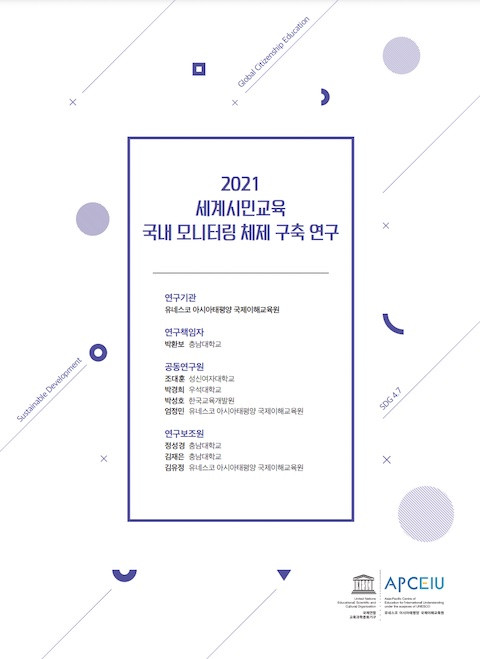 2021 Study on the Monitoring Framework of GCED in South Korea 발행 연도: 2021 저자: Hwanbo Park | Daehoon Jho | Kyunghee Park | Sungho Park | Jeongmin Eom 단체 저자: APCEIU The purpose of this study is to establish a feasible monitoring system for the implementation of Global Citizenship Education (GCED) in South Korea that can both align itself with the global indicator (SDG 4.7.1) and reflect the domestic context and feasibility. To this end, the study continues to examine the extent to which GCED is mainstreamed in education policies in Korea by utilizing the monitoring tool developed by the aforementioned 2020 study. In so doing, it aims to build sustaining and robust data in the area of GCED policies with the consistent monitoring tool developed. Second, the study explores enabling aspects as well as gaps between policies or programmes and how GCED is implemented on the ground by schools and teachers. Through this analysis, the study draws implications for further refining of the developed monitoring system. Third, the study surveys and analyzes existing monitoring tools developed by other fields and the data accumulated through those existing tools to assess learners' knowledge acquisition, values, skills and attitudes relevant to global citizenship competences, In so doing, it explores possibilities and makes recommendations for effectively monitoring learners’ competences by utilizing and modifying existing tools as well as developing new ones. 2021 세계시민교육 국내 모니터링 체제 구축 연구 보고서 발행 연도: 2021 저자: 박환보 | 조대훈 | 박경희 | 박성호 | 엄정민 단체 저자: 유네스코 아시아태평양 국제이해교육원 유네스코 아태교육원은 세계시민교육의 국내 모니터링을 체계화하기 위한 노력의 일환으로 2018년의 기초연구를 시작으로 매년 꾸준히 글로벌 지표(SDG 4.7.1)에 부합하면서도 국내 맥락과 실효성이 반영된 국내용 모니터링 도구를 마련하고, 세계시민교육의 주류화 정도를 시범적으로 조사해왔다. 2021년도 연구는 2020년도 연구를 통해 확립된 지표체계를 기반으로 꾸준히 실시하는 시・도교육청의 세계시민교육 정책분야 분석과 함께 구체적인 정책 이행 사례를 보다 미시적으로 분석하였다. 이와 더불어, 세계시민교육을 통한 성취라는 측면에서 국내의 다양한 패널데이터를 활용하여 초중등학교 학생들의 세계시민성 수준을 분석하였다. 마지막으로 이러한 연구 결과를 토대로 국내 세계시민교육 이행 모니터링 지표의 정교화 및 모니터링 체제 구축에 필요한 시사점을 도출하였다.