
자료
세계시민교육에 대한 이해를 넓히고 연구, 옹호 활동, 교수, 학습 등을 향상시킬 수 있는 다양하고 유용한 자료를 찾아보세요.
2,668 건의 결과가 검색되었습니다
 Language Rights of Linguistic Minorities: A Practical Guide for Implementation 발행 연도: 2017 단체 저자: UN. Office of the United Nations High Commissioner for Human Rights (UN. OHCHR) The purpose of this Guide is to further assist policy makers and rights holders in understanding and implementing the linguistic human rights of linguistic minorities. This touches upon the necessary balance between a state’s official language (or languages) and its obligations to use or respect the language preferences of linguistic minorities. These language rights can also contribute towards preserving the world’s linguistic diversity. The Guide aims to:● clarify what are the various human rights of linguistic minorities relevant to language use and preferences;● clarify the obligations of state authorities towards linguistic minorities;● support the development and continuous improvement of effective and cost-efficient approaches and practices for these linguistic human rights; and● promote consistent approaches to the participation and inclusion of minorities and implementation of their language rights.
  语言少数群体的语言权利:使用落实指南 발행 연도: 2017 단체 저자: UN. Office of the United Nations High Commissioner for Human Rights (UN. OHCHR) 本指南的目的在于进一步协助政策制定者及权利人全面理解语言少数群体的语言权利,便于其实施与落实。本指南希望协助在国家官方语言之间实现所需的平衡,履行使用或尊重语言少数民族语言偏好的义务,保护并推动语言权利也有助于保护世界语言多样性。本指南旨在: 阐明与语言使用及偏好相关的若干语言少数群体权利; 阐明国家当局对语言少数群体的义务; 支持通过有效方法和做法(包括经济有效的)发展和持续改进以实现语言少数群体的这些权利;以及 推动运用一贯的方法帮助少数群体参与并融入公共生活、落实其语言权利。
  National Plans on Human Rights: Debates and Reflections on Latin American Experiences 발행 연도: 2021 저자: Laura Pautassi | Mariela Alejandra Acevedo | Felicitas Acosta | Myriam Feldfeber | Pablo Imen | María Mercedes Palumbo | Fernanda Saforcada | Soledad Vercellino 단체 저자: Consejo Latinoamericano de Ciencias Sociales (CLACSO) The texts gathered in this book reflect the tensions and challenges involved in creating inclusive human rights public policies that respond to effective and impactful citizen participation. They also highlight the tension—once again—between the short and long term: the temporalities of governments and states. Furthermore, these writings incorporate an analysis of contexts and policies from a human rights perspective, revealing that, very often, plans of this nature—as tools provided by international protection bodies—are not fully implemented at the national or subnational level. Instead, they are frequently constructed as ways to appease international agendas rather than as means of engaging and engaging communities in collective initiatives for transformation. Therefore, we try to build interpretive proposals that allow us to critically analyze—and also strengthen—human rights plans in these ambiguous paths of formulation, implementation, and evaluation, because we believe that these comprehensive and cross-cutting policies are, or can be, instruments for building more just and inclusive societies, but they require long-term work and commitment. Planes nacionales en derechos humanos: Debates y reflexiones sobre experiencias latinoamericanas 발행 연도: 2021 저자: Laura Pautassi | Mariela Alejandra Acevedo | Felicitas Acosta | Myriam Feldfeber | Pablo Imen | María Mercedes Palumbo | Fernanda Saforcada | Soledad Vercellino 단체 저자: Consejo Latinoamericano de Ciencias Sociales (CLACSO) En este libro se presentan las experiencias en Chile, Colombia, Ecuador, Brasil, Uruguay, Perú y México, en cuanto a la elaboración e implementación de los Planes Nacionales de Derechos Humanos como herramienta de política pública recomendada en la Segunda Conferencia Mundial de Derechos Humanos, celebrada en Viena en 1993. Los textos reunidos en este libro dan cuenta de las tensiones y desafíos a la hora de generar políticas públicas en derechos humanos que sean inclusivas, que respondan a parámetros de participación ciudadana eficaces y con incidencia.
  Essentials of Dialogue: Guidance and Activities for Teaching and Practising Dialogue with Young People 발행 연도: 2017 단체 저자: Generation Global Essentials of Dialogue is a teaching resource filled with activities for use in learning communities to build the core skills of dialogue and is foundational for any curriculum or programme centred around global citizenship and intercultural communication.Each chapter includes both theory and practical activities to help explore, develop, and practise dialogue. The resource is free to use all over the world. أساسيّات الحوار: مورد لمنح الطلاب الشباب من حول العالم مهارات وتجربة الحوار 발행 연도: 2016 단체 저자: Tony Blair Institute for Global Change يزود "أساسيات الحوار" المعلمين بمقدمة للتعلم القائم على الحوار ويوفر أنشطة مهمة لبناء المهارات الأساسية لبناء مهارات الحوار، سواء كان ذلك شخصيًا أو عن بُعد.يقدم هذا الدليل دروسًا قابلة للتكيف ويركز على المهارات الخمسة الأساسية للحوار، والملاحظات الموجزة، وخطوات إعداد الشباب للانخراط في الحوار بين الثقافات عبر الإنترنت لدعم تنمية المواطنة العالمية.
  The Ultimate Dialogue Adventure: An Online Global Citizenship Game for Students Ages 13-17 단체 저자: Generation Global An interactive online platform that leads young people ages 13-17, through a game to learn the skills of intercultural dialogue and participate in forums focused on a variety of global topics and issues. The Ultimate Dialogue Adventure can be used as a self-directed learning journey for young people, or as an in-class companion for teachers, to support rigorous dialogue about a global topic or provide a place of practice when using our offline materials.
 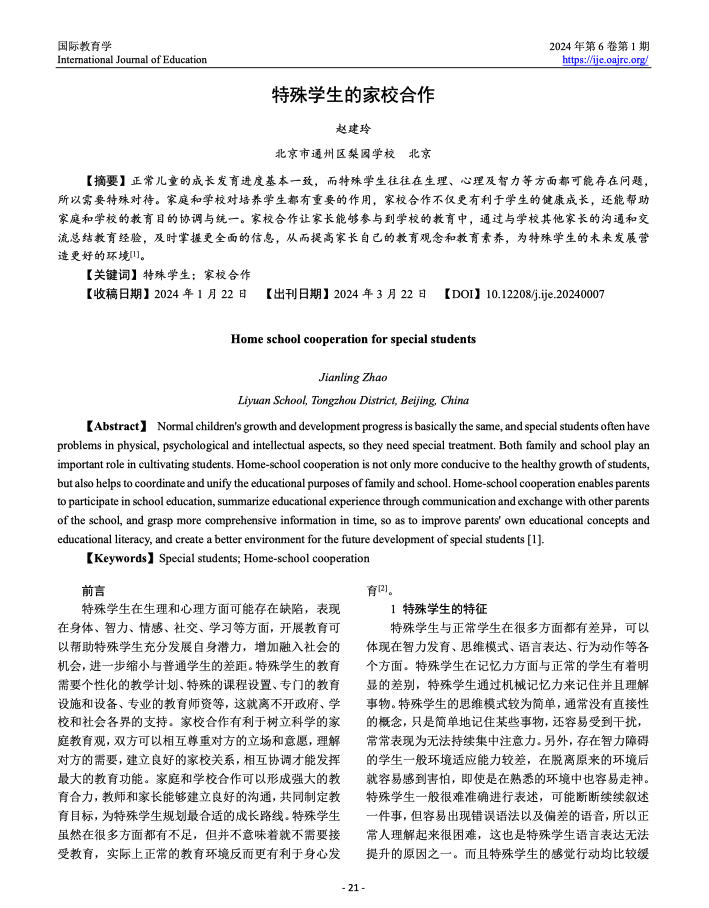 特殊学生的家校合作 (国际教育学 6卷第1期) 발행 연도: 2024 저자: 赵建玲 단체 저자: 国际开放获取期刊研究中心 正常儿童的成长发育进度基本一致,而特殊学生往往在生理、心理及智力等方面都可能存在问题,所以需要特殊对待。家庭和学校对培养学生都有重要的作用,家校合作不仅更有利于学生的健康成长,还能帮助家庭和学校的教育目的协调与统一。家校合作让家长能够参与到学校的教育中,通过与学校其他家长的沟通和交流总结教育经验,及时掌握更全面的信息,从而提高家长自己的教育观念和教育素养,为特殊学生的未来发展营造更好的环境。
 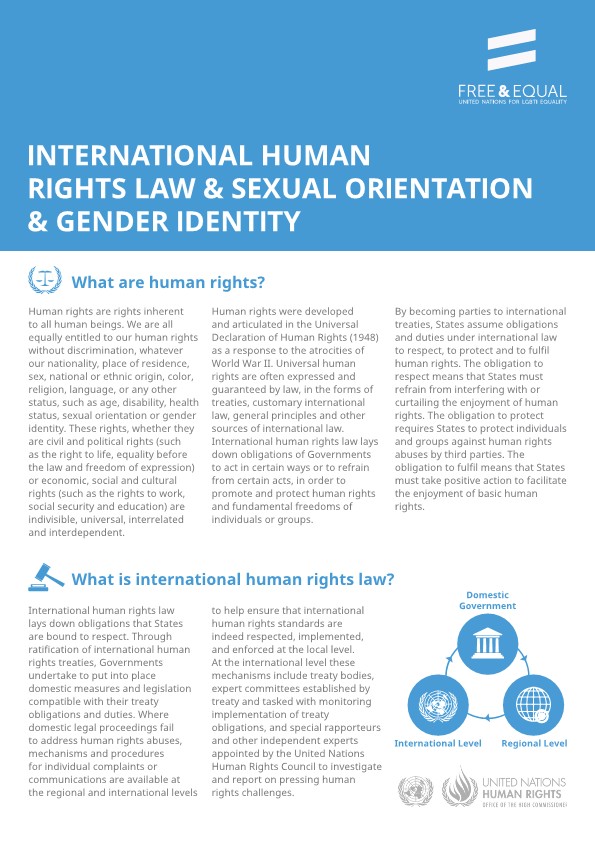 International Human Rights Law & Sexual Orientation & Gender Identity 발행 연도: 2017 단체 저자: UN. Office of the United Nations High Commissioner for Human Rights (UN. OHCHR) | United Nations Free & Equal What are human rights?Human rights are rights inherent to all human beings. We are all equally entitled to our human rights without discrimination, whatever our nationality, place of residence, sex, national or ethnic origin, color, religion, language, or any other status, such as age, disability, health status, sexual orientation or gender identity. These rights, whether they are civil and political rights (such as the right to life, equality before the law and freedom of expression) or economic, social and cultural rights (such as the rights to work, social security and education) are indivisible, universal, interrelated and interdependent.Human rights were developed and articulated in the Universal Declaration of Human Rights (1948) as a response to the atrocities of World War II. Universal human rights are often expressed and guaranteed by law, in the forms of treaties, customary international law, general principles and other sources of international law. International human rights law lays down obligations of Governments to act in certain ways or to refrain from certain acts, in order to promote and protect human rights and fundamental freedoms of individuals or groups.By becoming parties to international treaties, States assume obligations and duties under international law to respect, to protect and to fulfil human rights. The obligation to respect means that States must refrain from interfering with or curtailing the enjoyment of human rights. The obligation to protect requires States to protect individuals and groups against human rights abuses by third parties. The obligation to fulfil means that States must take positive action to facilitate the enjoyment of basic human rights.What is international human rights law? International human rights law lays down obligations that States are bound to respect. Through ratification of international human rights treaties, Governments undertake to put into place domestic measures and legislation compatible with their treaty obligations and duties. Where domestic legal proceedings fail to address human rights abuses, mechanisms and procedures for individual complaints or communications are available at the regional and international levels to help ensure that international human rights standards are indeed respected, implemented, and enforced at the local level. At the international level these mechanisms include treaty bodies, expert committees established by treaty and tasked with monitoring implementation of treaty obligations, and special rapporteurs and other independent experts appointed by the United Nations Human Rights Council to investigate and report on pressing human rights challenges.Is it ever legal to discriminate against lesbian, gay, bisexual, transgender or intersex people?No. The right to equality and non-discrimination are core principles of human rights, enshrined in the United Nations Charter, The Universal Declaration of Human Rights (UDHR) and human rights treaties. The opening words of the Universal Declaration of Human Rights are unequivocal: “All human beings are born free and equal in dignity and rights.”The equality and non-discrimination guarantee provided by international human rights law applies to all people, regardless of sex, sexual orientation and gender identity or “other status.” There is no fine print, no hidden exemption clause, in any of our human rights treaties that might allow a State to guarantee full rights to some but withhold them from others purely on the basis of sexual orientation and gender identity.Moreover, United Nations human rights treaty bodies have confirmed that sexual orientation and gender identity are included among prohibited grounds of discrimination under international human rights law. This means that it is unlawful to make any distinction of people’s rights based on the fact that they are lesbian, gay, bisexual or transgender (LGBT), just as it is unlawful to do so based on skin color, race, sex, religion or any other status. This position has been confirmed repeatedly in decisions and general guidance issued by several treaty bodies, such as the United Nations Human Rights Committee, the Committee on Economic, Social and Cultural Rights, the Committee on the Rights of the Child, the Committee against Torture, and the Committee on the Elimination of Discrimination against Women.What are some of the most common forms of human rights violations affecting LGBT people? The UN human rights office has documented a wide range of human rights violations committed against individuals on the basis of their sexual orientation and gender identity.These include:Violent attacks, ranging from aggressive verbal abuse and psychological bullying to physical assault, beatings, torture, kidnapping and targeted killings.Discriminatory criminal laws, often used to harass and punish LGBT people, including laws criminalizing consensual same-sex relationships, which violate rights to privacy and to freedom from discrimination.Discriminatory curbs on free speech and related restrictions on the exercise of rights to freedom of association and assembly, including laws banning dissemination of information on same-sex sexuality under the guise of restricting the spread of so-called LGBT “propaganda.”Discriminatory treatment, which can take place in a range of everyday settings, including workplaces, schools, family homes and hospitals. Without national laws prohibiting discrimination by third parties on grounds of sexual orientation and gender identity, such discriminatory treatment continues unchecked, leaving little recourse to those affected. In this context, lack of legal recognition of same-sex relationships or of a person’s gender identity can also have a discriminatory impact on many LGBT individuals. What have the UN General Assembly and Human Rights Council said on this subject?The United Nations General Assembly, in a series of resolutions, has called on States to ensure the protection of the right to life of all persons under their jurisdiction and to investigate promptly and thoroughly all killings including those motivated by the victim’s sexual orientation and gender identity (see, for example, resolution A/RES/67/168).In June 2011, the United Nations Human Rights Council became the first UN intergovernmental body to adopt a wide-ranging resolution on human rights, sexual orientation and gender identity. Resolution 17/19 expressed the Council’s “grave concern” at violence and discrimination against individuals based on their sexual orientation and gender identity, and commissioned a study on the scope and extent of these violations and the measures needed to address them.The requested study, prepared by the Office of the High Commissioner for Human Rights, was released in December 2011. It pointed to a pattern of violence and discrimination directed at individuals because of their sexual orientation and gender identity. Its findings and recommendations formed the basis of a panel discussion that took place at the Council in March 2012 – the first time a formal intergovernmental debate on the subject had been taken place at the United Nations.
  国际人权法与性取向和性别认同 발행 연도: 2017 단체 저자: UN. Office of the United Nations High Commissioner for Human Rights (UN. OHCHR) | United Nations Free & Equal 什么是人权?什么是国际人权法?歧视男女同性恋、双性恋、变性者或双性人是否合法?侵犯男女同性恋、双性恋、变性者人权的一些最常见形式是什么?联合国大会及人权事务委员会对该主题有何表述?各国在尊重男女同性恋、双性恋和变性者方面有哪些法律义务?