
자료
세계시민교육에 대한 이해를 넓히고 연구, 옹호 활동, 교수, 학습 등을 향상시킬 수 있는 다양하고 유용한 자료를 찾아보세요.
3,224 건의 결과가 검색되었습니다
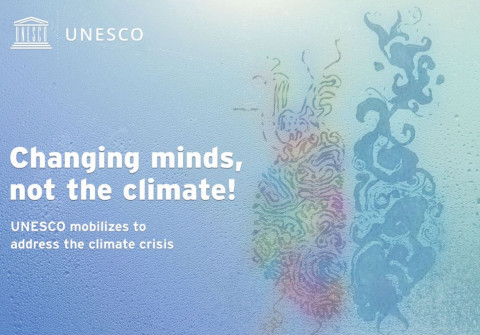 Changing Minds, Not the Climate: UNESCO Mobilizes to Address the Climate Crisis 발행 연도: 2019 단체 저자: UNESCO The climate crisis is the challenge of the century. Scientific reports, including those of UNESCO, one after another describe increasingly pessimistic scenarios. All experts agree on one thing: we are in a race against time. A race to try to reserve our natural habitat in all of its beauty and diversity, to protect our ecosystems and natural resources and to pass them on to future generations. A race to mitigate the destructive effects of climate change and find the most appropriate innovative solutions.The disruptions caused by climate change are already part of our daily lives and trigger social, political, geopolitical and humanitarian upheavals. The climate crisis is not only threatening our ecosystems, it is also undermining fundamental rights, widening inequalities and creating new injustices. That is why ethical imperative must guide our action. Beyond the political and legal agreements essential to preparing for the future, change involves a shift in mindset, a different way of considering the place of humans in nature. This challenge mobilizes all resources, including education, research and creativity. It is an ethical and humanistic commitment. This is UNESCO’s mandate, and it is a matter of urgency. Changeons les esprits, pas le climat: l'UNESCO se mobilise face à la crise climatique 발행 연도: 2019 단체 저자: UNESCO La crise climatique est le défi du siècle. Les rapports scientifiques, dont ceux de l’UNESCO, se succèdent et dessinent des scénarios de plus en plus pessimistes. Tous les experts s’accordent sur une certitude : une course contre la montre est lancée. Une course pour tenter de préserver notre habitat naturel dans sa beauté et sa diversité, pour protéger nos ecosystèmes, nos ressources naturelles et les transmettre aux générations futures. Une course pour atténuer les effets destructeurs du changement climatique et trouver les solutions innovantes les plus appropriées.Ces dérèglements constituent déjà notre quotidien et provoquent des bouleversements sociaux, politiques, géopolitiques et humanitaires. La crise climatique ne met pas seulement en péril nos écosystèmes : elle ébranle certains droits fondamentaux, creuse des inégalités et crée de nouvelles injustices. C’est pourquoi l’exigence éthique doit orienter notre action. Bien au-delà des accords politiques et juridiques indispensables pour préparer l’avenir, le changement passe par une évolution des mentalités, une manière différente d’envisager la place de l’humain dans la nature. Ce défi mobilise toutes les ressources l’éducation, de la recherche, de la créativité. C’est un engagement éthique et humaniste.Tel est le mandat de l’UNESCO, et l’urgence aujourd’hui.
 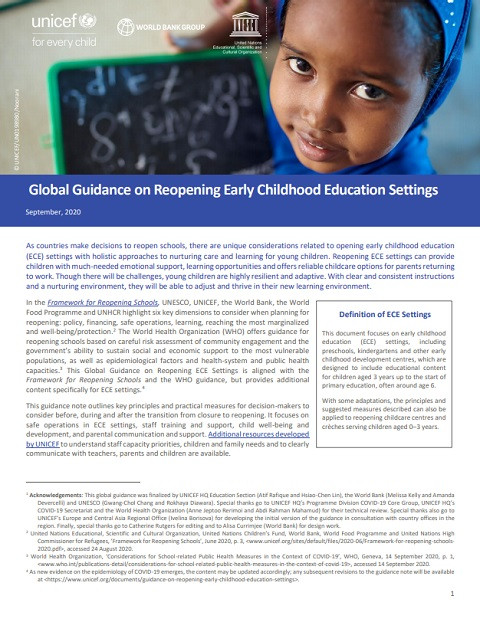 Global Guidance on Reopening Early Childhood Education Settings 발행 연도: 2020 단체 저자: United Nations Children's Fund (UNICEF) | World Bank | UNESCO This guidance note outlines key principles and practical measures for decision-makers to consider before, during and after the transition from closure to reopening. It focuses on safe operations in ECE settings, staff training and support, child well-being and development, and parental communication and support.
 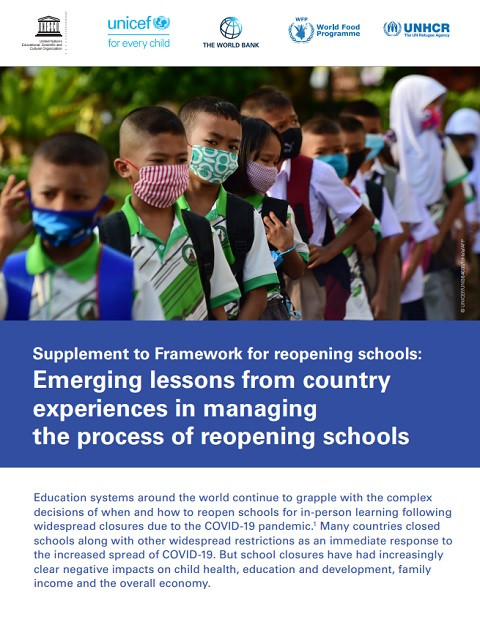 Supplement to Framework for Reopening Schools: Emerging Lessons From Country Experiences in Managing the Process of Reopening Schools 발행 연도: 2020 단체 저자: UNESCO | United Nations Children's Fund (UNICEF) | World Bank | World Food Programme | UN. Office of the United Nations High Commissioner for Refugees (UNHCR) Education systems around the world continue to grapple with the complex decisions of when and how to reopen schools for in-person learning following widespread closures due to the COVID 19 pandemic. This supplement to the Framework for reopening schools, originally published jointly by UNICEF, UNESCO, the World Bank, the World Food Programme, and the UN Refugee Agency (UNHCR) in April 2020, summarizes emerging lessons learnt over the past months.The supplement follows the four main dimensions of the Framework (safe operations, focus on learning, wellbeing & protection, and reaching the most marginalized) and highlighting a number of country examples.
 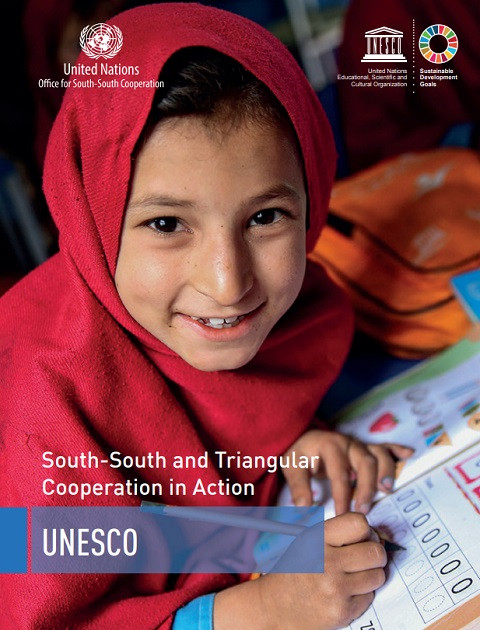 South-South and Triangular Cooperation in Action 발행 연도: 2018 단체 저자: UNESCO | UN. Office for South-South Cooperation (UNOSSC) This publication is UNESCO’s first dedicated report on South-South cooperation and triangular cooperation. It presents an overall picture of the progress achieved to support technical cooperation, capacity building and knowledge sharing through South-South and triangular cooperation in UNESCO’s areas of competence with highlights of specific examples. It paves the way for deepening future cooperation in this area. La cooperación Sur-Sur y la cooperación triangular en acción 발행 연도: 2018 단체 저자: UNESCO | UN. Office for South-South Cooperation (UNOSSC) Esta publicación es el primer informe específico de la UNESCO sobre la cooperación Sur-Sur y la cooperación triangular. Se presenta un panorama general de los avances en la cooperación técnica, la creación de capacidades y el intercambio de conocimientos mediante la cooperación SurSur y la cooperación triangular en las esferas de competencia de la UNESCO y se mencionan ejemplos concretos. Se allana el camino para profundizar la cooperación en este ámbito en el futuro. La coopération Sud-Sud et triangulaire en action 발행 연도: 2018 단체 저자: UNESCO | UN. Office for South-South Cooperation (UNOSSC) La présente publication est le premier rapport de l’UNESCO qui traite de la coopération SudSud et de la coopération triangulaire. Elle brosse un tableau d’ensemble, illustré par des exemples particuliers, des progrès que ces modalités de coopération ont permis d’accomplir pour faciliter la coopération technique, le renforcement des capacités et le partage des connaissances dans les domaines de compétence de l’UNESCO, et ouvre la voie à de plus amples efforts en la matière.
  Guidelines to Strengthen the Right to Education in National Frameworks 발행 연도: 2021 단체 저자: UNESCO These Guidelines aim to strengthen national frameworks by assisting countries and stakeholders in conducting an assessment of the compatibility of their national education legal and policy framework with international standard-setting instruments on the right to education, and in light of SDG 4 commitments. These Guidelines provide a hands-on approach aiming to assist in the review of national education legal and policy frameworks in view of:Developing practical knowledge on the right to education based on the Right to education handbook and supporting capacity developmentProviding operational tools to assess the status of the right to education at country level and its compatibility with international and regional human rights obligations and international commitments (notably SDG 4)Identifying legal and policy gaps in education at country level and resulting challengesMaking recommendations for the full alignment of national constitutions, legislation , singular and policies with international standards and provisionsProviding insights on how to implement the recommendations in view of necessary reforms.
  STEM Education for Girls and Women: Breaking Barriers and Exploring Gender Inequality in Asia 발행 연도: 2020 단체 저자: UNESCO Bangkok | UNESCO Science, Technology, Engineering and Mathematics (STEM) fields are considered catalysts for the achievement of the 2030 Agenda for Sustainable Development. Yet, particularly for STEM fields, girls and women, for a multitude of social, cultural and psychological reasons, engage and participate at a lower rate than boys and men. This research collection aims to highlight the contextual barriers that girls and women face in STEM education and careers and offer concrete examples of interventions that successfully encourage participation of girls and women in STEM. These eight case studies from across Asia explore both the barriers and the achievements in SDG 4 and SDG 5, and give context-specific analysis of different aspects of gender disparities in the respective countries.
  Humanistic Futures of Learning: Perspectives from UNESCO Chairs and UNITWIN Networks 발행 연도: 2020 단체 저자: UNESCO UNESCO’s Futures of Education initiative aims to rethink education and shape the future. The initiative is catalyzing a global debate on how knowledge, education and learning need to be reimagined in a world of increasing complexity, uncertainty and precarity. This publication presents the first curated input to the Futures of Education initiative from the UNITWIN/UNESCO Chairs Programme, which now represents an extensive global network of more than 800 higher education institutions in over 115 countries. It features think pieces that highlight key dimensions to be considered in re-visioning and re-purposing education for the future of humanity and the planet. The collection of the pieces calls for greater focus on a number of critical areas such as: The role of culture in strengthening social and environmental sustainability; the values and attitudes that are needed to shape future generations; the importance of both robust public education, as well as of other learning spaces; the need to strengthen human creativity and capability in the digital era, as well as the role of higher education in generating the knowledge and driving the innovation required to transform our world.