
자료
세계시민교육에 대한 이해를 넓히고 연구, 옹호 활동, 교수, 학습 등을 향상시킬 수 있는 다양하고 유용한 자료를 찾아보세요.
1,727 건의 결과가 검색되었습니다
 Charter of Partnership between the School and the Family: Rights and Duties 발행 연도: 2016 단체 저자: Saudi Arabia. Ministry of Education The file is a charter of partnership between the school and the family. It discusses the rights and duties of this partnership in the Kingdom of Saudi Arabia. The charter aims to enable the family and the school to inculcate and promote lofty principles in their children. The charter also aims to promote the concept of good citizenship in and outside the school community. The charter contains several articles, the most important of which are: the rights of the student, the family, and the school, and the duties of the student, the family, and the school.
 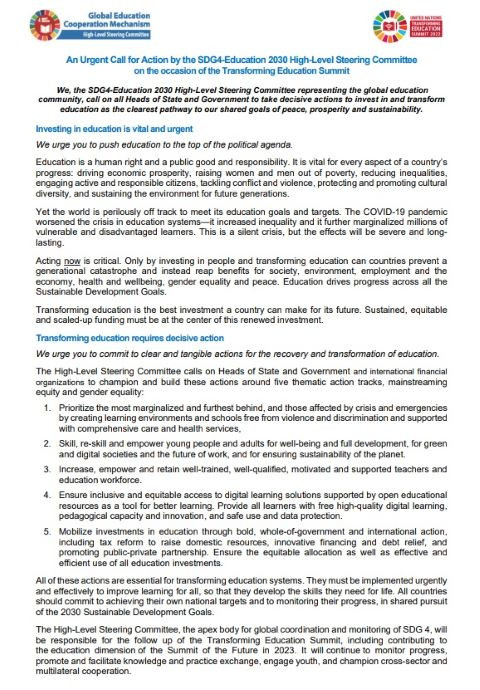 Срочный призыв к действиям Руководящего комитета высокого уровня по ЦУР 4 – «Образование-2030» по случаю Саммита по трансформации образования 발행 연도: 2022 단체 저자: United Nations (UN) Мы, Руководящий комитет высокого уровня ЦУР 4-Образование-2030, представляющий мировое образовательное сообщество, призываем всех глав государств и правительств предпринять решительные действия по инвестированию и преобразованию образования как наиболее четкого пути к нашим общим целям мира, процветания и устойчивости. 可持续发展目标 4—2030 年教育高级别指导委员会 在教育变革峰会之际的紧急行动呼吁 발행 연도: 2022 단체 저자: United Nations (UN) 我们,代表全球教育界的 SDG4-Education 2030 高级别指导委员会,呼吁所有国家元首和政府首脑采取果断行动,对教育进行投资和改造,作为实现和平、繁荣和可持续发展这一共同目标的最清晰途径 .
 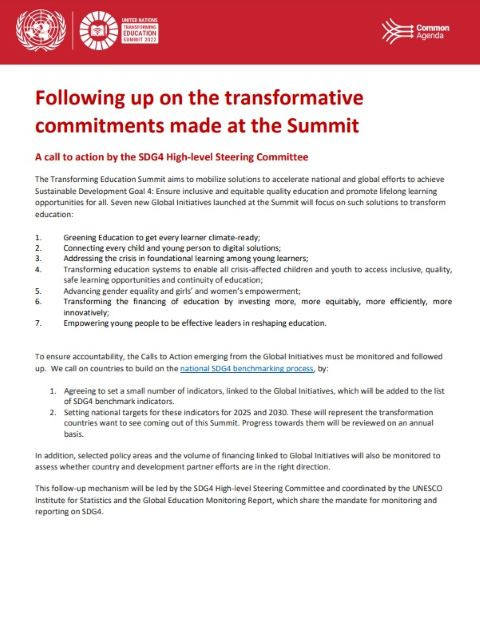 Following Up on the Transformative Commitments Made at the Summit: A Call to Action by the SDG4 High-level Steering Committee 발행 연도: 2022 단체 저자: United Nations (UN) The Transforming Education Summit aims to mobilize solutions to accelerate national and global efforts to achieve Sustainable Development Goal 4: Ensure inclusive and equitable quality education and promote lifelong learning opportunities for all. Seven new Global Initiatives launched at the Summit will focus on such solutions to transform education.
  Transforming Education Systems: Why, What, and How 발행 연도: 2022 저자: Rebecca Winthrop | David Sengeh 단체 저자: Brookings Institution This brief is for any education leader or stakeholder who is interested in charting a transformation journey in their country or education jurisdiction such as a state or district. It is also for civil society organisations, funders, researchers, and anyone interested in the topic of national development through education. In it, the authors answer the following three questions and argue for a participatory approach to transformation: Why is education system transformation urgent now? The world is at an inflection point. Climate change, the changing nature of work, increasing conflict and authoritarianism together with the urgency of COVID recovery has made the transformation agenda more critical than ever. What is education system transformation? Education system transformation must entail a fresh review of the goals of your system – are they meeting the moment that we are in, are they tackling inequality and building resilience for a changing world, are they fully context aware, are they owned broadly across society – and then fundamentally positioning all components of your education system to coherently contribute to this shared purpose. How can education system transformation advance in your country or jurisdiction? Three steps are crucial: Purpose (developing a broadly shared vision and purpose), Pedagogy (redesigning the pedagogical core), and Position (positioning and aligning all components of the system to support the pedagogical core and purpose). Deep engagement of educators, families, communities, students, ministry staff, and partners is essential across each of these 3P steps.
  Transforming Education: An Urgent Political Imperative for Our Collective Future; Vision Statement of the Secretary-General on Transforming Education 발행 연도: 2022 단체 저자: United Nations (UN) Education is a fundamental human right. It has long held a special place in the hearts and minds of people across the world, and for good reason. Throughout history, it has been a source of personal dignity and empowerment and a driving force for the advancement of social, economic, political, and cultural development.Yet today, beset by inequalities and struggling to adjust to the needs of the 21st century, education is in crisis. The impacts of this crisis play out over time and often go unseen. But they are profound and will be felt for decades to come. If we are to transform our world by 2030 as envisaged by the Sustainable Development Goals, then the international community must give this crisis the attention it deserves. We must respond decisively, with conviction, imagination, and in solidarity to transform education. Informed by an extensive and inclusive preparatory process, we offer this Vision Statement to Member States and the global public to support our joint efforts towards that transformation, to contribute to the upcoming Summit of the Future, and as a manifesto for collective action. نداء عاجل من أجل العمل صادر عن اللجنة التوجيهية الرفيعة املستوى املعنية هبدف التنمية املستدامة 4 اخلاص ابلتعليم حىت عام 2 مبناسبة قمة التحول املنشود يف التعليم 발행 연도: 2022 단체 저자: United Nations (UN) نحن ، اللجنة التوجيهية رفيعة المستوى للهدف الرابع من أهداف التنمية المستدامة للتعليم لعام 2030 التي تمثل مجتمع التعليم العالمي ، ندعو جميع رؤساء الدول والحكومات إلى اتخاذ إجراءات حاسمة للاستثمار في التعليم وتحويله باعتباره أوضح مسار لأهدافنا المشتركة المتمثلة في السلام والازدهار والاستدامة. An Urgent Call for Action by the SDG4-Education 2030 High-Level Steering Committee 발행 연도: 2022 단체 저자: United Nations (UN) We, the SDG4-Education 2030 High-Level Steering Committee representing the global education community, call on all Heads of State and Government to take decisive actions to invest in and transform education as the clearest pathway to our shared goals of peace, prosperity and sustainability. Llamamiento a la acción urgente del Comité de Dirección de Alto Nivel para el ODS 4-Educación 2030 con motivo de la Cumbre sobre la Transformación de la Educación 발행 연도: 2022 단체 저자: United Nations (UN) Nosotros, el Comité Directivo de Alto Nivel del ODS4-Educación 2030 que representa a la comunidad educativa mundial, hacemos un llamado a todos los Jefes de Estado y de Gobierno para que tomen medidas decisivas para invertir y transformar la educación como el camino más claro hacia nuestros objetivos compartidos de paz, prosperidad y sostenibilidad. Appel urgent à l’action du Comité directeur de haut niveau ODD 4 – Éducation 2030 lancé à l’occasion du Sommet sur la transformation de l’éducation 발행 연도: 2022 단체 저자: United Nations (UN) Nous, le Comité directeur de haut niveau ODD4-Éducation 2030 représentant la communauté mondiale de l'éducation, appelons tous les chefs d'État et de gouvernement à prendre des mesures décisives pour investir dans l'éducation et la transformer en voie la plus claire vers nos objectifs communs de paix, de prospérité et de durabilité.