
자료
세계시민교육에 대한 이해를 넓히고 연구, 옹호 활동, 교수, 학습 등을 향상시킬 수 있는 다양하고 유용한 자료를 찾아보세요.
1,190 건의 결과가 검색되었습니다
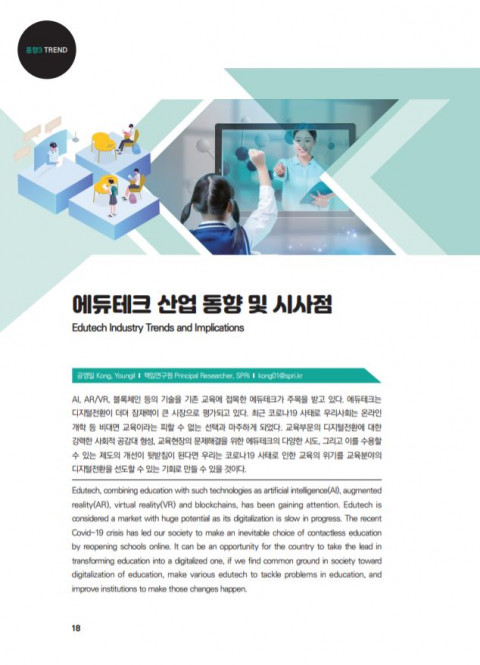 에듀테크 산업 동향 및 시사점 발행 연도: 2020 저자: 공영일 단체 저자: 소프트웨어정책연구소 AI, AR/VR, 블록체인 등의 기술을 기존 교육에 접목한 에듀테크가 주목을 받고 있다. 에듀테크는 디지털전환이 더뎌 잠재력이 큰 시장으로 평가되고 있다. 최근 코로나19 사태로 우리 사회는 온라인 개학 등 비대면 교육이라는 피할 수 없는 선택과 마주하게 되었다. 교육부문의 디지털전환에 대한 강력한 사회적 공감대 형성, 교육현장의 문제해결을 위한 에듀테크의 다양한 시도, 그리고 이를 수용할 수 있는 제도의 개선이 뒷받침된다면 우리는 코로나19 사태로 인한 교육의 위기를 교육 분야의 디지털전환을 선도할 수 있는 기회가 될 것이다.
  학교 현장 적용을 위한 평화교육 정책 연구 발행 연도: 2020 저자: 이대훈 단체 저자: 서울특별시교육청 교육연구정보원 | 서울교육정책연구소 본 연구는 서울특별시교육청의 학교 평화교육 도입 및 시행을 위한 평화교육 개념 및 정책 방향을 설정하는 토대 연구이다. 이를 통해서 변화하는 한반도 현실에 적합한 평화교육 정책 모색하면서, 학교 현장의 필요에 적합한 평화교육의 내용 및 활성화 방법과 평화교육과 교과 교육과정과의 연계의 방향을 찾고자 한다. 본 연구에서 다루는 평화교육의 초점은 ‘평화역량’ 개념의 교육적 적용, 즉 평화역량 중심의 평화교육을 위한 정의와 프로그램이다. 이를 위해 국내외 주요 평화교육으로부터의 시사점, 서울특별시교육청의 평화교육 비전 설정 및 주제와 이행단계 설정, 교육 현장의 욕구 및 필요를 반영한 평화교육의 통합적 운영 방안을 제시한다. 서울특별시교육청교육연구정보원이(가) 창작한 [서교연2019-25]2019 위탁연구(학교 현장 적용을 위한 평화교육 정책 연구) 최종보고서 저작물은 "공공누리 제4유형(출처표시-상업적 이용금지-변경금지)" 조건에 따라 이용 할 수 있습니다.
 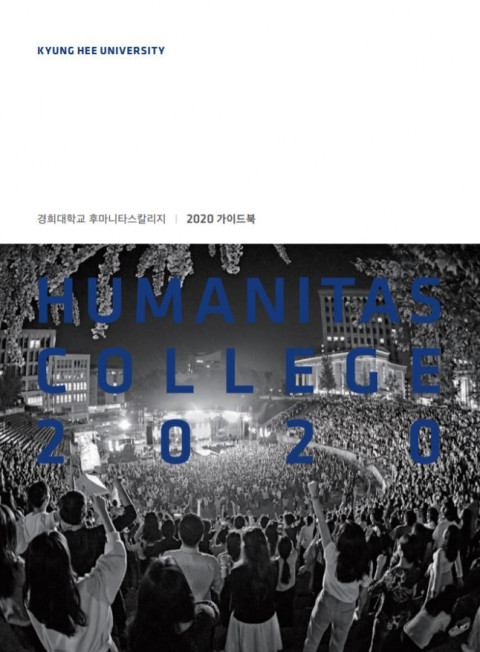 경희대학교 후마니타스칼리지 2020 가이드북 (Humanitas College 2020) 발행 연도: 2020 단체 저자: 경희대학교 후마니타스칼리지 신입생에게 후마니타스칼리지 교양교육에 대한 이해를 돕고, 후마가 한 해 동안 거둔 성과를 담은 『2020 후마니타스칼리지 가이드북』이 발간됐다. 후마는 2014년부터 해마다 가이드북을 발간하고 있다.『2020 후마 가이드북』에는 미래비전을 새로 정립하고 재도약에 나선 후마의 행보를 담았다. 신입생뿐 아니라 구성원 모두가 눈여겨볼 만하다. 대학 내에서의 세계시민교육 교과과정 및 현장 활동 우수 사례들을 담고 있으며 세계시민교육은 단순한 실험이나 실습이 아닌 ‘실천’임을 강조한다. 앞으로 세계시민교육을 수강하고 독립연구를 계획하는 학생들에게 도움이 될 것으로 보인다.
  Education for Global Citizenship: Meanings and Practices for a Transformative Cosmopolitism 발행 연도: 2017 저자: Alejandra Boni Aristizabal According to the author: "The article aims to analyze in depth the meanings of global citizenships in order to characterize the pedagogical practices of what is known as education for global citizenship. After a brief analysis of the different stages that education for development has gone through, from the assistencialist approach of the 50s to education for global citizenship, we study different perspectives of cosmopolitanism: a vision from the field of ethics, mainly from Martha Nussbaum's perspective that talks about cosmopolitan abilities, from politics, that has democratic proposals such as David Held's, critical perspectives as Boaventura de Souza Santos' ones, and the sociological perspective that allows us to identify intercultural communicative processes where the cosmopolitan view is produced, according to Ulrick Beck's or Gerald Delanty's words. After this, we conclude with a discussion about how to encourage education for develpment spaces that foster global citizenship." Educación para la Ciudadanía Global: Significados y espacios para un cosmopolitismo transformado 발행 연도: 2017 저자: Alejandra Boni Aristizabal Según la autora: "El presente artículo tiene como objetivo profundizar en los significados de la ciudadanía global con el fin de caracterizar las prácticas pedagógicas de lo que se conoce como educación para la ciudadanía global. Tras una breve análisis de las distintas etapas por las que ha pasado la educación para el desarrollo, desde el planteamiento asistencialista de los años 50 hasta la educación para la ciudadanía global, nos detenemos en diferentes perspectivas del cosmopolitismo: la visión desde la ética, fundamentalmente a través de la obra de Martha Nussbaum que nos habla de las habilidades cosmopolitas, desde la política, que contiene propuestas de democracia como las de David Held y perspectivas más críticas como las de Boaventura de Sousa Santos, y la perspectiva sociológica que nos permite identificar los procesos de comunicación intercultural donde se produce la mirada cosmopolita, según palabras de Ulrick Beck o Gerard Delanty. Tras ello, concluiremos con una discusión sobre cómo potenciar espacios de educación para el desarrollo desde donde contribuir a la formación de ciudadanos globales"
 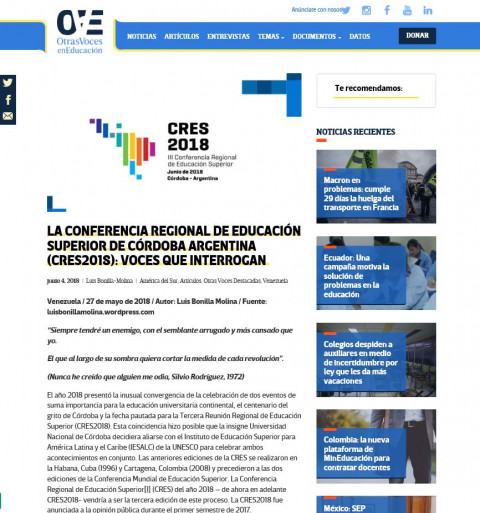 The Regional Conference on Higher Education of Córdoba Argentina (CRES2018): Voices That Question 발행 연도: 2018 저자: Luis Bonilla-Molina The report is about the Regional Conference on Higher Education (CRES2018), where the Universidad Nacional de Córdoba partnered with the Intenational Institute for Higher Education in Latin America and the Caribbean (IESALC) from the UNESCO. During the event seven main areas concerning Higher Education in Latin America were debated from a critical perspective. Regarding globalization, according to the author, during the event "the effects of the cultural 'worldization'" were analyzed, and it was stated that "planetary citizenship is a blurred topic" that can promote cultural homogenization, and that therefore, there was a need of the promotion of a critical intercultural approach. La Conferencia Regional de Educación Superior de Córdoba Argentina (CRES2018): Voces que interrogan 발행 연도: 2018 저자: Luis Bonilla-Molina El reporte habla de la celebración de la Tercera Reunión Regional de Educación Superior (CRES2018) donde la Univ. Nacional de Córdoba se alió con el Instituto de Ed. Superior para América Latina y el Caribe (IESALC) de la UNESCO. Durante ese evento hubieron siete ejes de debates que analizaban la Ed. Superior en América Latina desde una perspectiva crítica. En cuanto a la globalización, según el autor, durante el encuentro se problematizaron "los efectos de la mundializaciòn cultural", y se aseguró que la "ciudadanía planetaria aparece como un tema difuso" que puede promover homogeneización cultural por lo que se planteó la necesidad de un enfoque basado en un interculturalismo crítico.
 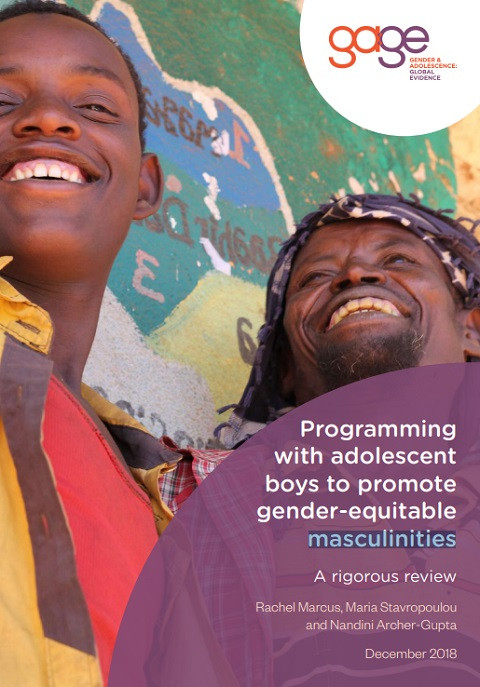 Programming with Adolescent Boys to Promote Gender-Equitable Masculinities: A Rigorous Review 발행 연도: 2018 저자: Rachel Marcus | Maria Stavropoulou | Nandini Archer-Gupta 단체 저자: Gender and Adolescence: Global Evidence (GAGE) | UK aid This review brings evidence from 36 studies of 34 programmes working with adolescent boys and young men to promote more gender-equitable masculinities. It draws on studies with a range of evaluation designs; the key requirements were adequate description of methodology and a valid comparison between participants and non-participants, or of attitudes and behaviour before and after participation.
  Methodological Mosaic: Diverse Paths to Reflect in Schools on the Value of Truth as a Fundamental Public Good for Peace in Colombia 발행 연도: 2018 저자: Juana Yuniz 단체 저자: EDUCAPAZ This publication reflects the work carried out by the National Program of Education for Peace EDUCAPAZ and the Truth Commission in Colombia, for education in schools that want to reflect on the value of truth in the reconstruction of memory, forgiveness and reconciliation. It presents the five proposed paths to achieve it. Mosaico Metodológico: Caminos diversos para reflexionar en las escuelas sobre el valor de la verdad como bien público fundamental para la paz de Colombia 발행 연도: 2018 저자: Juana Yuniz 단체 저자: EDUCAPAZ Esta publicación recoje el trabajo desarrollado por el Programa Nacional de Educación para la Paz EDUCAPAZ y a Comisión de la Verdad en Colombia, para el trabajo pedagógico en escuelas que quieran reflexionar sobre el valor de la verdad en la reconstrucción de la memoria, el perdón y la reconciliación. Presenta los cinco caminos propuestos para lograrlo.