
자료
세계시민교육에 대한 이해를 넓히고 연구, 옹호 활동, 교수, 학습 등을 향상시킬 수 있는 다양하고 유용한 자료를 찾아보세요.
518 건의 결과가 검색되었습니다
 Setting Commitments: National SDG 4 Benchmarks to Transform Education 발행 연도: 2022 단체 저자: Global Education Monitoring Report Team | UNESCO Institute for Statistics (UIS) This publication provides an overview of the transformative agenda being established by countries, as they set SDG 4 benchmarks for education progress to take ownership of the 2030 Agenda for Sustainable Development. Inspired by the UN Secretary-General’s 2014 call for countries to embrace ‘a culture of shared responsibility’ based on ‘benchmarking for progress’, paragraph 28 of the Education 2030 Framework for Action also called on countries to establish ‘appropriate intermediate benchmarks for addressing the accountability deficit associated with longer-term targets’. This report outlines the steps taken by countries to set these commitments for 2025 and 2030 against seven indicators and is timed to feed into the second review of SDG 4 at the High-level Political Forum.The SDG 4 benchmark values now defined for almost nine in ten countries lay out their nationally determined contributions to the common education goal, using a concept embraced by the climate change sector. Twelve countries’ experiences of approaching the challenge of setting benchmarks based on their education sector plans are included, serving as inspiration for other countries to reflect on their own contributions and the task of developing appropriate policy responses in line with their own ambitions for the next decade, especially in the context of recovery from COVID-19.This publication proposes a way forward for monitoring progress towards the national SDG 4 benchmarks. This way of monitoring will be context-specific, recognizing countries’ starting points, helping link their national with regional and global education agendas.The benchmarks could be a basis for a compact in which countries commit to increasing their ambition, and, in return, the international community offers a program of support. In other words, a system of political accountability associated to political commitments with a support mechanism to accomplish the task.
  Assessment for Advocacy to Transform Communities, Programmes and Policies in the Global South 발행 연도: 2024 단체 저자: UNESCO | Global Education Monitoring Report Team | PAL Network This paper was commissioned by the Global Education Monitoring Report as background information to assist in drafting the 2024 Spotlight Report on basic education completion and foundational learning in Africa. It has not been edited by the team. The views and opinions expressed in this paper are those of the author(s) and should not be attributed to the Global Education Monitoring Report or to UNESCO. The papers can be cited with the following reference: “Paper commissioned for the 2024 Spotlight Report on basic education completion and foundational learning in Africa”.
  Can African Countries Afford Their National SDG 4 Benchmarks? 발행 연도: 2024 단체 저자: UNESCO | Global Education Monitoring Report Team This brief paper follows the broad methodological approach of the two previous SDG 4 costing exercises and their main assumptions (UNESCO, 2015a; UNESCO, 2020). It introduces the SDG 4 benchmarking process and how to estimate the cost of achieving these targets set by countries, largely based on their sector plans. Finally, it presents the revised assumptions of the model and the key findings. Despite lowering ambition, there is still an average national financing gap of USD 78 billion per year in the 44 low- and lower-middle-income countries in Africa.
 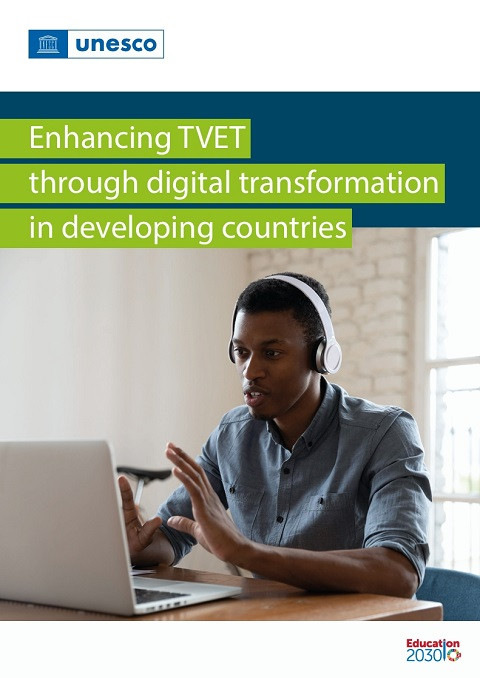 Enhancing TVET through Digital Transformation in Developing Countries 발행 연도: 2023 단체 저자: UNESCO Technological advancements and digitalization are profoundly reshaping our work and lifestyle, business models and operations, and government policy choices. Digital transformation in technical and vocational education and training (TVET) is the planned and structured introduction of automated and streamlined processes within institutions and national technical and vocational education and training (TVET) systems through digital technology, with the goal of enhancing their scope, scale, efficiency and effectiveness and ultimately, driving their more sustainable development. This document provides overall perspective and five country case studies on digital transformation in TVET. Most countries studied face similar enabling factors: the digital infrastructure available; legal and policy frameworks; focused institutional change to improve the acquisition of digital skills; and the promotion of equality and inclusivity. To understand how digital transformation in TVET is occurring, the report analyses it at four levels: technical and technological development; curriculum and qualifications; teaching and learning using technology; and its contribution to the sustainability and resilience of societies.
  Opportunities for Media and Information Literacy in the Middle East and North Africa: Yearbook 2016 발행 연도: 2016 저자: Magda Abu-Fadil | Jordi Torrent | Alton Grizzle 단체 저자: International Clearinghouse on Children, Youth and Media (Sweden) Opportunities for Media and Information Literacy in the Middle East and North Africa is the seventeenth Yearbook published by the Clearinghouse and fills a gap in the existing body of literature about the progress of media and information literacy work in different parts of the world. This book also helps educators in the Middle East and North Africa region looking for opportunities to bring to their classrooms elements of MIL education.
 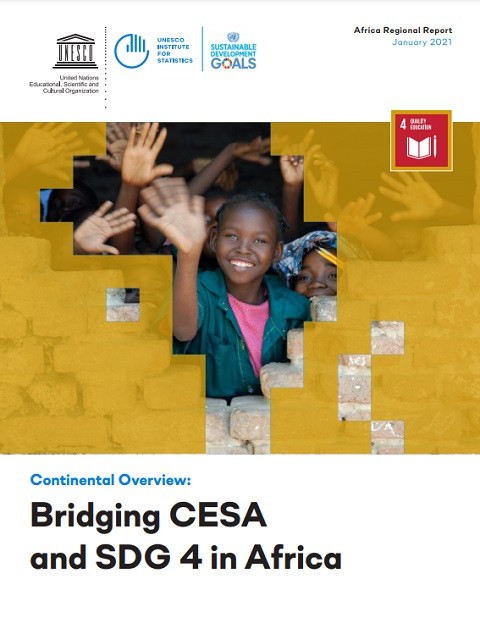 Continental Overview: Bridging CESA and SDG 4 in Africa; Africa Regional Report 발행 연도: 2021 단체 저자: UNESCO Institute for Statistics (UIS) Monitoring progress toward Sustainable Development Goal 4 for education (SDG 4) is crucial to ensuring that children around the world have access to a quality education where they can learn and gain the skills they need to meet their full potential. SDG 4 indicators are organized with a view to global, thematic, regional and national targets.This report by the UNESCO Institute for Statistics (UIS) is the first in a series intended to bring a regional focus to SDG 4 monitoring, highlight the work being done in the regions and compare SDG 4 targets with those established by regional bodies.This new series of regional reports serve two purposes. Firstly, to map regional and SDG 4 targets to provide an overview of the symmetries between the two. Continental Overview: Bridging CESA and SDG 4 in Africa looks at how the strategic objectives of the Continental Education Strategy for Africa (CESA) compares with SDG 4 targets. Secondly, it analyses progress towards these objectives by African sub-regions.
  Higher Education, Peace & Security in the Eastern Africa Region 발행 연도: 2023 저자: Sabiti Makara 단체 저자: UNESCO Nairobi This paper stems from issues that were deliberated on at a regional conference titled, Emerging Issues in the Sciences, Climate Change, Peace and Security and Information and Communication Technologies (ICTs), organized in Djibouti, in May 2017 by UNESCO Regional Office for Eastern Africa. The paper examines the issues and challenges of peace and security in Eastern Africa region. It puts into perspective higher education in the region, in terms of assess, quality, relevance, knowledge and skill products, and capacity to solve social challenges of society. The May 2017 Djibouti Conference on Higher Education, Peace and Security aimed at placing higher education at the center of understanding the complex regional challenges with regard to peace and security in a broad context, including poverty, climate change and environment, intergenerational transfer of knowledge, colonial/neo-colonial heritage, regional integration, cultural resources, and unemployment. The centrality of education as a tool for social transformation in Africa, and elsewhere is a critical element of transforming society, however that very element is up for debate. Specifically, the impact of higher education as a means of accelerating the sciences (natural and social sciences) is due for robust debate, as to whether or not, it is leading to innovations, creativity, and research-led solutions to challenges of society. The critical issue for the Djibouti Conference deliberations was: could Science, technology and in more recent years, information and communications technology, lead to transformation of society in the region? The other issue was: is it only the natural sciences that have the greatest potential for that transformation, or that the social sciences and humanities are relevant in this context? Besides, since issues of peace and security are complex, could multidisciplinary approaches be appropriate? This paper is not a rapporteur's report of the Djibouti conference. It is a set of reflection and reframing of issues for further debate and discussion.
  The prospects of development education in African countries: building a critical mass of citizenry for civic engagement 발행 연도: 2015 저자: Simon Eten 단체 저자: Centre for Global Education (CGE) This article argues that development education is often framed in an African context within notions of national citizenship designed to engender support for public institutions and policies rather than develop critical thinking skills. This limited concept and application of development education often results in public apathy and disengagement from participation in community, national and global development initiatives. The author argues that recourse to the more radical, Freirean conception of development education practice in African states could potentially support more engaged public activism in issues underpinning poverty and injustice locally and globally. The author draws upon his knowledge and experience of the public sector in Ghana and general trends across Africa to propose potentially fertile areas of research that could support more effective DE practice that nurtures enhanced civic engagement. Les perspectives de l'éducation au développement dans les pays africains: la construction d'une masse critique de citoyens pour l'engagement civique 발행 연도: 2015 저자: Simon Eten 단체 저자: Centre for Global Education (CGE) Cet article soutient que l'éducation au développement est souvent encadrée dans un contexte africain dans les notions de citoyenneté nationale visant à susciter le soutien des institutions et des politiques publiques plutôt que de développer la pensée critique. Ce concept limité et l'application de l'éducation au développement se traduit souvent par l'apathie du public et le désengagement de la participation à la communauté, les initiatives nationales et mondiales de développement. L'auteur fait valoir que le recours à la plus radicale, la conception freirienne de la pratique de l'éducation au développement dans les pays africains pourrait soutenir l'activisme public plus engagé dans les questions qui sous-tendent la pauvreté et de l'injustice localement et globalement. L'auteur puise dans ses connaissances et de l'expérience du secteur public au Ghana et les tendances générales à travers l'Afrique pour proposer des zones potentiellement fertiles de la recherche qui pourrait soutenir la pratique DE plus efficace qui favorise l'engagement civique renforcée.
 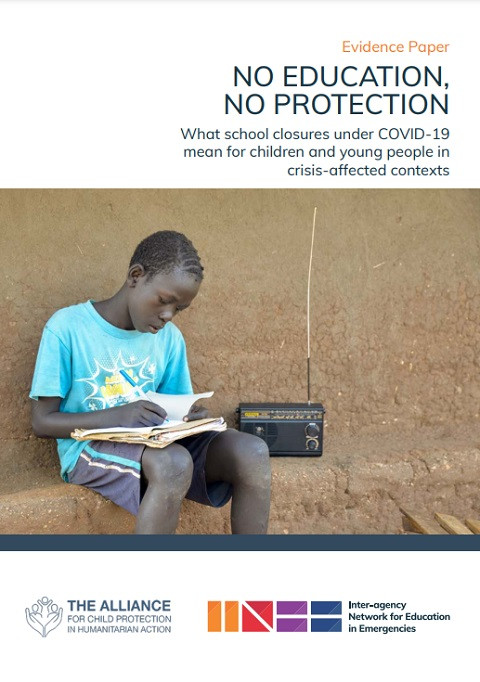 No Education, No Protection: What School Closures Under COVID-19 Mean for Children and Young People in Crisis-Affected Contexts 발행 연도: 2021 단체 저자: Inter-agency Network for Education in Emergencies (INEE) | Alliance for Child Protection in Humanitarian Drawing from research and experience on previous infectious disease outbreaks and an emergent body of work from the current COVID-19 pandemic, this report highlights the primarily negative effects resulting from the combination of sudden school closures and restricted access to and availability of services, social networks, and other protective facilities for children and young people living in crisis-affected contexts. The consequences of school closures on education and child protection can be categorized into three principal areas:1. Loss of learning and impediments to providing inclusive, equitable, quality education2. Negative impact on child well-being and healthy development3. Amplified child protection risks and harms experienced by children and young people