
자료
세계시민교육에 대한 이해를 넓히고 연구, 옹호 활동, 교수, 학습 등을 향상시킬 수 있는 다양하고 유용한 자료를 찾아보세요.
91 건의 결과가 검색되었습니다
 Learning to live together: an intercultural and interfaith programme for ethics education: Traning guides series 1; international train the trainers course; a report 발행 연도: 2012 단체 저자: United Nations Children's Fund (UNICEF) | Interfaith Council on Ethics Education for Children | Arigatou Foundation In 2010, Arigatou International offered an International Train the Trainers course designed to help those providing training programmes on the use of the Learning to Live Together. The University of Edinburgh helped develop and evaluate the Train the Trainers as a pilot project.
  Learning to live together: an intercultural and interfaith programme for ethics education: Executive Summary 발행 연도: 2015 단체 저자: United Nations Children's Fund (UNICEF) | Interfaith Council on Ethics Education for Children | Arigatou Foundation What is the Learning to Live Together? How was it developed? Where and how can it be used? In the Executive Summary you can find answers to all these questions, as well as information about outstanding projects that show the potential of the programme. Apprendre à vivre ensemble: Un programme interculturel et interreligieux pour l’enseignement de l’éthique: Résumé 발행 연도: 2015 단체 저자: United Nations Children's Fund (UNICEF) | Interfaith Council on Ethics Education for Children | Arigatou Foundation What is the Learning to Live Together? How was it developed? Where and how can it be used? In the Executive Summary you can find answers to all these questions, as well as information about outstanding projects that show the potential of the programme. Aprender a vivir juntos: Un programa intercultural e interreligioso para la educación ética: Resumen 발행 연도: 2015 단체 저자: United Nations Children's Fund (UNICEF) | Interfaith Council on Ethics Education for Children | Arigatou Foundation What is the Learning to Live Together? How was it developed? Where and how can it be used? In the Executive Summary you can find answers to all these questions, as well as information about outstanding projects that show the potential of the programme. Learning to live together: an intercultural and interfaith programme for ethics education: Executive Summary 발행 연도: 2015 단체 저자: United Nations Children's Fund (UNICEF) | Interfaith Council on Ethics Education for Children | Arigatou Foundation What is the Learning to Live Together? How was it developed? Where and how can it be used? In the Executive Summary you can find answers to all these questions, as well as information about outstanding projects that show the potential of the programme.
 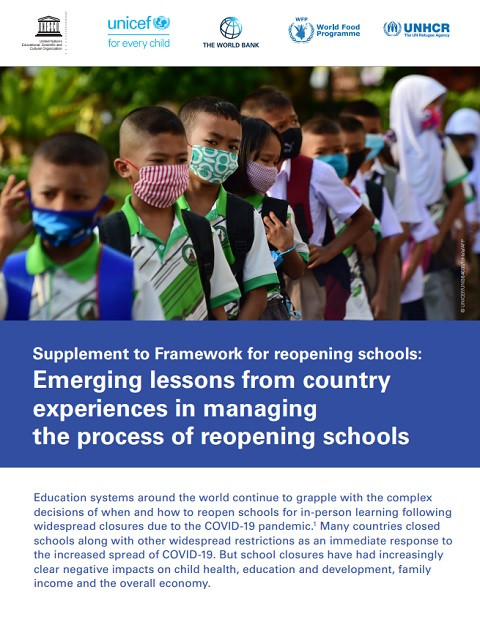 Supplement to Framework for Reopening Schools: Emerging Lessons From Country Experiences in Managing the Process of Reopening Schools 발행 연도: 2020 단체 저자: UNESCO | United Nations Children's Fund (UNICEF) | World Bank | World Food Programme | UN. Office of the United Nations High Commissioner for Refugees (UNHCR) Education systems around the world continue to grapple with the complex decisions of when and how to reopen schools for in-person learning following widespread closures due to the COVID 19 pandemic. This supplement to the Framework for reopening schools, originally published jointly by UNICEF, UNESCO, the World Bank, the World Food Programme, and the UN Refugee Agency (UNHCR) in April 2020, summarizes emerging lessons learnt over the past months.The supplement follows the four main dimensions of the Framework (safe operations, focus on learning, wellbeing & protection, and reaching the most marginalized) and highlighting a number of country examples.
  The Digital Transformation of Education: Connecting Schools, Empowering Learners 발행 연도: 2020 저자: Ana Sepúlveda | Doreen Bogdan-Martin | Alex Wong | Chris Fabian | Borhene Chakroun | Anna Polomska | Samantha O’Riordan | Miguel Alcaine | Istvan Bozsoki | Vladimir Daigele | Jose Maria Diaz Batanero | Hani Eskandar | Aminata Amadou Garba | John Garrity | Farid Nakhli | Sylvia Poll Ahrens | Martin Schaaper | Christine Sund | Nancy Sundberg | Sandeep Taxali | Cleveland Thomas | Frank McCosker | James Lo | Fengchun Miao | Jaime Archundia | Janice Dean | Sophia Farrar | Sunita Grote | Aditi Poddar | Naroa Zurutuza | Nanjira Sambuli | Kavita Gupta 단체 저자: International Telecommunication Union (ITU) | UNESCO | United Nations Children's Fund (UNICEF) This report looks into school connectivity and introduces a methodology and framework for mapping and connecting primary and secondary schools to the Internet. It aims to help governments, their partners and interested stakeholders to develop more holistic school connectivity plans. The analysis of this report provides a better understanding of the school connectivity landscape and requirements, to evaluate the benefits of different technologies for different environments, and to analyze business and financial models, as well as suitable content articulating connectivity with quality, safe, and inclusive learning.
 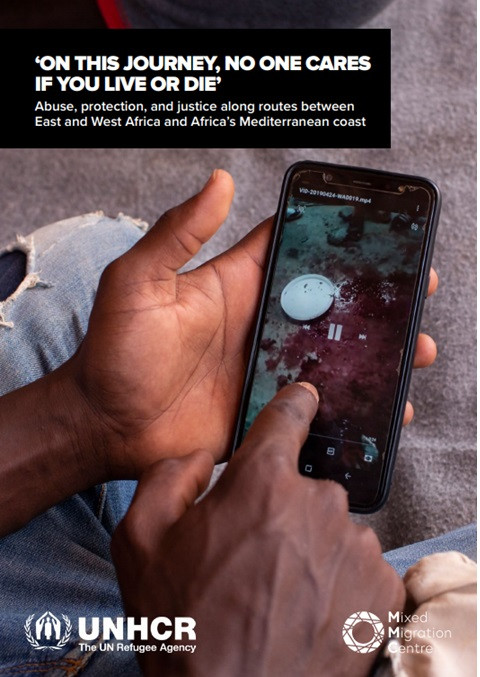 On This Journey, No One Cares If You Live or Die: Abuse, Protection, and Justice Along Routes Between East and West Africa and Africa’s Mediterranean Coast 발행 연도: 2020 단체 저자: UN. Office of the United Nations High Commissioner for Refugees (UNHCR) | Mixed Migration Centre This report draws on data collected by the Mixed Migration Centre’s 4Mi monitors along the route to map the places where refugees interviewed in 2018 and 2019 most frequently reported deaths, sexual and gender-based violence (SGBV), physical violence, and kidnappings occurred. It illustrates how refugees and migrants using the route face a series of risks including as they cross into eastern Sudan, and when crossing the Sahara Desert, and then again in multiple places in Libya. Similarly, those traveling through West Africa reported multiple incidents of physical violence, SGBV, as well as deaths at various points. Refugees and migrants have reported being subjected to brutal violence, including being burnt with hot oil, melted plastic, or heated metal objects, being electrocuted, tied in stress positions, and experiencing and witnessing repeated sexual violence, often in the context of ransom demands. UNHCR staff and partners continue to witness the severe impact these abuses have had on the mental health of many men, women, and children.
  State of the Global Climate 2023 발행 연도: 2024 단체 저자: World Meteorological Organization (WMO) The publication provides a summary on the state of the climate indicators in 2023 with sections on key climate indicators, extreme events and impacts. The indicators include global temperatures, greenhouse gas concentration, ocean heat content, sea level rise, ocean acidification, Arctic and Antarctic sea ice, Greenland ice sheet and glaciers and snow cover, precipitation and stratospheric ozone, with an analysis of major drivers of inter-annual climate variability during the year including the El Niño Southern Oscillation and other ocean and atmospheric indices. The highlighted extreme events include those related to tropical cyclones and wind storms; flooding, drought and extreme heat and cold events. The publication also provides most recent finding on climate related risks and impacts including on food security and population displacement.
 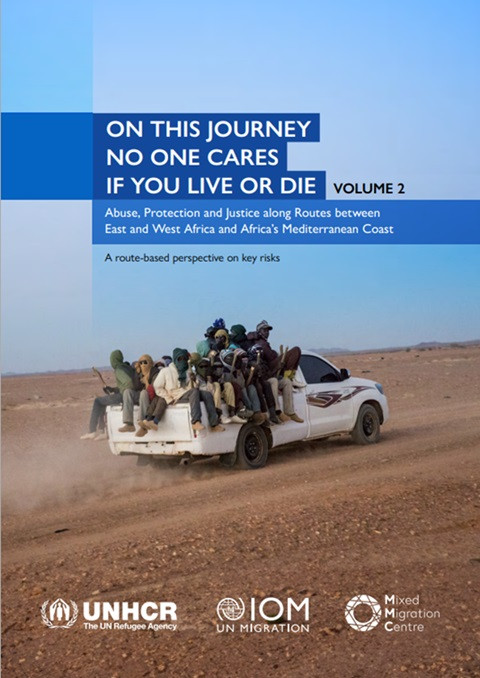 On This Journey No One Cares If You Live or Die, Volume 2: Abuse, Protection and Justice Along Routes Between East and West Africa and Africa's Mediterranean Coast 발행 연도: 2024 단체 저자: International Organization for Migration (IOM) | Mixed Migration Centre | UN. Office of the United Nations High Commissioner for Refugees (UNHCR) In the complex landscape of migration, this second volume of the report, On This Journey, No One Cares if You Live or Die, emerges as a crucial body of work that sheds light on the stark realities faced by refugees and migrants traversing the perilous Central Mediterranean route all the way from East and Horn of Africa and West Africa to the North African coast of the Mediterranean and across the sea. Jointly published by IOM, MMC and UNHCR, this report delves into the protection risks faced by refugees and migrants during these journeys. It aims to inform increased and concrete routes-based protection responses to reduce the suffering associated with the desperate journeys refugees and migrants undertake, and to serve as a call to action in addressing the root causes of displacement and drivers of irregular migration through positive action on peace, climate change, governance, inequality and social cohesion, as well as the creation of safe migration pathways.