
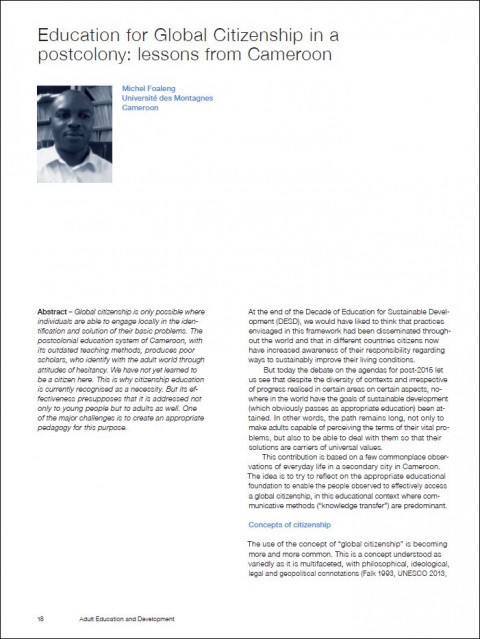
Education for Global Citizenship in a Postcolony: Lessons from Cameroon
- Автор
- Michael Foaleng
- Корпоративный автор
- Éducation des Adultes et Développement
- ISBN
- ISSN 0935-8161
- Колляция
- p. 20-25
- Язык ресурса
- АнглийскийФранцузскийИспанский
- Год публикации
- 2015
- Тема
- Гражданственность / Гражданство / ДемократияРазнообразие / Культурная грамотность / Инклюзивность
- Тип ресурса
- Исследовательские работы / журнальные статьи
- Уровень образования
- Начальное образованиеСреднее образованиеОбучение на протяжении всей жизни
- Регион
- Африка
- Место публикации
- Bonn
Global citizenship is only possible where individuals are able to engage locally in the identification and solution of their basic problems. The postcolonial education system of Cameroon, with its outdated teaching methods, produces poor scholars, who identify with the adult world through attitudes of hesitancy. We have not yet learned to be a citizen here. This is why citizenship education is currently recognised as a necessity. But its effectiveness presupposes that it is addressed not only to young people but to adults as well. One of the major challenges is to create an appropriate pedagogy for this purpose.
Связанные ресурсы
-
 IIEP-UNESCO 12th Medium-Term Strategy: 2026–2029
 -
 Youth Lens on the Silk Roads: Best Photos from the International Silk Roads Photo Contest; 6th Edition
 -
 Advancing Intergenerational Learning: Identifying Challenges and Opportunities for Older Adults; Integrated Case Study Report
 -
 Digital Empowerment for Lifelong Learning and Transformative Andragogy (DELTA) for Adult Educators: Introduction to the DELTA Framework and Resources