
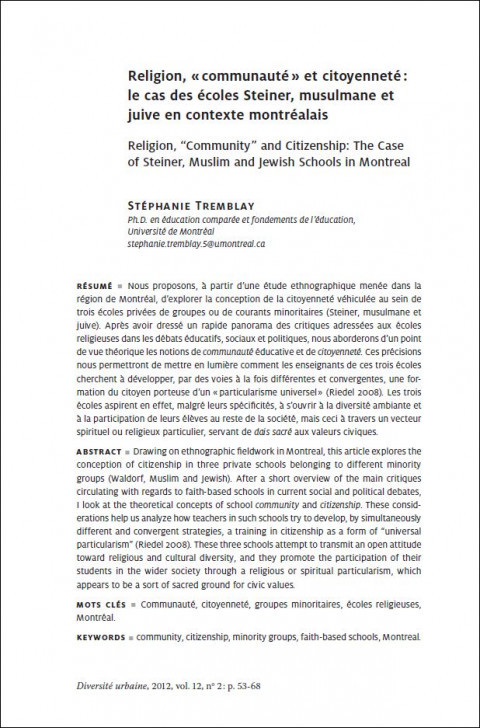
Religion, “Community” and Citizenship: The Case of Steiner, Muslim and Jewish Schools in Montreal
- Автор
- Stéphanie Tremblay
- Корпоративный автор
- Diversité urbaine
- ISBN
- ISSN 1913-0708 (numérique)
- Колляция
- p. 53–68
- Язык ресурса
- Французский
- Год публикации
- 2012
- Тема
- Гражданственность / Гражданство / ДемократияРазнообразие / Культурная грамотность / Инклюзивность
- Тип ресурса
- Исследовательские работы / журнальные статьиМеждународные нормативные документы / политика и адвокационные документы
- Уровень образования
- Неформальное образование
- Регион
- Европа и Северная Америка
- Место публикации
- Québec
Drawing on ethnographic fieldwork in Montreal, this article explores the conception of citizenship in three private schools belonging to different minority groups (Waldorf, Muslim and Jewish). After a short overview of the main critiques circulating with regards to faith-based schools in current social and political debates, I look at the theoretical concepts of school community and citizenship. These considerations help us analyze how teachers in such schools try to develop, by simultaneously different and convergent strategies, a training in citizenship as a form of “universal particularism” (Riedel 2008). These three schools attempt to transmit an open attitude toward religious and cultural diversity, and they promote the participation of their students in the wider society through a religious or spiritual particularism, which appears to be a sort of sacred ground for civic values.
Связанные ресурсы
-
 IIEP-UNESCO 12th Medium-Term Strategy: 2026–2029
 -
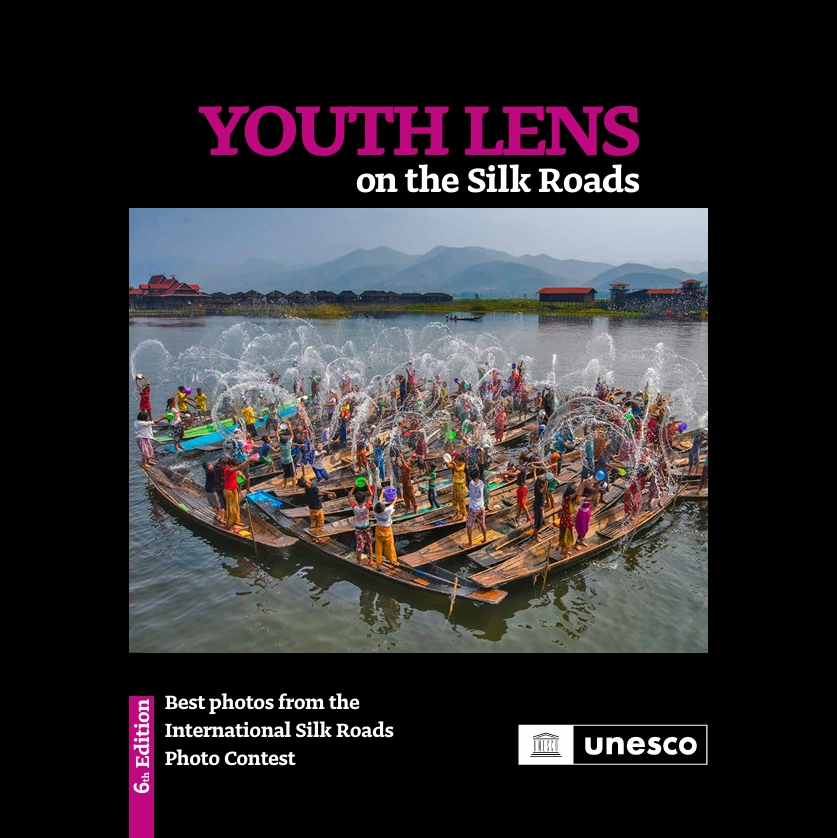 Youth Lens on the Silk Roads: Best Photos from the International Silk Roads Photo Contest; 6th Edition
 -
 Advancing Intergenerational Learning: Identifying Challenges and Opportunities for Older Adults; Integrated Case Study Report
 -
 Digital Empowerment for Lifelong Learning and Transformative Andragogy (DELTA) for Adult Educators: Introduction to the DELTA Framework and Resources