
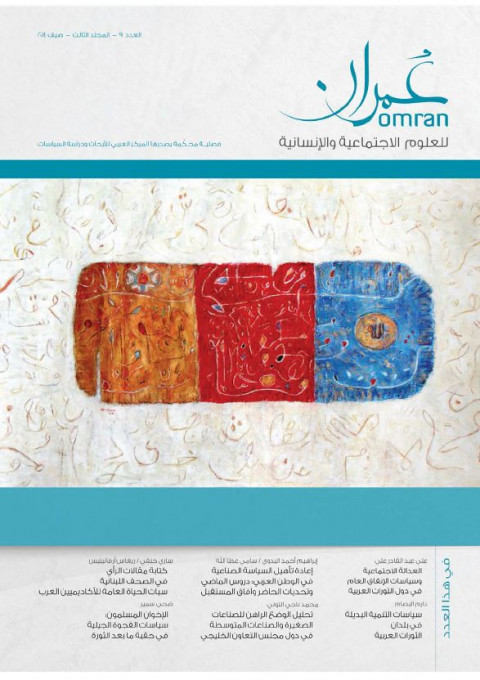
Social Justice and Public Expenditure Policies in the Arab Revolutions
- Автор
- Ali Abdul Qadir Ali
- Корпоративный автор
- Arab Center for Research and Policy Studies
- ISBN
- ISSN 2305-2473
- Колляция
- p. 7-26
- Язык ресурса
- Арабский
- Год публикации
- 2014
- Уровень образования
- Обучение на протяжении всей жизниДругое
- Регион
- Арабские государства
- Место публикации
- Doha
This paper examines the challenges faced by Arab spring states when formulating public expenditure policies that meet the revolutions’ demands. In an attempt to establish democratic regimes, the Arab revolutions dictated the creation of pluralist political institutions with concomitant implications for economic institutions. The paper suggests that the challenge of formulating a public expenditure policy in line with the revolutions’ aspirations for social justice lies in the inability of international development agencies, such as the IMF, to propose new and innovative ideas for formulating development policy. However, there are successful applied examples of distributive public expenditure policies for creating social justice. The paper reviews these examples in addition to the results of a survey identifying the size of the middle class in samples of Arab spring states. The survey demonstrates that the middle class represents a majority of population in these countries, suggesting that the transition to electoral democracy requires adopting distributional public expenditure policies in which the middle class voter occupies a central role.
Связанные ресурсы
-
 Addressing Violent Pasts through Education: A Policy Guide
 -
 UNESCO Prize for Global Citizenship Education 2025 Laureates
 -
 Confronting Inequality through GCED: Toward Justice, Inclusion, and Transformation (SangSaeng; No.65, 2025)
 -
 ACER-APCEIU Global Citizenship Education Monitoring Toolkit: For Teachers, Schools and System Leaders