
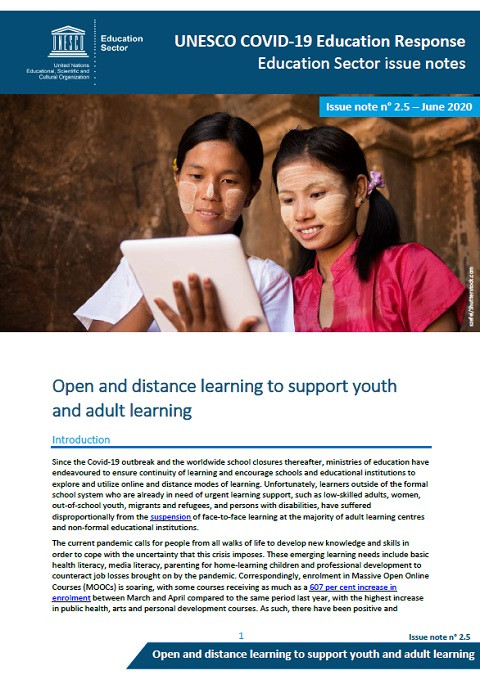
UNESCO COVID-19 Education Response: Open and Distance Learning to Support Youth and Adult Learning (Education Sector Issue Note; No. 2.5 – June 2020)
- Корпоративный автор
- UNESCO Institute for Lifelong Learning (UIL)
- Колляция
- 8 p.
- Язык ресурса
- Английский
- Год публикации
- 2020
- Тема
- Медийная и информационная грамотность / Цифровое гражданствоТрансформационные инициативы / Трансформационные педагогикиДругое
- Тип ресурса
- Международные нормативные документы / политика и адвокационные документыДоклады конференций и программ
- Уровень образования
- Обучение на протяжении всей жизниТехническое и профессиональное образование и обучениеНеформальное образование
- Регион
- Глобальный
- Место публикации
- Paris
A new UNESCO issue note, produced by the UNESCO Institute for Lifelong Learning (UIL), aims to support education policy-makers and planners in ensuring open and distance learning to support youth and adult learning in the context of the current pandemic, now and in its aftermath.
Since the COVID-19 outbreak and the worldwide school closures that followed, ministries of education have endeavoured to ensure continuity of learning and encourage schools and educational institutions to explore and utilize online and distance modes of learning. Unfortunately, learners outside of the formal school system who are already in need of urgent learning support, such as low-skilled adults, women, out-of-school youth, migrants and refugees, and persons with disabilities, have suffered disproportionally from the suspension of face-to-face learning at the majority of adult learning centres and non-formal educational institutions.
The current pandemic calls for people from people from all socio-economic backgrounds, wherever they live in the world, to develop new knowledge and skills in order to cope with the uncertainty that this crisis imposes. These learning needs include basic health literacy, media literacy, parenting for home-schooling children and professional development to counteract job losses brought on by the pandemic. Correspondingly, enrolment in massive open online courses (MOOCs) is soaring. As such, there have been positive and demand-driven trends in exploring alternative options, such as open and distance learning (ODL), to ensure the continuity and expansion of non-formal education and adult learning.
This issue note takes stock of opportunities and challenges in using ODL, both online and offline as defined in the UNESCO Issue Note on Distance Learning Strategies, for youth and adult learners outside the formal education system. After examining key issues and illustrating promising cases from public and private sectors, it provides key messages for policy interventions to support inclusive lifelong learning for youth and adults during and after the current pandemic.
UNESCO Education Sector’s issue notes cover key topics related to the COVID-19 education response.
Связанные ресурсы
-
 IIEP-UNESCO 12th Medium-Term Strategy: 2026–2029
 -
 Digital Empowerment for Lifelong Learning and Transformative Andragogy (DELTA) for Adult Educators: Introduction to the DELTA Framework and Resources
 -
 Bridging the Grey Digital Divide: Enhancing ICT Learning for Older Adults; Research Report
 -
 Envisioning the Future of Assessment in Transformative Education: A Synthesis Report of the Expert Meeting on Evaluation and Assessment for Transformative Education: Towards and Beyond 2030