
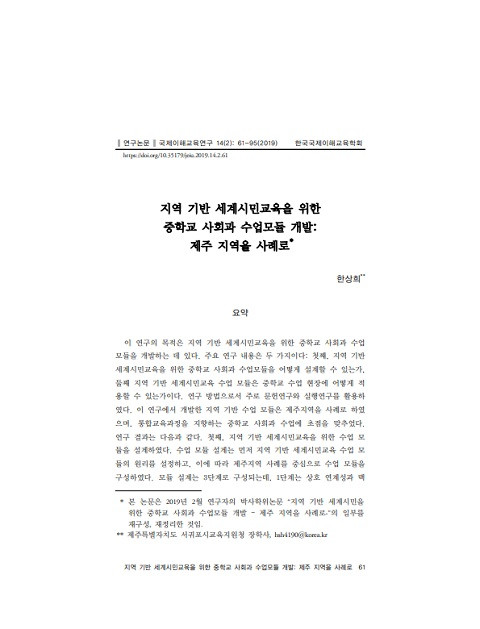
The Development of a Middle School Social Studies Instructional Module for Place-Based Global Citizenship Education: The Case of Jeju Island (Journal of Education for International Understanding; Vol. 14, No. 2)
- Автор
- Han Sanghee
- Корпоративный автор
- Korean Society of Education for International Understanding (KOSEIU)
- ISBN
- ISSN 2005-3665
- Колляция
- p. 61-95
- Язык ресурса
- Корейский
- Год публикации
- 2019
- Тип ресурса
- Исследовательские работы / журнальные статьи
- Уровень образования
- Среднее образование
- Регион
- Азия и Тихоокеанский регион
- Место публикации
- Seoul
This study aims to develop an instructional module for middle school social studies as part of place-based global citizenship education. The main contents of this study are as follows:first, the methods used in developing an instructional module for middle school social studies in global citizenship education; second, the method applied in the module for middle school classes. The study was mainly based on reference research and action research. The place-based class module developed for this study is the case of Jeju Island and is focused on middle school social studies classes as oriented to the integrated curriculum. The results are as follows: First, I developed a class module for place-based global citizenship education. For this module, I created principles for the class module for place-based global citizenship education and compose the class module by focusing on the case of Jeju Island. The design of this module went through 3 stages. The first stage explores regional issues by considering mutual relationships and the context from which suitable themes to foster global citizenship in the region are uncovered. The second stage explores the geological, historical, social, and cultural contexts of the place-based issues. The third stage expands on the contexts of the regional issues and practice to exercise global citizenship. Through the application of the principles and developmental stages for the class module, I then compose three Jeju-based modules. Second, I developed and conducted a Jeju-based instructional module for global citizenship education. For the themes and Jeju cases of the place-based module, I present sympathy for universal values through the life of Kim Mandeok who gave aid to the poor in the late Joseon era; respect for diversity and difference through the history of Haenamcheon, the Jeju immigrant community during early industrialization; and solidarity and practice through the Jeju 4·3 Uprising and Massacre. These three class modules can be utilized independently or stage by stage. I concede that this study has spatial and content limitations due to the fact that the Jeju cases are only presented among domains relating to global citizenship education which means that follow-up research is required to expand into relating domains and other regions. In addition, this study has other limits in that it hasn’t been verified quantitatively by presenting the effects of global citizenship education only through the stories of students who attended this class and the follow-up educational activities through this module.
Связанные ресурсы
-
 IIEP-UNESCO 12th Medium-Term Strategy: 2026–2029
 -
 Advancing Intergenerational Learning: Identifying Challenges and Opportunities for Older Adults; Integrated Case Study Report
 -
 Digital Empowerment for Lifelong Learning and Transformative Andragogy (DELTA) for Adult Educators: Introduction to the DELTA Framework and Resources
 -
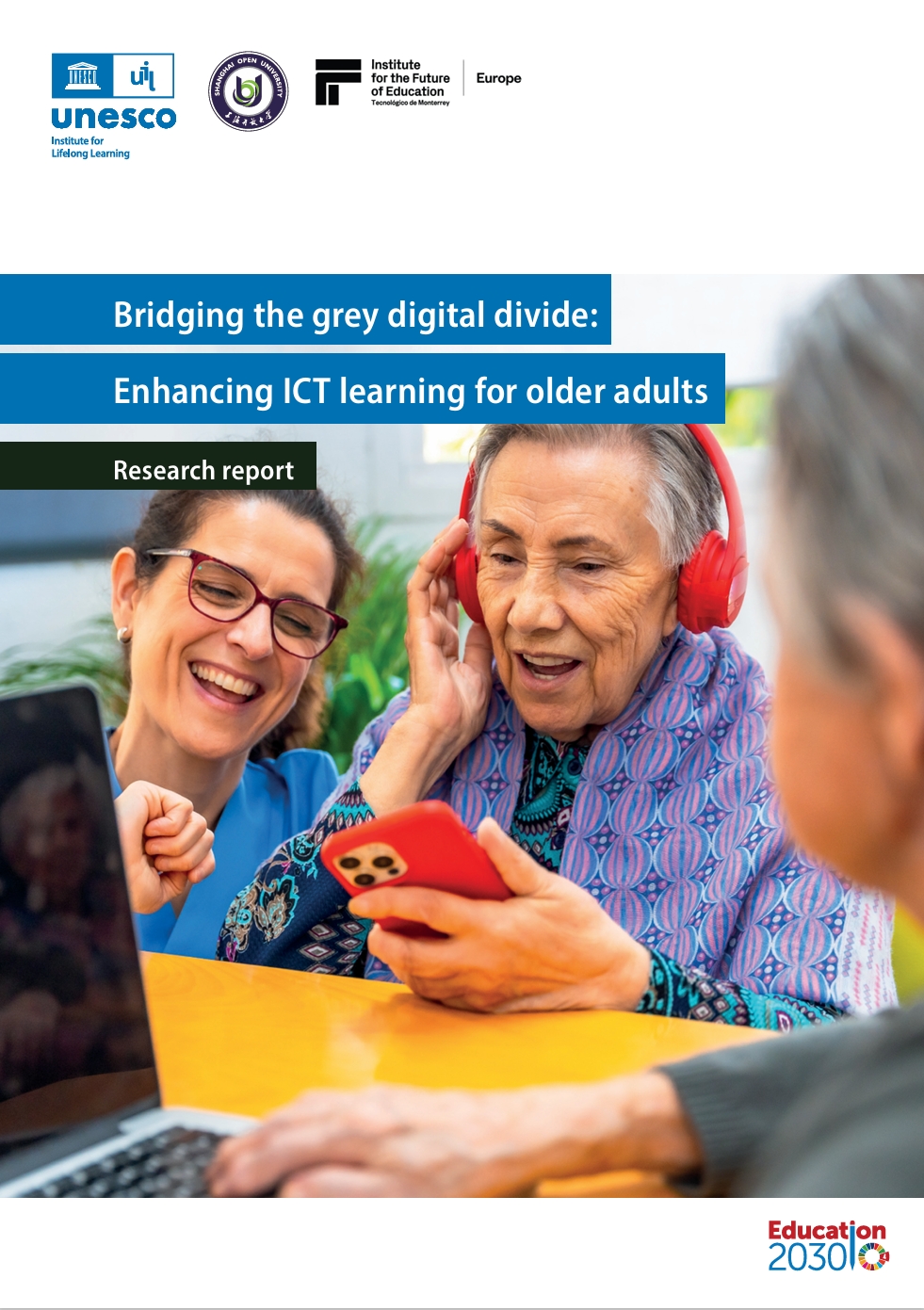 Bridging the Grey Digital Divide: Enhancing ICT Learning for Older Adults; Research Report