
Ресурсы
Изучайте широкий спектр ценных ресурсов ВГГ, чтобы углубить своё понимание и повысить эффективность исследований, просветительской деятельности, преподавания и обучения.
Найдено: 795
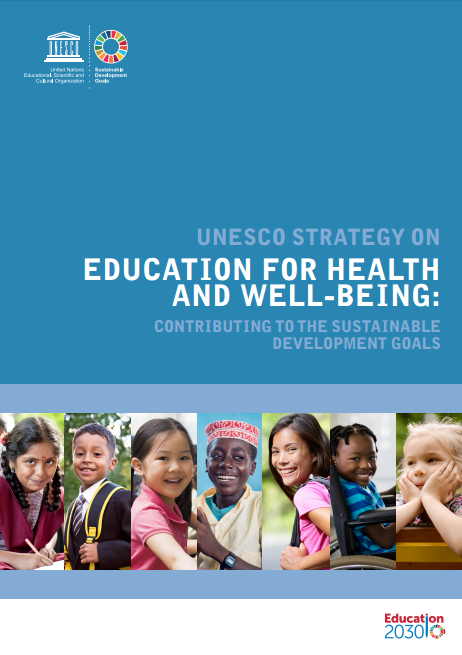 UNESCO Strategy on Education for Health and Well-Being: Contributing to the Sustainable Development Goals Год публикации: 2016 Организация-автор: UNESCO This strategy builds on UNESCO’s longstanding commitment to strengthen the links between education and health, reflecting international recognition that a more comprehensive approach to school health and coordinated action across sectors is needed. As stated in the 2015 Incheon Declaration, education develops the skills, values and attitudes that enable citizens to lead healthy and fulfilled lives, make informed decisions, and respond to local and global challenges. It updates previous UNESCO strategies and expands on UNESCO’s work on HIV and on promoting comprehensive sexuality education and safe and inclusive learning environments, placing more emphasis on the role of schools in promoting health. More specifically, it reflects recent developments in the global education, HIV and health agendas, and is aligned with the new UNAIDS 2016-2021 Strategy and the Sustainable Development Goals, in particular SDG 3 Health, SDG 4 Education and SDG 5 Gender Equality.
  Values Education thorugh Sports (infographics) Год публикации: 2016 Организация-автор: UNESCO
  Education sector responses to homophobic bullying Год публикации: 2012 Организация-автор: UNESCO This publication is part of a Good Policy and Practice series that addresses key themes of UNESCO’s work with the education sector including HIV and AIDS and safe, healthy educational environments for all learners. This volume, on the theme of homophobic bullying in educational institutions, builds on UNESCO’s work on gender, discrimination and violence in schools.
  Global guidance on addressing school related gender based violence Год публикации: 2016 Организация-автор: UNESCO | United Nations Entity for Gender Equality and the Empowerment of Women (UN Women) More than 246 million children are subjected to gender-based violence in or around schools every year. This is a violation of their human rights, and a form of gender-discrimination that has far-reaching physical, psychological and educational consequences. Ending schoolrelated gender-based violence (SRGBV) is a priority for countries wishing to achieve ambitious global goals on inclusive and quality education for all and gender equality.WHAT IS THE AIM OF THIS GUIDANCE? This guidance aims to provide a comprehensive, one-stop resource on school-related gender-based violence (SRGBV), including clear, knowledge-based operational guidance, diverse case studies drawn from examples of promising practice and recommended tools for the education sector and its partners working to eliminate gender-based violence. It distils programme knowledge based on existing global literature, promising practices, expert recommendations and practitioner consensus.WHO IS THIS GUIDANCE FOR? The primary audience for this global guidance is the national education sector, including government policy-makers, education ministries, school administrators, educators and other school staff. The guidance may also have wider interest for other national and international stakeholders that are interested in addressing SRGBV, including NGOs, bilateral and multilateral agencies, teachers’ trade unions and policy-makers in other domestic sectors. The guidance is intended primarily for use in low- and middle-income settings, but is based on norms and principles that are universally applicable.WHAT IS COVERED IN THIS GUIDANCE? Promising practice case studies and recommended tools are embedded throughout the relevant sub-sections of the guidance. These provide readers with illustrative examples of implementation in real-life contexts and can serve as resources that have been successfully used – and can be adapted – for application in different contexts.This guidance complements other existing tools and materials for specific bilateral, multilateral and NGO audiences on violence against women and girls, and violence in schools. An expanded online version, which will be regularly updated, is available at www.endvawnow.org
 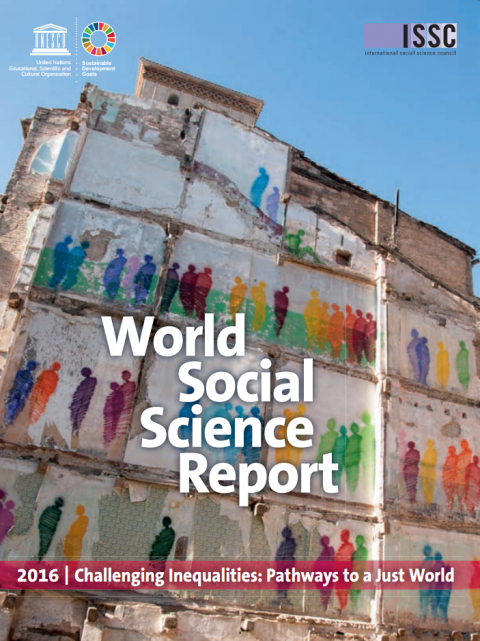 World social science report, 2016: Challenging inequalities; pathways to a just world Год публикации: 2016 Организация-автор: UNESCO Never before has inequality been so high on the agenda of policy-makers worldwide, or such a hot topic for social science research. More journal articles are being published on the topic of inequality and social justice today than ever before. This Report draws on the insights of over 100 social scientists and other thought leaders from all over the world, across various disciplines, to emphasize transformative responses to inequality at all levels, from the grass roots to global governance. Too many countries are investing too little in researching the long-term impact of inequality on the sustainability of their economies, societies and communities. Unless we address this urgently, inequalities will make the cross-cutting ambition of the Sustainable Development Goals (SDGs) to ‘leave no one behind’ by 2030 an empty slogan.
  2017 CCNGO, Education 2030: implementing SDG4-Education 2030; Global meeting declaration Год публикации: 2017 Организация-автор: Organización de las Naciones Unidas para la Educación, la Ciencia y la Cultura (UNESCO) | Collective Consultation of NGOs on Education for All We, the representatives of national, regional and international non-governmental and civil society organisations and members of the Collective Consultation of NGOs (CCNGO) for Education 2030 from different parts of the world have gathered in Siem Reap, Cambodia on 8 and 9 May 2017.We re-affirm that education is a fundamental human right and a public good that is key to promoting social, economic and environmental justice. States have the duty to provide free quality equitable public education at all levels and lifelong learning for all, and to ensure the right to education is enshrined in law and enforceable.We have met to take stock and discuss the implementation of SDG4-Education 2030 since its adoption and make recommendations. Participants discussed initiatives undertaken, key challenges encountered, opportunities identified and ways forward, as well as debated the role of civil society organizations in supporting the implementation of SDG4-Education 2030 at national, regional and global levels, and the contributions of the CCNGO in this regard. We furthermore agreed upon the revised working procedures of the CCNGO in light of SDG4-Education 2030 and elected a new CCNGO Coordination Group for 2017- 2019. In this context, we reaffirm:· Our endorsement of the vision, principles, goals and targets laid out under SDG 4 within ‘The 2030 Agenda for Sustainable Development’; the Incheon Declaration; the ‘Education 2030 Framework for Action’; and the 2015 Incheon Final Declaration of the NGO Forum;· The important role of civil society organisations in the implementation of SDG4-Education 2030, and their engagement and involvement at all stages, from policy formulation and planning through to monitoring and evaluation with their participation institutionalized and guaranteed, as stated in the Education 2030 Framework for Action.
  Mainstreaming SDG4-Education 2030 in sector-wide policy and planning: technical guidelines for UNESCO field offices Год публикации: 2016 Организация-автор: UNESCO The main responsibility for implementing the SDG4-Education 2030 Agenda lies with governments, with UNESCO and partners providing support through coordinated policy advice, technical assistance, capacity development and monitoring of progress at global, regional and national levels. By their position, UNESCO field offices have a key role to play in providing such support at country level and therefore require adequate technical capacity to fulfil their mission.These guidelines aim at providing a basic resource to field offices for ensuring adequate technical support to national authorities in this process. In doing so, it takes into account different profiles of country needs and capacities, thus avoiding a one-size-fits-all approach. Countries may have different levels of awareness of, or political commitment to, Sustainable Development Goal 4 (SDG4). In all cases, UNESCO is expected to ensure that all the relevant information about SDG4-Education 2030 is properly disseminated and that national authorities and stakeholders are reminded of its importance. To assist field offices in this task UNESCO has developed and made available a number of resources and support materials, notably the Unpacking SDG4-Education 2030 Guide, parts of which are excerpted here, and will continue coordination efforts in this respect.Inevitably, field staff will have to adapt the guidelines provided here to the reality of the country they are serving. That is why this document is full of resources and pointers that can be combined and tailored to fit the particular context of each country. At the same time, field staff are invited to require additional technical guidance from the corresponding regional bureaus, which can rely on the backstopping of Headquarters services and support from the specialized institutes.These guidelines represent a first attempt to provide specific directions and resources to allow field offices to technically support Member States. After a first evaluation, in which all field staff are invited to participate, the guidelines will be improved so as to make them even more suitable and useful. They will also be supplemented with other material to ensure that UNESCO plays its role as the leading United Nations agency in the field.
 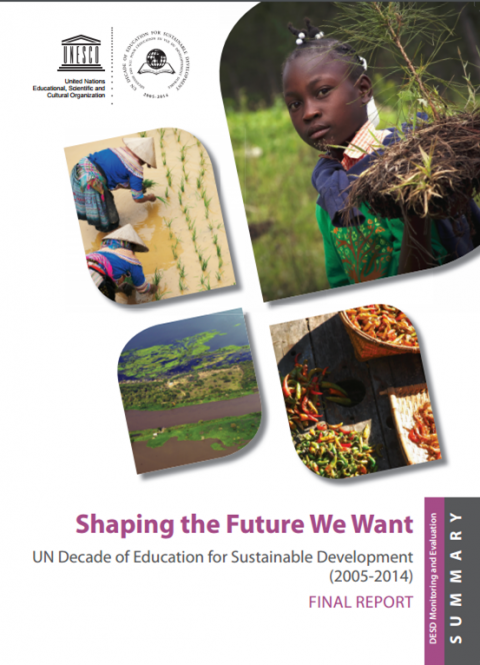 Shaping the future we want: UN decade of education for sustainable development (2005-2014); final report; summary Год публикации: 2014 Автор: Carolee Buckler | Heather Creech Организация-автор: UNESCO This summary for policy- and decision-makers provides a brief overview of the key findings and trends, a synopsis of highlights, challenges and actions across all levels and areas of education, and steps for scaling up actions presented in the UNESCO 2014 Global Monitoring and Evaluation Final Report, Shaping the Future We Want – UN Decade of Education for Sustainable Development (2005-2014). The Final Report provides an assessment of progress towards embedding education for sustainable development (ESD) into education systems and into sustainable development efforts. Building on the findings of the past two DESD Global Monitoring and Evaluation reports, and based upon Member States’ and other stakeholders’ assessments of the current state of ESD, the Final Report maps the achievements and challenges of a decade of progress and action on ESD at the global, national, regional and local levels, and within all areas and levels of education. The Final Report concludes that a solid foundation has been laid for ESD at the end of the DESD, achieved by raising awareness, influencing policies and generating significant numbers of good practice projects in all areas of education and learning. At the end of 10 years of work, 10 key findings and trends have emerged that will guide ESD into the future. The report also shows that despite the successes, a full integration of ESD into education systems has yet to take place in most countries.
 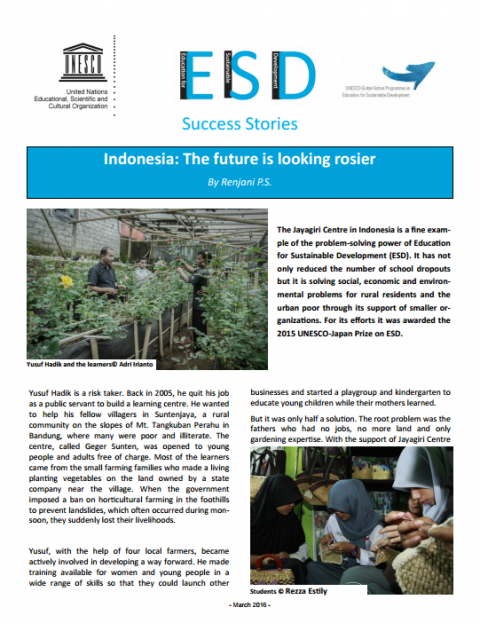 Indonesia: the future is looking rosier Год публикации: 2016 Автор: P.S. Renjani Организация-автор: UNESCO ESD Success Stories are showcasing compelling stories with a personal/human dimension from all five UNESCO regions (Africa, Arab States, Asia and Pacific, Europe & North America and Latin America & the Caribbean). The stories illustrate the wide diversity of ESD approaches and initiatives taking place in different parts of the world. They show how involvement with ESD has changed the lives of specific individual persons and how they have become more active in their community. Each story centers on one individual or a group of individuals.The Jayagiri Centre in Indonesia teaches environment-friendly business skills. It helps reduce the number of school dropouts and supports rural residents.
 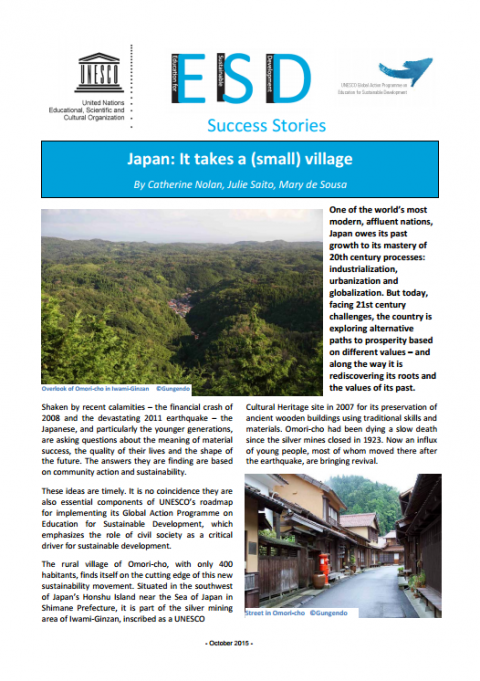 Japan: it takes a (small) village Год публикации: 2015 Автор: Catherine Nolan | Julie Saito | Mary de Sousa Организация-автор: UNESCO ESD Success Stories are showcasing compelling stories with a personal/human dimension from all five UNESCO regions (Africa, Arab States, Asia and Pacific, Europe & North America and Latin America & the Caribbean). The stories illustrate the wide diversity of ESD approaches and initiatives taking place in different parts of the world. They show how involvement with ESD has changed the lives of specific individual persons and how they have become more active in their community. Each story centers on one individual or a group of individuals.The small village of Omori-cho in Japan explores alternative paths to prosperity based on community action and sustainability.