
Ресурсы
Изучайте широкий спектр ценных ресурсов ВГГ, чтобы углубить своё понимание и повысить эффективность исследований, просветительской деятельности, преподавания и обучения.
Найдено: 180
 Etnomatemática africana Год публикации: 2014 Автор: María del Carmen Ararat Córdoba | Alexandra Riveros Rueda | Andrés Eduardo González | Arturo Grueso Bonilla | Ángela Patricia Valencia Salas Организация-автор: Bogotá. Secretaría de Educación del Distrito (SED) These materials contribute with contents and select activities help teachers get comfortable with the study of the Afro-Colombian culture, helping to include this knowledge into their curricular plans. The first material is a book written by the teacher Maria del Carmen Ararat Córdoba, which studies Afro-Colombian identities in Colombia. The second one is called ethno science, a pedagogical perspective of the Afro-Colombian studies for the teaching process of natural science, in which raises a science that recognizes that each group of people that has habited our world has made a meaningful explanation of their surroundings. The third one is called African Ethno mathematics, which seeks to recover the relation between mathematical knowledge and reality, making visible the human groups that made it possible and finding new pedagogical perspectives to make the experience of teaching mathematics as inclusive, intercultural and participative process.
  E-learning Diversité & Inclusion Организация-автор: UPANDGO Sur ce site vous trouverez des modules e-learning, micro-learning, jeux de sensibilisation, quiz diversité sur la question de l'inclusion et la diversité. Cette approche parfois décalée et ludique vous permet d’aborder cette thématique sereinement et de mobiliser efficacement vos collaborateurs. On this site you'll find e-learning modules, micro-learning, awareness-raising games and diversity quizzes on the subject of inclusion and diversity. This sometimes offbeat and playful approach enables you to tackle this issue with peace of mind and effectively mobilize your employees.
  Guide de la Diversité, de l'Equité et de l'Inclusion Год публикации: 2023 Автор: Michelle Norman Организация-автор: Suntory Beverage & Food Europe En promouvant la diversité au sein de nos équipes, ainsi qu’en embrassant des valeurs et des idées différentes, nous sommes convaincus de pouvoir créer les meilleures conditions pour que chacun s’épanouisse dans son travail et puisse y déployer tout son potentiel. Ce guide est une ressource pour vous sensibiliser aux thèmes structurants de la Diversité, de l’Equité et de l’Inclusion. Il s’agit d’un outil pédagogique permettant à chacun de comprendre l’essence même du sujet et vous donner les bases pour agir de manière significative au quotidien. Vous y découvrirez nos 5 engagements prioritaires, ainsi qu’un décryptage des différentes notions de DE&I pour mieux comprendre les identités et mieux identifier les comportements discriminatoires. By promoting diversity within our teams, as well as embracing different values and ideas, we are convinced that we can create the best conditions for everyone to flourish in their work and develop their full potential. This guide is a resource to raise your awareness of the structuring themes of Diversity, Equity and Inclusion. It's an educational tool to help you understand the very essence of the subject, and to give you the foundations to take meaningful action on a daily basis. You will discover our 5 priority commitments, as well as a decoding of the different notions of DE&I to better understand identities and better identify discriminatory behavior.
  Cultural Diversity and Interculturality in Higher Education. Experiences in Latin America Год публикации: 2008 Автор: Daniel Mato Организация-автор: UNESCO International Institute for Higher Education in Latin America and the Caribbean (IESALC) The work that we present below under the title Cultural Diversity and Interculturality in Higher Education. Experiences in Latin America offers a documented and novel analysis on the subject, accompanied by more than thirty studies on concrete experiences that allow to appreciate the richness and vitality that this field exhibits in Latin America, as well as the problems and challenges it faces. The volume brings together thirty-six studies of experiences of the types mentioned, each of which identifies achievements, obstacles and learning, and culminates in offering recommendations. This collection of texts is preceded by a study of regional scope that analyzes significant contextual elements, as well as salient aspects of the studied experiences, evaluates problems, challenges and opportunities, and offers a set of recommendations. Diversidad Cultural e Interculturalidad en Educación Superior. Experiencias en América Latina Год публикации: 2008 Автор: Daniel Mato Организация-автор: UNESCO International Institute for Higher Education in Latin America and the Caribbean (IESALC) La obra que a continuación presentamos bajo el título Diversidad Cultural e Interculturalidad en Educación Superior. Experiencias en América Latina ofrece un documentado y novedoso análisis sobre el tema, acompañado de más de treinta estudios sobre experiencias concretas que permiten apreciar la riqueza y vitalidad que este campo exhibe en América Latina, así como los problemas y desafíos que enfrenta. El volumen reúne treinta y seis estudios de experiencias de los tipos mencionados, cada uno de los cuales identifica logros, obstáculos y aprendizajes, y culmina ofreciendo recomendaciones. Esa colección de textos es precedida por un estudio de alcance regional que analiza elementos contextuales significativos, así como aspectos salientes de las experiencias estudiadas, evalúa problemas, retos y oportunidades, y ofrece un conjunto de recomendaciones.
  The Clandestine Schools in Ecuador. Roots of Intercultural Indigenous Education Год публикации: 2015 Автор: María Isabel González Terreros By the mid-twentieth century in Ecuador, indians implemented clandestine schools to teach their people. Those schools were persecuted and harassed by landowners, who did not see pertinent that indians were educated. This was a pioneering, innovative and different project. Pioneer because it is the first known project with these features in Ecuador; innovative because it was leaded by Indians who took their cultural background to school (such as the teaching of ancestral language and some knowledge about nature and territory); and different because it was a proposal contrary to the homogenizing and assimilationist education that the Nation-state was implementing in rural areas. That proposal was led by Dolores Cacuango, a Quechua Indian who was subject to the hacienda system (in which communities did farm work for the employer, in exchange for a piece of land to live in with their families). She, who suffered injustice and had no chance to go to school, insisted that children and young people should "learn letter" (that is, they should learn Castilian). Las Escuelas Clandestinas en Ecuador. Raíces de la Wducación Indígena Intercultural Год публикации: 2015 Автор: María Isabel González Terreros A mediados del siglo xx en Ecuador los indígenas implementaron escuelas clandestinas para enseñar a los suyos, escuelas que fueron perseguidas y hostigadas por los hacendados que no veían pertinente que los indígenas se educaran. Se trató de un proyecto pionero, novedoso y diferente. Pionero porque es el primero que se conoce con estas características en el Ecuador; novedoso porque fue dirigido por indígenas que llevaron los saberes culturales a la escuela, como la enseñanza del idioma ancestral y algunos conocimientos sobre la naturaleza y el territorio; y diferente porque fue una propuesta contraria a la educación homogeneizante y asimilacionista que el Estado-nación implementaba en zonas rurales. Esta propuesta fue dirigida por Dolores Cacuango, una indígena kichwa que estuvo sometida al sistema de hacienda, en el que las comunidades realizaban trabajos agrícolas para el patrón a cambio de tener un pedazo de tierra y vivir con sus familias. Ella, que vivió la injusticia y no tuvo la posibilidad de ir a la escuela, se empeñó en que los niños y jóvenes “aprendieran letra”.
 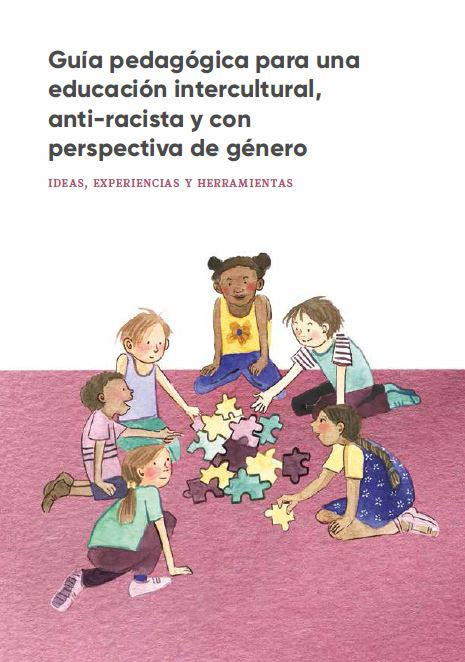 Pedagogical Guide for an Intercultural, Anti-racist and Gender Perspective Education: Ideas, Experiences and Tools Год публикации: 2017 Автор: Carolina Stefoni | Andrea Riedemann | Fernanda Stang | Andrea Guerrero | Antonia Garcés | Marta Camarena Организация-автор: Programa Interdisciplinario de Estudios Migratorios (PRIEM) | Universidad Alberto Hurtado | Fundación para la Superación de la Pobreza (FUSUPO) The main purpose of this Guide is, then, to share some ideas, tools and experiences that can help build and walk the path towards an intercultural, anti-racist and gender perspective education in various educational spaces. It is directed primarily - though not exclusively, of course - to all those people who are part of formal and informal teaching-learning processes. It is important to emphasize that the Guide does not pretend to be a recipe for a mechanical application, but a tool box that each educational community can use considering its specific context, its particular needs and its potentialities. Guía pedagógica para una educación intercultural, anti-racista y con perspectiva de género: ideas, experiencias y herramientas Год публикации: 2017 Автор: Carolina Stefoni | Andrea Riedemann | Fernanda Stang | Andrea Guerrero | Antonia Garcés | Marta Camarena Организация-автор: Programa Interdisciplinario de Estudios Migratorios (PRIEM) | Universidad Alberto Hurtado | Fundación para la Superación de la Pobreza (FUSUPO) El propósito principal de esta Guía es, entonces, compartir algunas ideas, herramientas y experiencias que puedan ayudar a construir y andar el camino hacia una educación intercultural, anti-racista y con perspectiva de género en diversos espacios educativos. Está dirigida principalmente -aunque no de manera exclusiva, por supuesto- a todas aquellas personas que sean parte de procesos de enseñanza-aprendizaje formales e informales. Es importante enfatizar que la Guía no pretende ser un recetario para una aplicación mecánica, sino una caja de herramientas que cada comunidad educativa puede usar considerando su contexto específico, sus necesidades particulares y sus potencialidades. Discours de Mme Irina Bokova, Directrice Générale de l'UNESCO, à l'occasion de la Conférence sur L'Education au Service du Développement Durable en Appui à la Diversité Culturelle et Biologique, Oman, 24 Janvier 2011 Год публикации: 2011 Организация-автор: UNESCO. Director-General, 2009-2017 (Bokova, I.G.) This address was given by Irina Bokova, Director-General of UNESCO on the occasion of the Conference on Education for Sustainable Development in Support of Cultural and Biological Diversity.