
Ресурсы
Изучайте широкий спектр ценных ресурсов ВГГ, чтобы углубить своё понимание и повысить эффективность исследований, просветительской деятельности, преподавания и обучения.
Найдено: 276
 One country, many cultures! Does Holocaust education have an impact on pupils' citizenship values and attitudes? The Holocaust has been regarded as the defining moment of modern history and perhaps of all time. For most people it still evokes the ultimate in barbarism and inhumanity. The focus of this paper is to examine the impact that Holocaust education has on citizenship values in the primary and secondary stages of schooling. Previous research on teaching the Holocaust, primarily case studies in either the primary or the secondary sectors, suggests that the contribution of Holocaust education to citizenship includes developing pupils' understanding of the notion of justice, tolerance and the many forms of racism and discrimination, and provides opportunities for developing the positive values of empathy, awareness of antiracism, and an understanding that the individual can make a difference. Further, it can make a significant contribution to citizenship in developing pupils' awareness of human rights issues and genocides, the concepts of stereotyping and scapegoating and the exercise of power in local, national and global contexts. Our ongoing longitudinal research (sponsored by the Scottish Executive Education Department and running from November 2003 until summer 2005) aims to examine the value of Holocaust education in achieving aspects of citizenship. It is concerned with the immediate and longer term effects of Holocaust education on pupils' values and attitudes. Initially focused on primary pupils aged 11-12 years, it will follow them into secondary and compare their values and attitudes with pupils in their year who did not study the Holocaust in their primary schools. The proposed paper, which will report on the first stages of this ongoing research, will concentrate on: the relevance of Holocaust education to citizenship; the research methodology; the first results of the understanding of pupils and the impact of Holocaust teaching; tentative conclusions. (By the author) Educator Resources from Facing History and Ourselves Facing History and Ourselves fights racism, antisemitism, and prejudice and nurtures democracy through education programmes worldwide, with specific focus on the history of the Holocaust and other examples of genocide and mass violence. Facing History proposes various resources, workshops, seminars and online learning opportunities for educators and students. Ressources éducateur de Face à l'histoire et nous-mêmes « Face à l'histoire et nous-mêmes » lutte contre le racisme, l'antisémitisme et les préjugés et nourrit la démocratie grâce à des programmes d'éducation dans le monde entier, avec un aCECnt particulier sur l'histoire de l'Holocauste et d'autres exemples de génocide et la violence de masse. « Face à l'histoire » propose diverses ressources, des ateliers, des séminaires et des possibilités d'apprentissage en ligne pour les enseignants et les étudiants.
  Teaching the Holocaust: The relevance of children's perceptions of Jewish culture and identity The Holocaust is now part of the history curriculum for all 11-14-year olds in maintained schools in England and Wales. In this paper it is argued that for the Holocaust to be taught effectively, teachers will need to have some idea of how children within this age group perceive Jewish culture and identity. The empirical core of the paper attempts to go some way towards meeting this need. Seventy-two children aged between 12 and 14 were interviewed in order to explore their knowledge of Judaism, the nature of any misconceptions they may have about the faith, the extent to which they appreciate the commonalities between Judaism and Christianity and their awareness of anti-Semitism. The paper concludes with a discussion of the policy implications of the findings. (By the author)
  The role of the Holocaust in antiracist education: A view from the United Kingdom The failure of antiracist educators in the United Kingdom to engage seriously with the issue of anti‐Semitism provides the background to this article. With specific reference to the Holocaust, it argues that a lack of interest among antiracists in how the subject is taught has had a number of adverse consequences. These include the forfeiture of a potent vehicle for reinforcing and advancing the aims of antiracism and the loss of the unique contribution that a study of the Holocaust can make to an understanding of racism. Lack of interest in the Holocaust has also meant that inadequate consideration has been given to the consequences for antiracist education of the subject being taught badly. To obviate these drawbacks, the article advocates a definition of racism that can embrace anti‐Semitism and thereby facilitate the involvement of antiracists in teaching about the attempted annihilation of European Jewry. (By the author)
 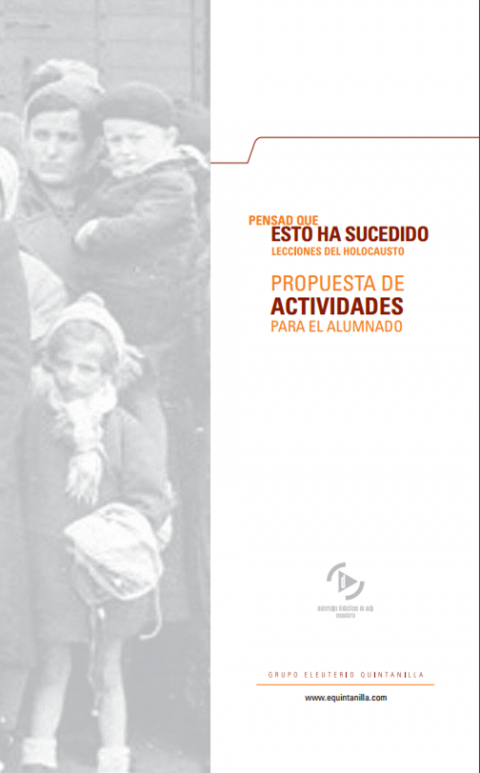 Pensad que esto ha sucedido : lecciones del Holocausto : Propuesta de actividades para el alumnado Год публикации: 2007 Организация-автор: Grupo Eleuterio Quintanilla This resource guide published by the Spanish anti-racist association "Grupo Eleuterio quintanilla" was developed for teachers to broach the Holocaust by examining the historical process and its circumstances through legal and historiographical documents. Pensad que esto ha sucedido : lecciones del Holocausto : Propuesta de actividades para el alumnado Год публикации: 2007 Организация-автор: Grupo Eleuterio Quintanilla This resource guide published by the Spanish anti-racist association "Grupo Eleuterio quintanilla" was developed for teachers to broach the Holocaust by examining the historical process and its circumstances through legal and historiographical documents. Pensez ce cours s'est passé de l'Holocauste: les activités proposées pour les étudiants Год публикации: 2007 Организация-автор: Grupo Eleuterio Quintanilla Ce guide de ressources publiées par l'association anti-raciste espagnol "Grupo Eleuterio Quintanilla" a été développé pour les enseignants à aborder l'Holocauste en examinant le processus historique et sa situation par le biais de documents juridiques et historiographiques.
  Meeting a moral imperative. A rationale for teaching the Holocaust A primary rationale for studying the Holocaust (Shoah) involves the opportunity to consider the moral implications that can be drawn from examining the event. Studying the Shoah forces students to consider what it means to be human and humane by examining the full continuum of individual behavior, from ultimate evil to ultimate good. This article discusses several implications involved in studying the event, while proposing that a moral imperative exists for the presence of Holocaust education in contemporary classrooms. (By the publisher) Holocaust education: An investigation into the types of learning that take place when students encounter the Holocaust This study employs qualitative methods to investigate the types of learning that occurred when students in a single school encountered the Holocaust. The study explored the experiences of 48 students, together with two of their teachers and a Holocaust survivor who visited the school annually to talk to the students. A thematic analysis was conducted to identify prevalent similarities in the students’ responses. Three themes were identified, analysed and discussed. The three themes were: ‘surface level learning’ (their academic knowledge and understanding of the Holocaust), ‘affective learning’ (their emotional engagement with the topic) and ‘connective learning’ (how their encounter with the Holocaust fitted their developing worldview). The first theme revealed that students had a generally sound knowledge of the Holocaust, but there were discrepancies in the specifics of their knowledge. The second theme revealed that learning about the Holocaust had been an emotionally traumatic and complicated process. It also revealed that meeting a Holocaust survivor had a significant impact upon the students, but made them begin to question the provenance of different sources of Holocaust learning. The third theme showed that students had difficulty connecting the Holocaust with modern events and made flawed connections between the two. Finally, the study examines the views of the Holocaust survivor in terms of his intentions and his reasons for giving his testimony in schools. The study’s conclusions are drawn within the context of proposing a new conceptualization of the Holocaust as a ‘contested space’ in history and in collective memory. A tripartite approach to Holocaust Education is suggested to affect high quality teaching within the ‘contested space’ of the event. (By the author)