
Ресурсы
Изучайте широкий спектр ценных ресурсов ВГГ, чтобы углубить своё понимание и повысить эффективность исследований, просветительской деятельности, преподавания и обучения.
Найдено: 3,530
 Escribe por los derechos: Conjunto de materiales para la educacion ed derechos humanos Год публикации: 2015 Организация-автор: Amnesty International This education pack contains five activities on human rights for young people. It can be used as an introduction to human rights, to global solidarity, to campaigning and activism, and to the wider work of Amnesty International. The activities provide a broad perspective on these issues and others.They are useful in opening young people’s minds to global concerns and involving them in actions which can have a real impact on people’s lives.The activities can be run at any time, but will be most effective either before or during the time of Amnesty International’s ‘Write for Rights’ campaign, which this year runs from 4 to 17 December. By working on these cases and taking part in the campaign, young people will know that they are part of a massive global movement of people. They – and you – can bring about a real improvement in the lives of the people featured in the following pages. Écrire pour les droits: Dossier pour l’éducation aux droits humains Год публикации: 2015 Организация-автор: Amnesty International This education pack contains five activities on human rights for young people. It can be used as an introduction to human rights, to global solidarity, to campaigning and activism, and to the wider work of Amnesty International. The activities provide a broad perspective on these issues and others.They are useful in opening young people’s minds to global concerns and involving them in actions which can have a real impact on people’s lives.The activities can be run at any time, but will be most effective either before or during the time of Amnesty International’s ‘Write for Rights’ campaign, which this year runs from 4 to 17 December. By working on these cases and taking part in the campaign, young people will know that they are part of a massive global movement of people. They – and you – can bring about a real improvement in the lives of the people featured in the following pages.
  The Write for Rights: A Human Rights Education Pack Год публикации: 2015 Организация-автор: Amnesty International This education pack contains five activities on human rights for young people. It can be used as an introduction to human rights, to global solidarity, to campaigning and activism, and to the wider work of Amnesty International. The activities provide a broad perspective on these issues and others.They are useful in opening young people’s minds to global concerns and involving them in actions which can have a real impact on people’s lives.The activities can be run at any time, but will be most effective either before or during the time of Amnesty International’s ‘Write for Rights’ campaign, which this year runs from 4 to 17 December. By working on these cases and taking part in the campaign, young people will know that they are part of a massive global movement of people. They – and you – can bring about a real improvement in the lives of the people featured in the following pages.
  Educating Students about the Holocaust: A Survey of Teaching Practices More than half a century has passed since the horrific events of the Holocaust took place, but images of the state-sponsored, systematic persecution and annihilation of European Jewry by Nazi Germany are no less shocking than they were 60 years ago. Any discussion of the Holocaust inevitably leads to questions of not only how and why this event occurred in the modern era but, more importantly, how the legacy of the Holocaust can continue to raise international awareness of human rights abuses and genocide. One way of achieving this awareness is by providing holocaust education to the nation's young people. While this objective has obtained widespread support, there has been an absence of reliable nationwide information on how the Holocaust is actually taught in U.S. schools. This article attempts to fill that gap by presenting the results of a yearlong study commissioned by the United States Holocaust Memorial Museum of teaching practices in Holocaust education in the nation's secondary public schools in 2003-04. The study assessed secondary teaching practices in middle and high schools in the field of Holocaust education, and investigated teachers' rationales for teaching about the Holocaust. (By the publisher) Menschenrechtsbildung in NS-Gedenkstätten. Neue pädagogische Überlegungen zum Lernen aus der Geschichte des Nationalsozialismus Learning from history means acting with historical awareness in both the present and future, making decisions and taking knowledge of the past into account and developing greater sensitivity for current processes in light of what has gone before. The contemporary relevance and subject relations are decisive prerequisites for learning about history. Without integrating the addressee's identity within the learning process, without any reference to facts of significance of subjective importance to the learner, all educational efforts will fail to bear fruit. This problem is more relevant than ever as far as historico-political education at memorial sites for Holocaust victims is concerned. The pedagogical approach to Holocaust memorial sites is currently facing an educational challenge in the light of the increasing chronological distance to the historical events and their multi-ethnic audience. Although a discussion of National Socialist history continues to constitute an important focus in both schools and the public domain, the results of empirical studies attest to significant gaps in knowledge. Furthermore, in an international comparison, German teenagers demonstrate considerably less interest in the National Socialist era than those from other countries. Instead of displaying an interest in this aspect of history, they react defensively and state that they are "sick and tired" of the topic. In the face of such developments, the question of the direction which the pedagogical approach to holocaust memorial sites will take in future arises. In order to integrate connections between past and present more deliberately, those involved in running Holocaust memorial sites are considering placing a stronger focus on human rights education. The fusion of both disciplines is designed to provoke more intense contemporary historical discussion and thus prompt a subjectively significant learning process. The present research project concentrates on the question of the extent to which this approach can be implemented and on the areas of tension which may arise in the practice of memorial site education as a result. Human rights education at holocaust memorial sites ‒ the concept sounds promising. The terms reflect precisely what one would expect of the historico-political education at Holocaust memorial sites offered by a free and democratic constitution: the opportunity to learn lessons for the present from past crimes. This research project seeks to close a gap. Its aim is to develop a comprehensive model of human rights education at Holocaust memorial sites, analyse areas of tension and potential and, finally provide suggestions for the further development of educational practice. In consequence, the research project is located firmly within practical research. In order to answer the question posed in an adequate manner, diverse qualitative methods were required. It follows that results obtained via participatory observation, expert interviews and group discussion processes form the basis of my deliberations. (By the author)
  The layering of knowledge, memory, and understanding. Using Berlin’s ‘Places of Remembrance’ memorial to teach about the Holocaust Carson Phillips offers detailed and specific suggestions for teaching about the Berlin memorial described in Pnina Rosenberg’s essay (pp. 90–96), along with extended learning opportunities that feature contemporary encounters with, and the meaning of, that and two additional exhibits. “This educational unit,” he writes, “is designed to develop the critical thinking skills of students, to elucidate the complexities of the Holocaust, and to examine the range of human responses to it.” An invaluable aid for educators is the appendix with the text of decrees originally imposed between 1933 and 1945. (By the publisher)
  Mémorial de la Shoah - Musée, Centre de documentation juive contemporaine The Shoah Memorial provides access to various resources on the Holocaust, mostly in French.
 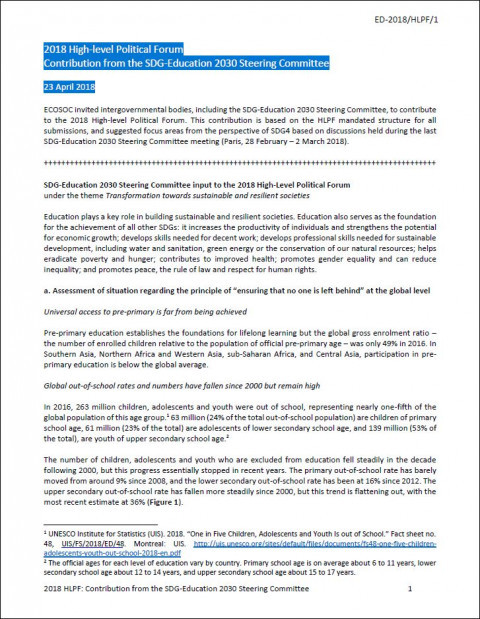 2018 High-level Political Forum: Contribution from the SDG-Education 2030 Steering Committee Год публикации: 2018 Организация-автор: SDG-Education 2030 Steering Committee ECOSOC invited intergovernmental bodies, including the SDG-Education 2030 Steering Committee, to contribute to the 2018 High-level Political Forum. This contribution is based on the HLPF mandated structure for all submissions, and suggested focus areas from the perspective of SDG4 based on discussions held during the last SDG-Education 2030 Steering Committee meeting (Paris, 28 February – 2 March 2018). Developing reflective citizens: The role of Holocaust education In what way can we best conceptualize the relationship of Holocaust education to the broader goal of developing reflective citizens? Keeping in mind the diversity of our audience while simultaneously recognizing the traditions of social studies education in the United States, the author argues that Holocaust education should be integrated within the rationale of educating young people to reflect upon issues that have direct relationships to (1) the development of values and (2) the fostering of behaviours emphasizing social responsibility. In short, Holocaust education ‒ meaning the design of curricula, creation of pedagogical strategies and evaluation of student performance ‒ can be a critical component in developing a citizenry who are capable of addressing global problems such as human rights violations and genocide by employing a reflective understanding of history and its relationships to present and future policies and practices, irrespective of national boundaries (By the author) Les élèves face à la Shoah : lieux, histoire, voyage Teaching the Holocaust is not easy. All teachers know it. In order to develop new forms of teaching, some have found a solution: leave the classroom and go with their students to visit places of memory. This approach, at a time when travel in general is developing, is increasingly popular. Its success has helped fuel a debate: what is the impact on students participating in these visits? What does the teacher need to do to prepare and to conduct such a trip to a memorial site? This books addresses the subject from the French perspective, and also from the English, Belgian, Spanish, Italian, Swiss, and Israeli point of view. Auschwitz is the main focus, but other places are also examined. (By the publisher - Translation)