
Ресурсы
Изучайте широкий спектр ценных ресурсов ВГГ, чтобы углубить своё понимание и повысить эффективность исследований, просветительской деятельности, преподавания и обучения.
Найдено: 1,725
 Including Education in the Pact for the Future: An SDG 4 Youth & Student Network Contribution Год публикации: 2024 Автор: Laeek Siddiqui | Juliette Gudknecht | Daniela Moreno Farfán | Azkha Mikdhar Организация-автор: SDG 4 Youth & Student Network | UNESCO Inclusion is the promise towards a fair and equitable education for all. It is critical to ensuring that every youth and student succeeds. Highlighted by UNESCO in the 2020 Global Education Monitoring Report, striving towards inclusive education is non-negotiable, as education is a human right. With the current challenges of our world highlighted in the 2030 Agenda, specifically in the areas of poverty, armed conflict and digital transformation, inclusion must be an essential imperative in all policies. The Summit of the Future (SOTF) convenes on the 22 to 23 of September at the United Nations Headquarters in New York, United States. One of its outcomes, if inter-governmentally agreed-upon, would be the Pact for the Future. The Pact is action-oriented, including a chapeau followed by 5 chapters: 1) sustainable development and financing for development; 2) international peace and security; 3) science, technology and innovation and digital cooperation; 4) youth and future generations; and 5) transforming global governance. Along with the Pact are two annexures: the Global Digital Compact and the Declaration on Future Generations. This document introduces the advocacy of the SDG 4 Youth & Student Network – a network hosted by the United Nations Educational, Scientific and Cultural Organization (UNESCO) as the Global Education Cooperation Mechanisms Inter-Agency Secretariat – for inclusive and equitable education at the SOTF, to uphold peace, sustainable development, youth and future generations. It is essential to #IncludeEducation in the Pact and the outcomes of the SOTF for our #InclusiveFuture, to ensure that no one is left behind. It brings attention to how education is essential to global cooperation and empowering future generations, calling upon you to join us in supporting inclusive education systems, with the Global Education Meeting convened by UNESCO side by side with the G20 meeting on 31 October and 1 November 2024 in Fortaleza, Brazil.
  Mainstreaming Social and Emotional Learning in Education Systems: Policy Guide; Highlights Год публикации: 2024 Организация-автор: UNESCO UNESCO’s policy guide unpacks social and emotional learning (SEL) as a broadening of the educational process, from a focus on cognitive aspects to a balance between cognitive, social and emotional, and behavioural dimensions of learning, putting forward initial action ideas to guide its systematic mainstreaming in education. It builds on and extends previous work undertaken by UNESCO on SEL from the perspective of Global Citizenship Education (GCED) and Education for Sustainable Development (ESD), Building Strong Foundations for Health and Well-being Education, the Happy Schools Framework, and in multiple UNESCO Offices and Institutes.
 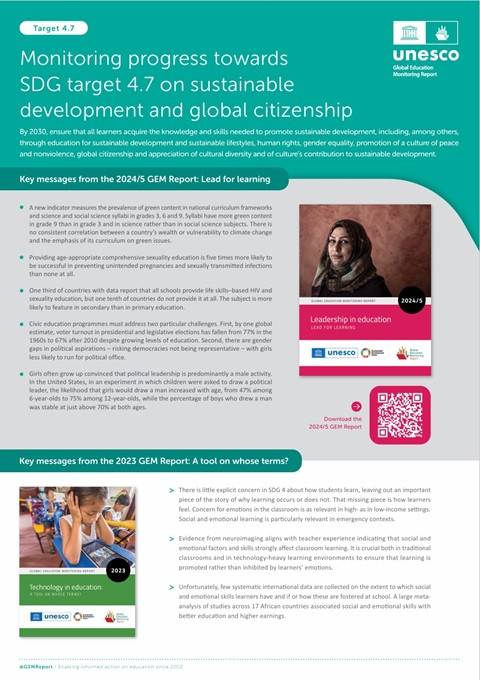 Monitoring Progress towards SDG Target 4.7 on Sustainable Development and Global Citizenship Год публикации: 2024 Организация-автор: UNESCO | Global Education Monitoring Report Team This document introduces key messages from the GEM Reports and other related publications and online resources regarding the progress towards SDG Target 4.7.
 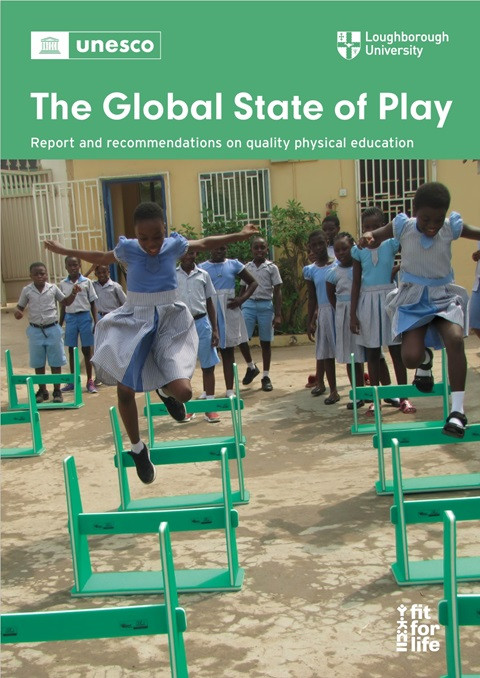 The Global State of Play: Report and Recommendations on Quality Physical Education Год публикации: 2024 Организация-автор: UNESCO | Loughborough University Active lifestyles are key to ensuring both individual well-being and sustainable, social development. Quality Physical Education (QPE) plays a key role in achieving this by fostering lifelong physical activity, improving young people’s mental and emotional well-being, and developing critical life skills. UNESCO’s sport initiative, Fit for Life, advocates QPE as a cost-effective investment. Despite its potential as a core curricula subject, UNESCO data reveal that PE is often under-prioritized and due to a lack of investment in certain areas, such as staff training and facilities, potential benefits are not fully realised for students around the world. This investment gap connects directly to a delivery gap. Although 83% of countries worldwide report PE as compulsory in schools, there remain significant issues with the quality of delivery and the diversity of lesson planning within curricula:• Only 1 in 3 secondary school students worldwide meet the minimum requirement of 180 minutes of PE minutes per week set out in UNESCO’s Quality Physical Education Policy Guidelines.• Only 61.7% of schools fully include students with disabilities alongside their peers without disabilities in PE classes.• Only 7.1% of schools implement equal PE time for boys and girls, despite 54.5% of countries having policies or plans for it. Policymakers, PE practitioners and academia are encouraged to take action to implement PE policies, increase investment in PE, upskill PE teachers, enhance PE curricula and promote more equitable and inclusive PE environment.
  Global Education Meeting: Fortaleza Declaration; Unlocking the Transformative Power of Education for Peaceful, Equitable and Sustainable Futures Год публикации: 2024 Организация-автор: UNESCO | Brazil. Ministry of Education The 2024 Global Education Meeting (GEM), held in Fortaleza, Brazil, marked a significant milestone in the global pursuit of education equity and financing, with the adoption of the powerful Fortaleza Declaration by over 650 participants including over 50 Ministers from across the globe. Reunión mundial sobre la educación: Declaración de Fortaleza; Aprovechar el poder transformador de la educación para forjar futuros pacíficos, equitativos y sostenibles Год публикации: 2024 Организация-автор: UNESCO | Brazil. Ministry of Education Este documento recoge la declaración de los ministros, los jefes y los miembros de las delegaciones nacionales, los representantes de los organismos de las Naciones Unidas, los asociados humanitarios y para el desarrollo, las organizaciones internacionales y regionales, las organizaciones de la sociedad civil, la profesión docente, los jóvenes y los estudiantes, el sector privado y las fundaciones, a partir de su participación en la Reunión Global sobre Educación (GEM) 2024, llevada a cabo los días 31 de octubre y 1° de noviembre. Esta reunión, organizada por la UNESCO y con sede en Brasil, tuvo el propósito de trazar la ruta para que la educación sea la prioridad de las naciones, las regiones y el mundo como un elemento clave para alcanzar todos los ODS, adoptando un enfoque integrado y de aprendizaje permanente, centrado en el fortalecimiento y la transformación de la educación.
  Guidelines for the governance of digital platforms: safeguarding freedom of expression and access to information through a multi-stakeholder approach Год публикации: 2023 Организация-автор: UNESCO Guidelines for an Internet for TrustSafeguarding freedom of expression and the right to information while dealing with dis- and misinformation, hate speech, and conspiracy theories requires a multistakeholder approach. This is the reason why UNESCO, the leading UN agency for the promotion and protection of freedom of expression and to information, is launching Guidelines for the Governance of Digital Platforms. The Guidelines outline a set of duties, responsibilities and roles for States, digital platforms, intergovernmental organizations, civil society, media, academia, the technical community and other stakeholders to enable the environment where freedom of expression and information are in the core of digital platforms governance processes. The Guidelines were produced through a multi-stakeholder consultation that gathered more than 10,000 comments from 134 countries. These global-scale consultations fostered inclusive participation, ensuring a diversity of voices to be heard, including those from groups in situation of marginalization and vulnerability. Cultivating an Internet of Trust is a shared responsibility among all stakeholders. It calls upon us all to sustain an enabling environment for freedom of expression and the right to information.
  Solidarity as the Future of Education: Perspectives From the Ibero-American Experience of Service-Learning Год публикации: 2024 Автор: Elena Massat Организация-автор: UNESCO | Latin American Center for Service-Learning (CLAYSS) With this work we have proposed to put into dialogue the recent UNESCO document “Reimagining our futures together. A new social contract for education. Report of the international commission on the futures of education” with the theory and practice of service-learning in Ibero-America. We would like to show how UNESCO's proposal for education for the future can already be verified as a practice in many educational institutions in the region, which develop solidarity service-learning projects even in the most vulnerable contexts. In these experiences, solidarity ceases to be just learning content, to become an educational process, a pedagogy to learn to solve complex problems of reality, and to use the SDGs as a “curriculum” for the education of the future (UNESCO, 2022:54). These practices are deeply innovative, as the experts who comment on them point out, and we hope that they can be inspiring for many other educational institutions. La solidaridad como futuro de la educación: Perspectivas desde la experiencia iberoamericana del aprendizaje-servicio Год публикации: 2024 Автор: Elena Massat Организация-автор: Organización de las Naciones Unidas para la Educación, la Ciencia y la Cultura (UNESCO) | Latin American Center for Service-Learning (CLAYSS) Con esta obra nos hemos propuesto poner en diálogo el reciente documento de la UNESCO “Reimaginar juntos nuestros futuros. Un nuevo contrato social para la educación. Informe de la comisión internacional sobre los futuros de la educación.” con la teoría y práctica del aprendizaje-servicio en Iberoamérica. Quisiéramos evidenciar de qué manera la propuesta de educación para el futuro de UNESCO se puede ya verificar como práctica en muchas instituciones educativas de la región, que desarrollan proyectos de aprendizaje-servicio solidario aún en los contextos de mayor vulnerabilidad. En estas experiencias, la solidaridad deja de ser sólo contenido de aprendizaje, para transformarse en proceso educativo, en pedagogía para aprender a solucionar problemas complejos de la realidad, y usar a los ODS como “currículo” de la educación del futuro (UNESCO, 2022:54). Estas prácticas son profundamente innovadoras, como lo señalan los expertos que las comentan, y esperamos que puedan ser inspiradoras para muchas otras instituciones educativas.
  Operational Guidelines: Constructing UNESCO Media and Information Literacy Cities Год публикации: 2024 Организация-автор: UNESCO To support the integration of media and information literacy in urban spaces, UNESCO is releasing operational guidelines for city governance stakeholders. These guidelines aim to help cities align their goals with the benefits of integrating MIL into physical and virtual spaces.The guidelines offer examples of actions for cities interested in pioneering the MIL Cities. Cities are encouraged to share their progress and achievements with UNESCO for future initiatives.All cities and municipalities can participate, regardless of size, internet penetration, or technology use. The guidelines aim to foster diverse partnerships at the municipal level for implementing MIL actions and programmes.