
Ресурсы
Изучайте широкий спектр ценных ресурсов ВГГ, чтобы углубить своё понимание и повысить эффективность исследований, просветительской деятельности, преподавания и обучения.
Найдено: 3,396
 Déclaration d'Incheon: Education 2030: Vers une éducation inclusive de qualité et équitable et de l'apprentissage à vie pour tous Год публикации: 2015 Организация-автор: Organisation des Nations Unies pour l'éducation, la science et la culture (UNESCO) La ‘Déclaration de Incheon: Education 2030: Vers une éducation inclusive de qualité et équitable et l'apprentissage continu pour tous’ a été signé et adopté à la fin du Forum Mondial sur l'Éducation 2015 (FME 2015) par plus de 130 ministres de l'éducation et plus de 1500 participants. La Déclaration marque une étape importante dans le développement de la politique de l'éducation internationale, continue l'Education pour tous (EPT) a commencé à Jomtien en 1990 et formalisé à Dakar en 2000. La Déclaration réaffirme également l'engagement de réaliser le SDG4, ‘Assurer inclusivement l'éducation équitable de la qualité et promouvoir les possibilités d'apprentissage continu pour tous’ et la volonté d'investir des efforts sur l'accès, l'équité et l'inclusion, la qualité des résultats et de l'apprentissage, dans une approche de l'apprentissage continu.
  Panorámica regional: América Latina y el Caribe Год публикации: 2011 Организация-автор: Organización de las Naciones Unidas para la Educación, la Ciencia y la Cultura (UNESCO) The past decade has seen mixed progress towards Education for All (EFA) in Latin America and the Caribbean. More children are participating in pre-school education, many countries have achieved universal primary education and more students are moving from primary to secondary education. Gender parity has been achieved at the primary level in the majority of countries and adult literacy rates are improving. The region invests a relatively high share of national income in education and external aid to basic education has increased in recent years. However, challenges remain. The Caribbean has seen a decline by nearly one-tenth in primary enrolment ratios and 2.9 million children were not enrolled in school in the region as a whole in 2008. Some 36 million adults are still illiterate and levels of learning achievement are low in many countries. The 2011 EFA Global Monitoring Report puts the spotlight on armed conflict and one of its most damaging yet least reported consequences: its impact on education. Conflict-affected states have some of the world’s worst indicators for education. The Report documents the scale of this hidden crisis in education, looks at its underlying causes and explores the links between armed conflict and education. It also presents recommendations to address identified failures that contribute to the hidden crisis. It calls on governments to demonstrate greater resolve in combating the culture of impunity surrounding attacks on schoolchildren and schools, sets out an agenda for fixing the international aid architecture and identifies strategies for strengthening the role of education in peacebuilding.
  Regional overview: Latin America and the Caribbean Год публикации: 2011 Организация-автор: UNESCO The past decade has seen mixed progress towards Education for All (EFA) in Latin America and the Caribbean. More children are participating in pre-school education, many countries have achieved universal primary education and more students are moving from primary to secondary education. Gender parity has been achieved at the primary level in the majority of countries and adult literacy rates are improving. The region invests a relatively high share of national income in education and external aid to basic education has increased in recent years. However, challenges remain. The Caribbean has seen a decline by nearly one-tenth in primary enrolment ratios and 2.9 million children were not enrolled in school in the region as a whole in 2008. Some 36 million adults are still illiterate and levels of learning achievement are low in many countries. The 2011 EFA Global Monitoring Report puts the spotlight on armed conflict and one of its most damaging yet least reported consequences: its impact on education. Conflict-affected states have some of the world’s worst indicators for education. The Report documents the scale of this hidden crisis in education, looks at its underlying causes and explores the links between armed conflict and education. It also presents recommendations to address identified failures that contribute to the hidden crisis. It calls on governments to demonstrate greater resolve in combating the culture of impunity surrounding attacks on schoolchildren and schools, sets out an agenda for fixing the international aid architecture and identifies strategies for strengthening the role of education in peacebuilding. Aperçu régional: Amérique latine et les Caraïbes Год публикации: 2011 Организация-автор: Organisation des Nations Unies pour l'éducation, la science et la culture (UNESCO) La dernière décennie a vu des progrès mitigés vers l'Education Pour Tous (EPT) en Amérique latine et dans les Caraïbes. Plus d'enfants participent à l'éducation préscolaire, de nombreux pays ont réalisé l'enseignement primaire universel et plus d'étudiants sont en mouvement du primaire au secondaire. La parité des sexes a été atteint au niveau primaire dans la majorité des pays et les taux d'alphabétisation des adultes sont l'amélioration. La région investit une part relativement élevée du revenu national dans l'éducation et l'aide extérieure à l'éducation de base a augmenté ces dernières années. Cependant, les défis demeurent. Les Caraïbes ont connu une baisse de près d'un dixième des taux de scolarisation primaire et 2,9 millions d'enfants ne sont pas inscrits à l'école dans la région dans son ensemble en 2008. Quelque 36 millions d'adultes sont encore analphabètes et les niveaux de résultats de l'apprentissage sont faibles dans de nombreux pays . Rapport Mondial de Suivi sur L'EPT 2011 met l'aCECnt sur les conflits armés et l'un de ses plus dommageables conséquences encore moins signalés: son impact sur l'éducation. États touchés par un conflit ont certains des pires indicateurs au monde pour l'éducation. Le rapport documente l'ampleur de cette crise cachée de l'éducation, se penche sur ses causes sous-jacentes et explore les liens entre les conflits armés et l'éducation. Il présente également des recommandations aux échecs d'adresses identifiées qui contribuent à la crise cachée. Il appelle les gouvernements à démontrer une plus grande détermination dans la lutte contre la culture de l'impunité des attaques contre des écoliers et des écoles environnantes, établit un ordre du jour pour la fixation de l'architecture de l'aide internationale et identifie des stratégies pour renforcer le rôle de l'éducation dans la paix.
  The Influence of education on conflict and peace building Год публикации: 2010 Автор: Alan Smith Организация-автор: UNESCO The purpose of this paper is to identify aspects of education that may have a positive influence on the dynamics of conflict or make a contribution to peacebuilding. The UN Secretary-General’s (2009) report on peacebuilding identifies a number of recurring priorities in conflict-affected situations, ‘establishing security, building confidence in a political process, delivering initial peace dividends and expanding core national capacity’. These priorities include ‘the provision of basic services, such as water and sanitation, health and primary education’. However, in conflict-affected situations education is also about more than service delivery because it is a means of socialization and identity development through the transmission of knowledge, skills, values and attitudes across generations. Education may therefore be a driver of conflict (fuelling grievances, stereotypes, xenophobia and other antagonisms), but can also be a way of contributing to ‘conflict transformation’ and ‘peacebuilding’. Programme d'action de l'UNESCO: pour une culture de la paix et de la non-violence, une vision en action Год публикации: 2013 Организация-автор: Organisation des Nations Unies pour l'éducation, la science et la culture (UNESCO) This document builds upon the experience and resources of the Intersectoral Platform for a Culture of Peace and Non-Violence and has benefited from the contribution of Professor Arjun Appadurai. This document shows the UNESCO's mission; Buidling the defences of peace in the minds of men and women and Culture of peace and Non-violence which is positive values, attitudes and behaviours for everyday peace. This document pointed out today's multiple crisis, and then introduced the programme of action on a culture of peace and non-violence. After drew the UNESCO's strategies, UNESCO's peace activities were followed.
 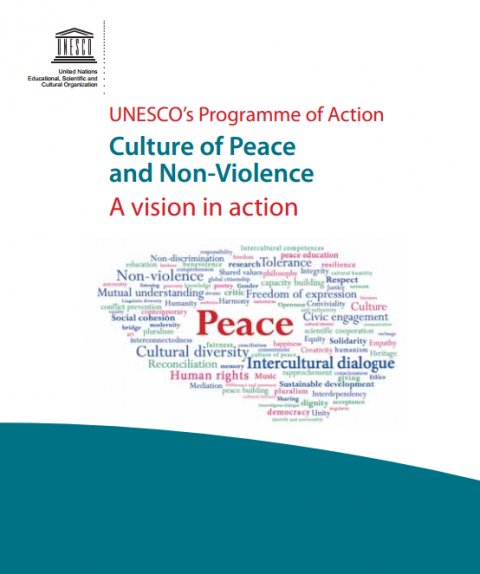 UNESCO's programme of action: culture of peace and non-violence, a vision in action Год публикации: 2013 Организация-автор: UNESCO This document builds upon the experience and resources of the Intersectoral Platform for a Culture of Peace and Non-Violence and has benefited from the contribution of Professor Arjun Appadurai. This document shows the UNESCO's mission; Buidling the defences of peace in the minds of men and women and Culture of peace and Non-violence which is positive values, attitudes and behaviours for everyday peace. This document pointed out today's multiple crisis, and then introduced the programme of action on a culture of peace and non-violence. After drew the UNESCO's strategies, UNESCO's peace activities were followed. UNESCO's programme of action: culture of peace and non-violence, a vision in action Год публикации: 2013 Организация-автор: Organisation des Nations Unies pour l'éducation, la science et la culture (UNESCO) Ce document se fonde sur l'expérience et les ressources de la plate-forme intersectorielle pour une Culture de la Paix et la non-violence et a bénéficié de la contribution du Professeur Arjun Appadurai. Ce document montre la mission de l'UNESCO; Buidling Construire les défenses de la paix dans l'esprit des hommes et des femmes et la culture de la paix et de non-violence qui est des valeurs positives, les attitudes et les comportements pour la paix tous les jours. Ce document a souligné multiples crises d'aujourd'hui, et a ensuite présenté le programme d'action sur une culture de paix et de non-violence. Après les stratégies de l'UNESCO, les activités de paix de l'UNESCO ont été suivies. Dialogue interculturel: impliquer les jeunes dans le monde entier Год публикации: 2010 Автор: Elizabeth Khawajkie Организация-автор: Organisation des Nations Unies pour l'éducation, la science et la culture (UNESCO) | DAIMLER It is hoped that this review will help to highlight why there is a persistent call for the continuation of such endeavors, like Mondialogo, which promoted dialogue among cultures and people, mutual respect and understanding so effectively. The Mondialogo journey, begun as an exploratory exercise, ended with compelling and often moving experiences.
 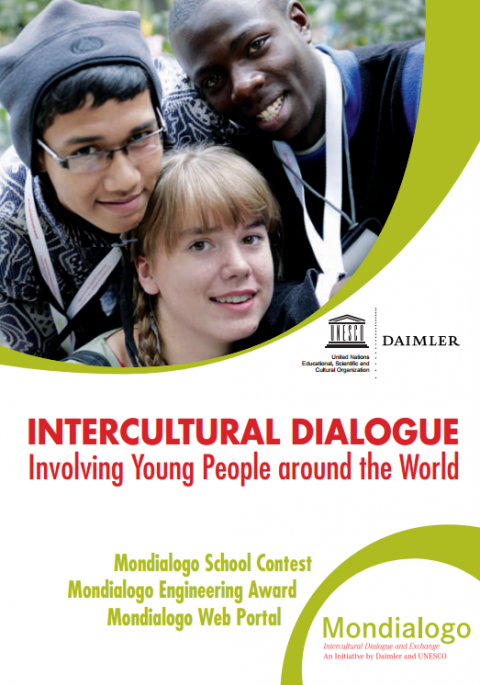 Intercultural dialogue: involving young people around the world Год публикации: 2010 Автор: Elizabeth Khawajkie Организация-автор: UNESCO | DAIMLER It is hoped that this review will help to highlight why there is a persistent call for the continuation of such endeavors, like Mondialogo, which promoted dialogue among cultures and people, mutual respect and understanding so effectively. The Mondialogo journey, begun as an exploratory exercise, ended with compelling and often moving experiences.