
Ресурсы
Изучайте широкий спектр ценных ресурсов ВГГ, чтобы углубить своё понимание и повысить эффективность исследований, просветительской деятельности, преподавания и обучения.
Найдено: 3,446
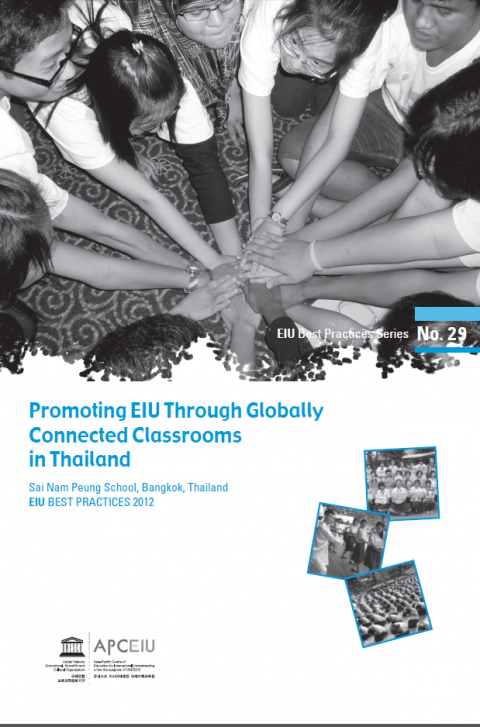 Promouvoir ECI travers les salles de classe branchés sur le monde en Thaïlande (ECI Série des Meilleures Pratiques no.29) Год публикации: 2012 Автор: Ajarn Kanchaphat Chaoplaina Организация-автор: Centre Asie-Pacifique d'éducation pour la compréhension internationale (APCEIU) Cette question présente un projet multilatéral en Thaïlande, qui interconnectée étudiants en provenance de Thaïlande, Royaume-Uni, la Corée, l'Indonésie, la Malaisie, Taïwan et le Vietnam pour partager leurs valeurs et leurs réflexions sur les questions ECI. A travers les portails de connexion, les étudiants de différentes régions ont été en mesure de collaborer à faire des travaux et des activités de groupe, qui ont été axées sur le partage des idées sur l'intérêt des élèves et expériences quotidiennes. Ce cas met en lumière la pratique spécifique qui a encouragé les élèves à apprendre activement les uns des autres et de comprendre la diversité culturelle, qui a optimisé le résultat de la capacité des étudiants en techniques de communication, les compétences linguistiques et le développement personnel en tant que citoyens. En plus de renforcer le réseau entre les écoles participantes, l'impact du projet multilatéral étendu aux enseignants alors qu'ils étaient engagés dans l'échange de méthodes et de connaissances pédagogiques pour soutenir et inspirer les uns des autres.
 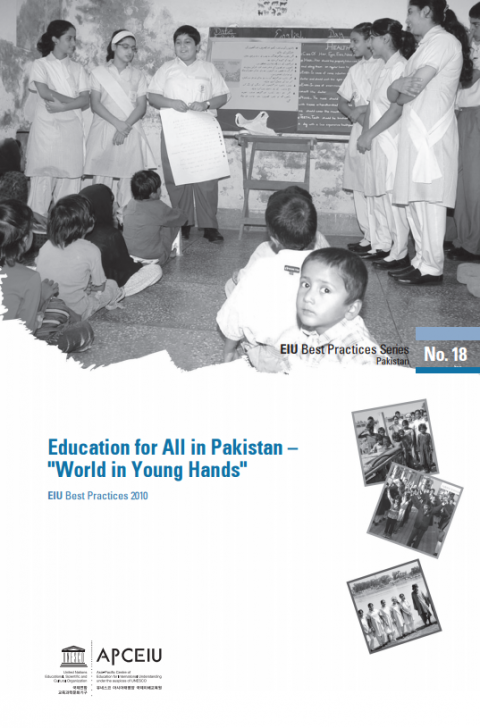 EIU Best Practices Series No.18: Education for All in Pakistan - "world in young hands" Год публикации: 2010 Автор: Ayesha Saqib Организация-автор: APCEIU The programme provides a student-participatory approach to face local problems that stem from ignorance and have roots in poverty. Bridging the school with the local community, Social Action Program (SAP) aims to inspire students with keen awareness on problems that threaten our community as well as to equip them with necessary tools to deal with challenges they may face. Through practices, SAP integrates EIU into curriculum that emphasizes maintaining peace and harmony among different folds of religions, ethnicity, and sects, dissipating the elements of hate and intolerance. The major areas of concern are Literacy for All, Sustainable Development, Cultural Diversity, and Peace Education. Éducation pour tous au Pakistan - «monde aux mains des jeunes» (ECI Série des Meilleures Pratiques no.18) Год публикации: 2010 Автор: Ayesha Saqib Организация-автор: Centre Asie-Pacifique d'éducation pour la compréhension internationale (APCEIU) Le programme offre une approche étudiant-participative pour faire face à des problèmes locaux qui découlent de l'ignorance et ont des racines dans la pauvreté. Combler l'école avec la communauté locale, le programme d'action sociale (PAS) vise à inspirer les élèves ayant conscience aiguë des problèmes qui menacent notre communauté ainsi que de les doter des outils nécessaires pour faire face aux défis auxquels ils peuvent être confrontés. Grâce à des pratiques, PAS intègre EIU dans les programmes qui met l'accent maintenir la paix et l'harmonie entre les différents plis de religions, l'origine ethnique, et les sectes, dissipant les éléments de la haine et de l'intolérance. Les principaux domaines de préoccupation sont l'alphabétisation pour tous, le développement durable, la diversité culturelle et éducation à la paix.
  Preparing teachers for inclusive education in Latin America (Prospect: quarterly review of comparative education) Год публикации: 2011 Автор: Denise Vaillant Организация-автор: UNESCO International Bureau of Education (IBE) This article analyzes the current challenges facing inclusive education in Latin America and explores some possible solutions. The author suggests that teachers play a key role in providing education that is inclusive for all. In Latin America, today, however, inclusive education often does not respond to the needs of children and young people, and teachers often finish their professional training without acquiring the skills they need to work with children and young people living in difficult circumstances. Teachers also need incentives to work in remote or difficult geographical areas, and they benefit from national efforts to improve their status, including awards for innovative work. Much remains to be done, but the training of teachers for a more inclusive education system is gradually being incorporated as part of the educational policy agenda in Latin America. Préparer les enseignants pour l'éducation inclusive en Amérique latine (Perspectives: la revue trimestrielle d'éducation comparée) Год публикации: 2011 Автор: Denise Vaillant Организация-автор: UNESCO International Bureau of Education (IBE) Cet article analyse les défis actuels éducation inclusive en Amérique latine et explore des solutions possibles. L'auteur suggère que les enseignants jouent un rôle clé dans l'éducation inclusive pour tous. En Amérique latine, aujourd'hui, cependant, l'éducation inclusive souvent ne répond pas aux besoins des enfants et des jeunes, et les enseignants finir souvent leur formation professionnelle sans acquérir les compétences dont ils ont besoin pour travailler avec les enfants et les jeunes vivant dans des circonstances difficiles. Les enseignants ont également besoin d'incitations à travailler dans des zones géographiques éloignées ou difficiles, et ils bénéficient des efforts nationaux pour améliorer leur statut, y compris des prix pour des travaux novateurs. Il reste encore beaucoup à faire, mais la formation des enseignants pour un système éducatif plus inclusif est progressivement intégré dans le cadre de l'ordre du jour de la politique éducative en Amérique latine.
  Rapport relatif à l'enquête sur la mise en oeuvre de la Feuille de route pour l'éducation artistique Год публикации: 2010 Организация-автор: Organisation des Nations Unies pour l'éducation, la science et la culture (UNESCO) The Road Map for Arts Education is a reference document that aims to explore the role of arts education in meeting the need for creativity and cultural awareness in the 21st Century, while placing emphasis on the strategies required to introduce or promote arts education in the learning environment. Within this conceptual framework, all UNESCO Member States interested in initiating or developing arts education practices can mould their own national policy guidelines, adapted to their socio-cultural specificities. With the Road Map, UNESCO advocates the essential role of arts education within societies, to create a common ground of understanding for all stakeholders. The development of the Road Map for Arts Education was a lengthy and comprehensive consultation process. The document was first elaborated by a group of experts and UNESCO, then presented at the First World Conference on Arts Education (Lisbon, 2006) and later revised and updated, following recommendations from NGOs and Member States. The Road Map was finally distributed to the UNESCO Member States in November 2007 in English and French and then translated into Spanish and Russian following popular demand. More than a year after this distribution, UNESCO launched a wide-ranging survey in order to assess the implementation of the Road Map in its 193 Member States. Through its National Commissions, the Organization relayed this document to Ministries of both Education and Culture. The aim of this exercise was threefold: to learn whether the Road Map was being applied and to what extent it was influencing policy decisions at national level; to act as a reminder of the importance of the UNESCO reference document and encourage its use; finally, to assess the situation of arts education in the responding countries. Thus, this survey not only acted as a catalyst for the implementation of the Road Map, but also provided precious knowledge on arts education around the world. The Member States’ responses also contributed greatly to the Second World Conference on Arts Education (Seoul, May 2010), inspiring one of its main themes and the topics for a number of workshops. They also encouraged a more integral participation of these States in the conference through preparatory consultations.
 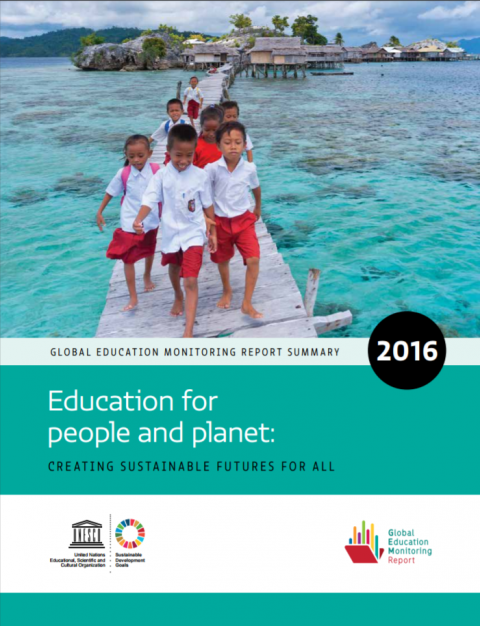 L'Education pour les peuples et la planète: créer des avenirs durables pour tous, résumé du rapport mondial de suivi sur l'éducation, 2016 Год публикации: 2016 Организация-автор: Organisation des Nations Unies pour l'éducation, la science et la culture (UNESCO) The GEM Report provides an authoritative account of how education is the most vital input for every dimension of sustainable development. Better education leads to greater prosperity, improved agriculture, better health outcomes, less violence, more gender equality, higher social capital and an improved natural environment. Education is key to helping people around the world understand why sustainable development is such a vital concept for our common future. Education gives us the key tools – economic, social, technological, even ethical – to take on the SDGs and to achieve them. These facts are spelled out in exquisite and unusual detail throughout the report. Yet the report also emphasizes the remarkable gaps between where the world stands today on education and where it has promised to arrive as of 2030. [Summary] Education for People and Planet: Creating sustainable Futures for All, Global Education Monitoring Report, 2016; Summary Год публикации: 2016 Организация-автор: UNESCO Education for People and Planet: Creating Sustainable Futures for All explores the complex relationship between education and the new 2030 Agenda for Sustainable Development, covering six fundamental pillars – Planet, Prosperity, People, Peace, Place and Partnerships. This report shows that education will not deliver its full potential unless participation rates increase dramatically and sustainable development guides education system reform. It also warns of the destructive impact that climate change, conflict, unsustainable consumption and the increasing gap between rich and poor have on education. A huge transformation is needed if we are to create sustainable futures for all.
 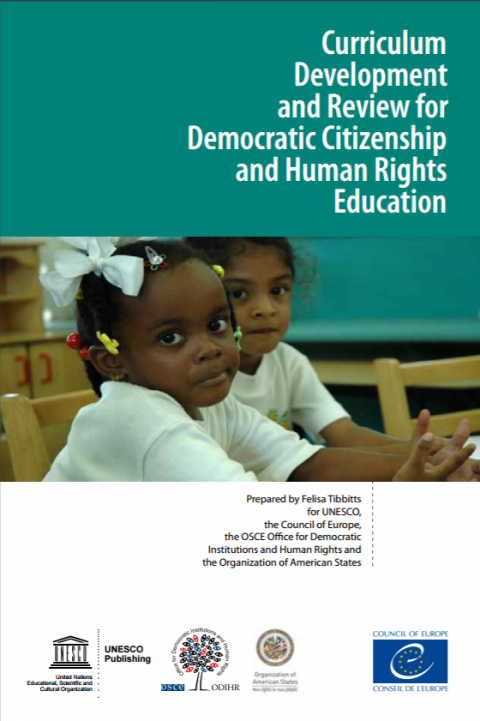 Curriculum Development and Review for Democratic Citizenship and Human Rights Education Год публикации: 2016 Организация-автор: UNESCO | Council of Europe | Organization of American States (OAS) | OSCE. Office for Democratic Institutions and Human Rights (ODIHR) Education for democratic citizenship and human rights education are vital for peaceful, sustainable and inclusive societies based on respect for the human rights of every person. Effective teaching and learning processes require well-trained teachers, positive learning environments and high-quality learning materials. This is underpinned by education policy, including curriculum development and review, which is the main focus of this book. The strengthening of education policies in the fields of education for democratic citizenship and human rights lies at the very heart of the efforts of the Council of Europe, the United Nations Educational, Scientific and Cultural Organization, the Office for Democratic Institutions and Human Rights of the Organization for Security and Co-operation in Europe, and the Organization of American States. These organisations have jointly produced this publication in order to support states’ commitment to fostering citizenship and human rights education and improving access to quality education for all. Élaboration et révision des programmes d'enseignement pour l'éducation à la citoyenneté démocratique et aux droits de l'homme Год публикации: 2016 Организация-автор: Organisation des Nations Unies pour l'éducation, la science et la culture (UNESCO) | Conseil de l'Europe | Organization of American States (OAS) | OSCE. Office for Democratic Institutions and Human Rights (ODIHR) Education for democratic citizenship and human rights education are vital for peaceful, sustainable and inclusive societies based on respect for the human rights of every person. Effective teaching and learning processes require well-trained teachers, positive learning environments and high-quality learning materials. This is underpinned by education policy, including curriculum development and review, which is the main focus of this book. The strengthening of education policies in the fields of education for democratic citizenship and human rights lies at the very heart of the efforts of the Council of Europe, the United Nations Educational, Scientific and Cultural Organization, the Office for Democratic Institutions and Human Rights of the Organization for Security and Co-operation in Europe, and the Organization of American States. These organisations have jointly produced this publication in order to support states’ commitment to fostering citizenship and human rights education and improving access to quality education for all.