
Ресурсы
Изучайте широкий спектр ценных ресурсов ВГГ, чтобы углубить своё понимание и повысить эффективность исследований, просветительской деятельности, преподавания и обучения.
Найдено: 1,180
 L’éducation dans un contexte mondial pour les élèves de l’Ontario : Stratégies pratiques - Sommaire de recherche Год публикации: 2018 Автор: Caroline Manion | Nadya Weber Организация-автор: Ontario (Canada). Ministry of Education Le présent sommaire découle de la politique énoncée dans le document Stratégie ontarienne en matière d’éducation internationale de la maternelle à la 12e année (Ministère de l’Éducation de l’Ontario, 2015). Il cible les connaissances actuelles sur les bonnes pratiques prometteuses dans le domaine de l’éducation dans un contexte mondial1 afin de proposer des stratégies pratiques visant à améliorer l’enseignement, l’apprentissage et la réussite. Le présent document s’adresse à tous les intervenants du secteur de l’éducation, c’est-à-dire les membres du milieu, les parents, les élèves, les leaders du système, les leaders scolaires et les éducateurs. Tous sont des agents de changement actifs qui appuient une stratégie d’éducation conçue dans le but d’intégrer les perspectives, les cultures et les expériences mondiales dans le curriculum et le milieu d’apprentissage. L’objectif consiste à permettre aux élèves d’acquérir les compétences dont ils auront besoin pour prospérer en tant que citoyens face à une mondialisation grandissante.L’analyse est présentée par thème. Pour souligner les raisons pour lesquelles l’éducation dans un contexte mondial est d’une importance cruciale pour les élèves de l’Ontario, nous commençons par présenter les contributions importantes que l’éducation dans un contexte mondial peut apporter au bien-être des individus et de la société dans son ensemble. Nous présentons ensuite une vue d’ensemble résumant différentes notions de « l’éducation dans un contexte mondial » et de « l’éducation à la citoyenneté mondiale », ainsi qu’un large éventail de notions secondaires qui se chevauchent.Ensuite, par une revue de la littérature internationale sur le sujet, nous présentons une série de défis et de possibilités concernant la mise en oeuvre de l’éducation dans un contexte mondial et énumérons des exemples pertinents de bonnes pratiques liées à la prestation de l’éducation dans un contexte mondial. Une autre section porte sur les bonnes pratiques en matière de renforcement des capacités et de leadership du système afin d’assurer une éducation dans un contexte mondial efficace. Nous concluons en énumérant les principaux messages et les leçons apprises. Global Education for Ontario Learners: Practical Strategies - A Summary of Research Год публикации: 2018 Автор: Caroline Manion | Nadya Weber Организация-автор: Ontario (Canada). Ministry of Education This summary report flows from the policy outlined in Ontario’s Strategy for K–12 International Education (OME, 2015). The report highlights current knowledge about good and/or promising practices in global education1 in order to suggest practical strategies for improved teaching, learning, and achievement. The intended audience for this piece includes all education stakeholders – community members, parents, learners, system leaders, school leaders, and educators – as active agents of change in support of an education strategy designed to integrate global perspectives, cultures, and experiences in the curriculum and learning environment. The purpose is to enable students to develop the competencies they will need to thrive as citizens in an increasingly globalized world.The discussion is organized by theme. To underline why global education is critically important for Ontario learners, we begin by outlining the significant contributions global education can make to the well-being of individuals and society as a whole. We then provide an overview synthesizing different conceptualizations of “global education” and “global citizenship education”, as well as a broad range of their overlapping sub-concepts. Next, through a review of the international literature on the subject, we present a series of challenges and opportunities for implementing global education, and list pertinent examples of good practices associated with delivering global education. A further section focuses on good practice in building system capacity and leadership for effective global education. We conclude by identifying key messages and lessons learned.
  Digital Pedagogies for Building Peaceful & Sustainable Societies (The Blue Dot Issue 8, 2018) Год публикации: 2018 Организация-автор: Mahatma Gandhi Institute of Education for Peace and Sustainable Development (MGIEP) In this issue of The Blue Dot (Digital Pedagogies for Building Peaceful and Sustainable Societies), some of the most prominent experts in the field of digital pedagogies share with us their views and perspectives in the growing field for education. Foreword by the visionary Chief Minister, Honourable Nara Shri Chandrababu Naidu of the State of Andhra Pradesh, India, pretty much lays the ground for the future of EdTech and the way he sees its role in his state as well as for the global community. The second foreword by the Global Head of Education, Unity Technologies, one of the world’s largest provider of game engines, demonstrates the willingness of the private sector to engage with educators to provide the platform to develop learners as creative explorers.
  UNESCO IICBA: strategic plan Год публикации: 2019 Организация-автор: UNESCO International Institute for Capacity-Building in Africa (IICBA) UNESCO IICBA’s Strategic Plan for 2018-2021 is guided by its mandate and mission to strengthen the capacity of Member States in Africa in teacher policy and development. This work is vital to realizing its vision of an integrated, prosperous and peaceful Africa where everyone has access to qualified, motivated and professionally supported teachers. This plan is supported by a vision for Strategic Partnerships, because UNESCO IICBA recognizes their value in promoting regional and national cooperation in teacher-related issues, and in fostering dialogue on teachers and education. Strategic partnerships have three objectives:Successfully implement UNESCO IICBA’s Strategic Plan 2018-2021 Ensure the efficiency and effectiveness of resource mobilizationStrengthen advocacy, cooperation and coordination mechanisms The Strategic Plan is also supported by a Communication Strategy that covers all of UNESCO IICBA’s programme areas and will support collaboration, coordination and institutional operations. The strategy aims to contribute to effective communication that will:Help to fulfill UNESCO IICBA’s strategic goals and objectivesAmplify the visibility of UNESCO IICBA to its stakeholdersInform partners and donors on implementation progress, and demonstrate UNESCO IICBA’s accountabilityEnsure people understand what UNESCO IICBA represents and doesImprove teachers’ professional image and raise awareness to address teachers’ issues in AfricaKeep UNESCO IICBA team members proud, motivated, innovative and accountable in their tasks
  Transitions from School to Work: UNICEF Technical Note Год публикации: 2019 Организация-автор: United Nations Children's Fund (UNICEF) This report provides guidance on ways that UNICEF can support governments and partners to help adolescents to make a smooth transition from school to decent work. To prepare them for life, work, citizenship and life-long learning, UNICEF encourages governments and partners to expand access to learning and skills development for all children and adolescents – from pre-primary to upper-secondary age, and particularly for the most marginalized. UNICEF further advocates strengthening systems to enable them to develop a breadth of skills across the life course and through multiple learning pathways, such as formal, non-formal, on the job and community based.
  Every Child Learns: UNICEF Education Strategy 2019–2030 Год публикации: 2019 Организация-автор: United Nations Children's Fund (UNICEF) The gap between the levels of learning that education systems are providing and what children, communities and economies need, is growing. The breadth and depth of this learning crisis constitute the greatest global challenge to preparing children and adolescents for life, work and active citizenship. The lesson of the learning crisis is clear: the conventional assembly of education inputs is not improving learning outcomes. This presents a fundamental challenge to the way that governments, development partners and communities are managing and supporting education systems. A new, more radical approach that focusses on enhancing learning outcomes is long overdue and forms the basis for this strategy.The report also outlines the shift towards a greater focus on improving learning outcomes, including supporting the breadth of skills that allow young people to become agile, adaptive learners and citizens, equipped to navigate personal, social, academic, economic and environmental challenges.
  A School of Cosmopolitanism: Experiences with Global Citizenship Education in Classroom Practice Год публикации: 2019 Автор: Heidi Grobbauer | Werner Wintersteiner Организация-автор: Austrian Commission for UNESCO This publication focuses on examples from academic practice: this best practice collection demonstrates how young people can successfully be inspired to “think globally, act locally”. What is crucial is maintaining a view of the wider world; in particular, cooperation efforts with educational institutes outside of Europe (e.g. “élèves pour élèves” in Burkina Faso) provide a critical awareness of global connections. Learning to know/Learning to do/Learning to be/Learning to live together – these four pillars form the pedagogical foundation of the work carried out at more than 90 UNESCO schools throughout the whole of Austria. Since their founding in 1957, UNESCO schools have been considered model schools at which lessons are structured in a project-oriented, participative and even topic-specifc way. The unique ‘spirit’ of UNESCO schools often makes special projects possible. In the programme for the annual meetings of recent years, for example, Global Citizenship Education has been an ongoing topic of focus, accompanied by experts from various specialised institutions and NGOs. The pedagogical preparation of contents in a manner that ensures they are actually absorbed in the classroom presents a major challenge. Different types of schools have different educational goals, and the themes have to be made accessible for different age groups. The pedagogical finesse of each class team or individual teacher lies in finding the most motivating approaches.
  Critical Global Semiotics: Understanding Sustainable Transformational Citizenship Год публикации: 2019 Автор: Maureen Eills Critical Global Semiotics: Understanding Sustainable Transformational Citizenship incorporates powerful unifying frameworks which make explicit a developing global consciousness. It explores transdisciplinary ‘common wealth’ through focus on multimodality, media, and metaphor, testing two universally applicable humanitarian frameworks: critical realism (CR) and systemic functional semiotics (SFS).Every day global citizens encounter an overwhelming host of genres and sub-genres, emergent semantic triangles, evolving semiotic trinity. Embodying philosophy, incorporating active engagement, this book addresses the political economy and cultural politics of diverse domains.Challenging daily drama and performative dharma, 24 analysts from 13 countries present current issues in Anthropology, Architecture, Dance, Feminism, Film, Health, Law, Management, Medicine, Music, Politics, Pharmaceuticals, Sociology, Sustainability Education, and Urban Development.The book’s integrative, unifying foundations will be of interest to researchers, academics, and post-graduate students in the fields of linguistics, semiotics, and critical realist philosophy, as well as to policy makers, curriculum developers, and civil society.
 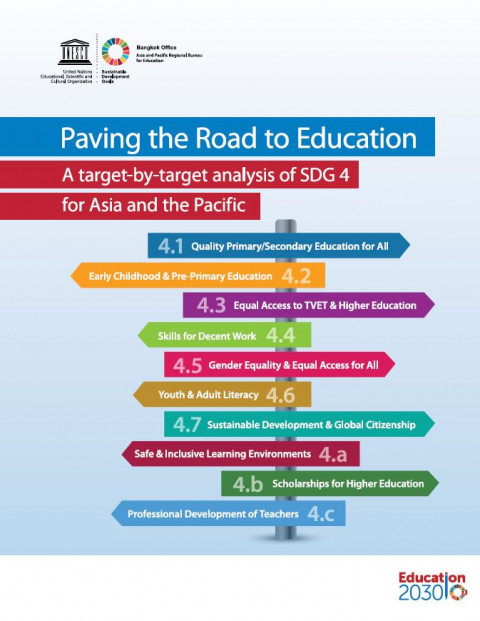 Paving the Road to Education: A Target-by-Target Analysis of SDG 4 for Asia and the Pacific Год публикации: 2018 Организация-автор: UNESCO Bangkok The globally adopted development agenda “Transforming our World: the 2030 Agenda for Sustainable Development” has established ambitious intentions that build on the past Millennium Development Goals but also expand on their achievements.The Sustainable Development Goal 4 on education propels forward the vision of ensuring inclusive and equitable quality education and to promote lifelong learning opportunities for all through a holistic, aspirational and systematic education agenda. Education monitoring is an integral part in this process.This publication delivers a data-rich snapshot of Sustainable Development Goal 4, its targets and their monitoring indicators while analyzing available data through a lens of inequality.Assessing the progress which countries have made in the recent past as well as where countries currently stand, this publication sets a baseline against which Member States from Asia and the Pacic are able to monitor progress in achieving the Goal 4 over time but at latest by 2030.Finally, after discussing emerging opportunities and remaining challenges in the region, this publication seeks to assist Member States in identifying what steps can be taken to ensure that the region will achieve the new education agenda.
 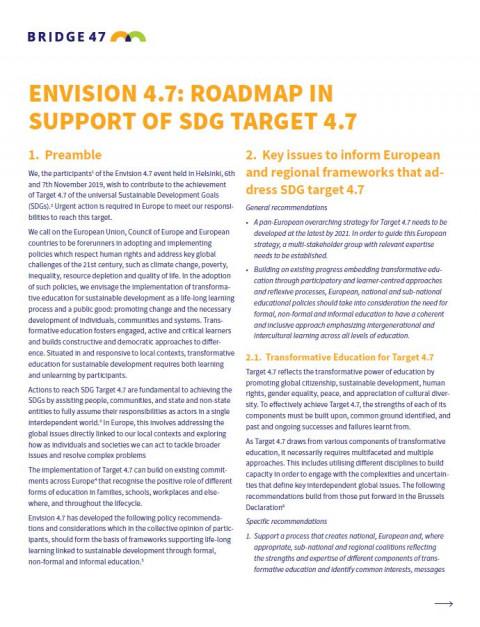 ENVISION 4.7: ROADMAP IN SUPPORT OF SDG TARGET 4.7 Год публикации: 2019 Организация-автор: Bridge 47 In November 2019, 200 policy makers, civil society members and researchers from all over the world got together in Helsinki to make a roadmap for the future implementation of SDG Target 4.7 in Europe. The participants of the Envision 4.7 event held in Helsinki, 6th and 7th November 2019, made this document to contribute to the achievement of Target 4.7 of the universal Sustainable Development Goals (SDGs). This document was shaped and influenced by the expertise and insight of everyone who came to the conference. Bridge 47 is calling on this collective knowledge and community of experts to continue moving these recommendations forward as we all aim to achieve SDG Target 4.7 and use transformative education as a mechanism for achieving all of the Sustainable Development Goals.