
Ресурсы
Изучайте широкий спектр ценных ресурсов ВГГ, чтобы углубить своё понимание и повысить эффективность исследований, просветительской деятельности, преподавания и обучения.
Найдено: 1,445
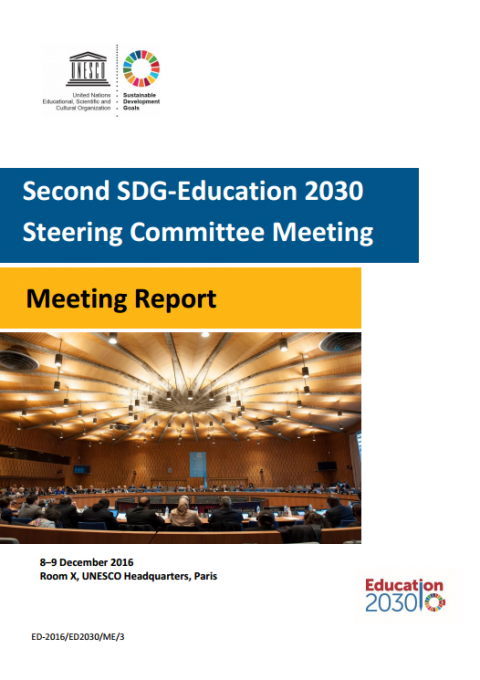 Second SDG-Education 2030 Steering Committee: meeting report Год публикации: 2016 Организация-автор: UNESCO The present report provides the SDG-Education 2030 SC meeting programme, a short summary of key outcomes and decisions, as well as a second part including a more detailed summary of deliberations reflecting the themes, issues and understandings emerging from the discussions.
 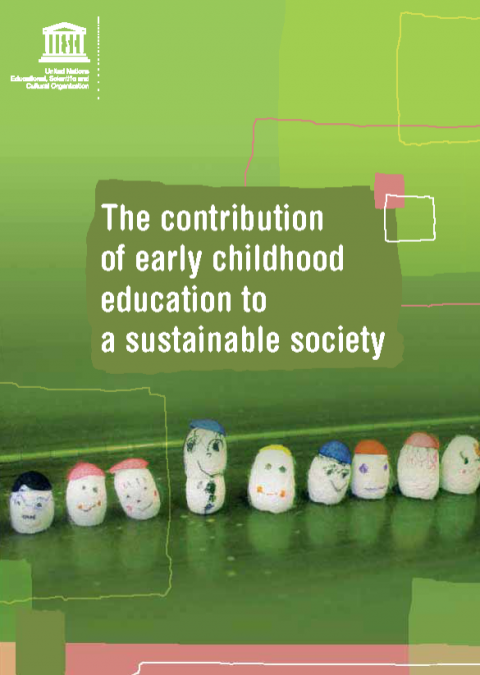 The contribution of early childhood education to a sustainable society Год публикации: 2008 Организация-автор: UNESCO This report originates from the international workshop, ‘The Role of Early Childhood Education for a Sustainable Society’, jointly organized in Göteborg, Sweden, by Göteborg University, Chalmers University of Technology and the City of Göteborg, from 2 to 4 May 2007. It was attended by thirty-five participants from sixteen different countries (see ‘List of Participants’). The workshop was a follow-up to the international conference on education for sustainable development, ‘Learning to Change Our World’, held in May 2004, in Göteborg. It was one of four preparatory workshops leading to another international conference on education for sustainable development, to be organized in 2008 or 2009, in the same city. The aim of the four workshops is to discuss promoters and barriers related to learning for sustainability, and to propose recommendations for the upcoming international conference. The present workshop was conceived for the following reasons. First, our societies urgently require new kinds of education that can help prevent further degradation of our planet, and that foster caring and responsible citizens genuinely concerned with and capable of contributing to a just and peaceful world. Second, these new kinds of education must be available to all – not only a handful of people – and take place in various settings, including families and communities. Third, they must begin in early childhood, as the values, attitudes, behaviours and skills acquired in this period may have a long-lasting impact in later life. Thus, early childhood education clearly has an important place in the efforts to bring about sustainable development.
  Análisis de los contextos y estructuras de la educación para el desarrollo sostenible 2009: principales conclusiones y camino a seguir Год публикации: 2009 Организация-автор: UNESCO This document suggests key findings and ways forward in review of the contexts and strctures of education for sustainable development. Contextes et structures de l'education pour le développement durable 2009: principales conclusions et propositions d'action Год публикации: 2009 Организация-автор: Organisation des Nations Unies pour l'éducation, la science et la culture (UNESCO) This document suggests key findings and ways forward in review of the contexts and strctures of education for sustainable development. Décennie des Nations Unies pour L'Education au Service du Développement Durable (DEDD 2005-2014): les deux premières années Год публикации: 2007 Организация-автор: Organisation des Nations Unies pour l'éducation, la science et la culture (UNESCO) The implementation of the DESD has made considerable progress since its international launch in March 2005. Apart from regional and national launches, progress has been achieved in both institutional and programmatic areas at international, regional and national levels. The objective of this report is not solely to highlight and showcase to Member States all that has been achieved in the two years since the international launch. The report also takes stock of on-going UNESCO initiatives, established prior to the Decade, which are providing major contributions to the implementation of the DESD, and thus cannot be by-passed. Equally important are the recommendations to remedy problems in the implementation of the DESD and strengthen those measures that are working efficiently. Oбзор содержания и структур Образования в интересах устойчивого развития 2009 г. Основные выводы и направления будущей работы Год публикации: 2009 Организация-автор: UNESCO This document suggests key findings and ways forward in review of the contexts and strctures of education for sustainable development. Batir l'éducation de demain: rapport 2012 sur la décennie des Nations Unies pour l'éducation au service du développement durable, version abrégée Год публикации: 2013 Организация-автор: Organisation des Nations Unies pour l'éducation, la science et la culture (UNESCO) As the lead agency for the UN Decade of Education for Sustainable Development (DESD, 2005 – 2014), UNESCO is responsible for monitoring and evaluating progress during the DESD. UNESCO is publishing three reports during the DESD – in 2009, 2012 and 2014. This second report focuses specifically on processes and learning in the context of Education for Sustainable Development (ESD). What kinds of learning processes have emerged in the course of the DESD? What is the role of ESD in supporting them? What changes in ESD have occurred since the early years of the Decade? The report is informed by a broad consultation process that includes input from hundreds of policy makers, scholars and practitioners engaged in ESD around the world.
 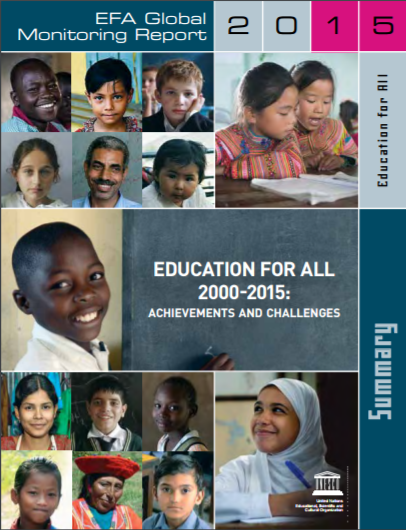 모두를 위한 교육 2000-2015: 성과와 과제; EFA 세계 현황 보고서, 2015; 요약본 Год публикации: 2015 Организация-автор: 유네스코 At the World Education Forum in Dakar, Senegal, in 2000, governments from 164 countries, together with representatives of regional groups, international organizations, donor agencies, non-government organizations (NGOs) and civil society, adopted a Framework for Action to deliver Education for All (EFA) commitments. The Dakar Framework comprised 6 goals and their associated targets to be achieved by 2015, and 12 strategies to which all stakeholders would contribute. The EFA Global Monitoring Report (GMR) has monitored progress on an almost annual basis towards the EFA goals and the two education-related Millennium Development Goals (MDGs). The 2015 GMR provides a complete assessment of progress since 2000 towards the target date for reaching the Dakar Framework’s goals. It takes stock of whether the world achieved the EFA goals and stakeholders upheld their commitments. It explains possible determinants of the pace of progress. Finally, it identifies key lessons for shaping the post-2015 global education agenda.
  Meeting on Learning to Live Sustainably in Cities in Latin America and the Caribbean, Villa María, Argentina (26-28 April 2017): Meeting Report Год публикации: 2017 Организация-автор: UNESCO Villa Maríia, the first Argentinian city to join the UNESCO Global Network of Learning Cities (GNLC), co-hosted the first GNLC meeting in the region, titled ‘Learning to live sustainably in cities in Latin America and the Caribbean’. This three-day event was a joint effort of the City of Villa Maríia, the UNESCO Institute for Lifelong Learning (UIL), UNESCO Headquarters, and the UNESCO Regional Bureau for Education in Latin America and the Caribbean (OREALC/UNESCO Santiago). Participants explored new ways to implement sustainable solutions at the local level, as well as increase awareness and training related to Education for Sustainable Development (ESD). More than 170 city representatives from over 40 cities and 20 countries (including mayors and deputy mayors, experts, authorities and practitioners) were welcomed by the host city. The first day of the meeting was composed of plenary sessions; the second day consisted of two parallel workshop sessions: (1) a regional workshop on the Global Action Programme (GAP) on ESD and Cities, and (2) a regional workshop on learning cities. Aprender a Vivir de Manera Sostenible en Ciudades de América Latina y el Caribe, Villa María (Argentina), 26-28 de abril de 2017: informe de la reunión Год публикации: 2017 Организация-автор: UNESCO Villa Maríia, la primera ciudad argentina que entróo a formar parte de la Red Mundial de Ciudades del Aprendizaje de la UNESCO, fue una de las organizadoras de la primera reunióon de esta Red en la regióon, titulada “Aprender a vivir de manera sostenible en ciudades en Améerica Latina y el Caribe”. Este acto, de tres díias de duracióon, fue una iniciativa conjunta de la ciudad de Villa Maríia, el Instituto de la UNESCO para el Aprendizaje a lo Largo de Toda la Vida (IUAL), la Sede de la UNESCO y la Oficina Regional de Educacióon de la UNESCO para Améerica Latina y el Caribe (OREALC/UNESCO Santiago). Los participantes estudiaron nuevas formas de poner en práactica soluciones sostenibles a escala local, asíi como de fomentar una mayor sensibilizacióon y formacióon en materia de educacióon para el desarrollo sostenible (EDS). Villa Maríia acogióo a máas de 170 representantes de máas de 40 ciudades y 20 paíises, entre los que se encontraban alcaldes y tenientes de alcalde, expertos, autoridades y profesionales. Durante la primera jornada de la reunióon tuvieron lugar reuniones plenarias y la segunda jornada se dividióo en dos sesiones paralelas de talleres: 1) un taller regional sobre el Programa de Accióon Mundial de EDS y las ciudades, y 2) un taller regional sobre las ciudades del aprendizaje.