
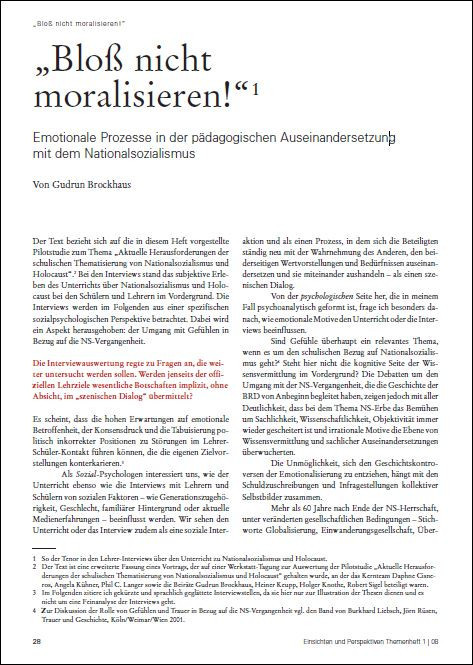
“Just Don’t Moralize!” Emotional Processes in the Pedagogical Engagement with National Socialism
- 载体形态
- pp. 28–33
- 资源语言
- German(德语)
- 出版年份
- 2008
The original title: “Bloß nicht moralisieren!” Emotionale Prozesse in der pädagogischen Auseinandersetzung mit dem Nationalsozialismus
(Einsichten und Perspektiven, Bayerische Zeitschrift für Politik und Geschichte, 1(8), pp. 28–33.)
The article is a critical reflection on the outcomes of an empirical study (Kühner 2008; Kühner et al. 2008), based on a psychological/psychoanalytical perspective: how should we deal with emotions when dealing with the Holocaust? The author highlights the teachers’ very high expectations regarding the emotional Betroffenheit, the pressure on consensus, and the tabooisation of “political incorrectness” in the classroom, tendencies that can lead to a problematic teacher-student relationship. Thus, teachers encounter specific didactical difficulties and show a certain lack of self-assertion. Brockhaus assumes that this is based on how the teacher relates, as a person and as a pedagogue, to the heritage of National Socialism. Brockhaus concludes by insisting on the necessity to reflect openly, as students and as teachers, on the emotional processes and the reluctance caused by the topic of the Holocaust in this society.
The above abstract is taken from the International Holocaust Remembrance Alliance Education Research Project. Please also consult the full list of abstracts in 15 languages and the accompanying publication Research in Teaching and Learning about the Holocaust: A Dialogue Beyond Borders. Ed: IHRA, Monique Eckmann, Doyle Stevick, Jolanta Ambrosewicz-Jacobs, 2017, Metropol Verlag at www.holocaustremembrance.com/resources/publications
相关资源
-
 Voices Against Violence: Middle Years
 -
 Study on the Historical Impact of the 1974 Recommendation concerning Education for International Understanding, Cooperation and Peace and Education relating to Human Rights and Fundamental Freedoms
 -
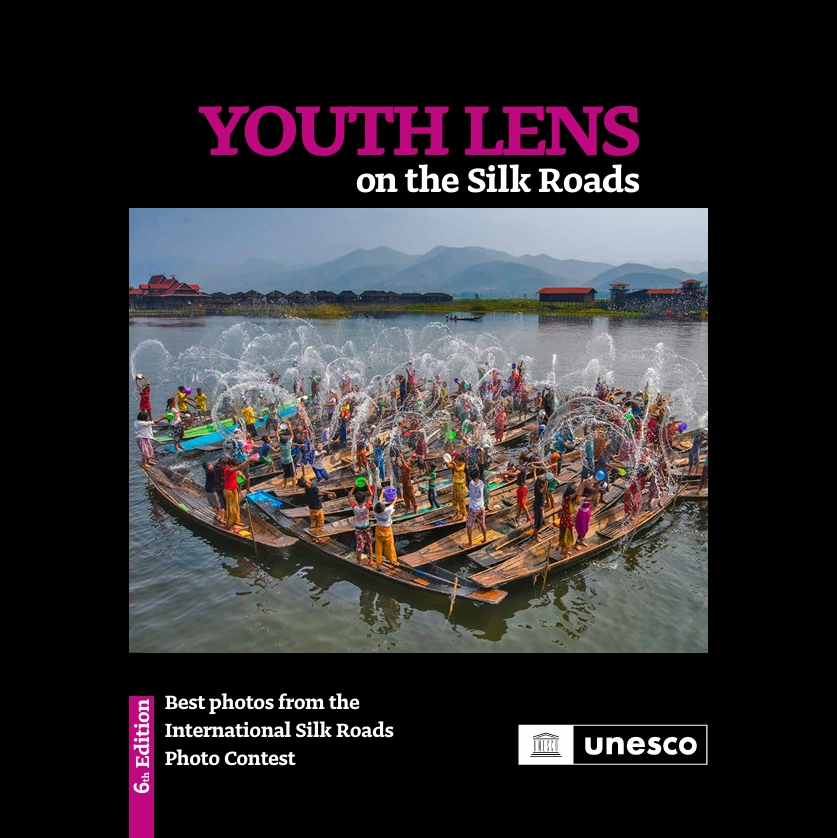 Youth Lens on the Silk Roads: Best Photos from the International Silk Roads Photo Contest; 6th Edition
 -
 More than Welcome: Intercultural Integration of Migrants in and Through Higher Education