
相关资源
探索丰富的全球公民教育资源,深化理解,促进研究、倡导、教学与学习。
共找到7条结果
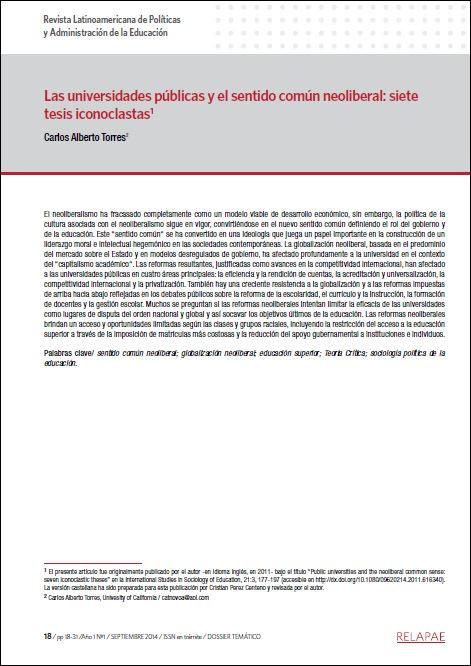 Public Universities and Neoliberal Common Sense: Seven Iconoclastic Thesis 出版年份: 2014 作者: Carlos Alberto Torres 机构作者: Universidad Nacional de Tres de Febrero (UNTREF) Neoliberalism has utterly failed as a viable model of economic development, yet the politics of culture associated with neoliberalism is still in force, becoming the new common sense shaping the role of government and education. This ‘common sense’ has become an ideology playing a major role in constructing hegemony as moral and intellectual leadership in contemporary societies. Neoliberal globalisation, predicated on the dominance of the market over the state and on deregulatory models of governance, has deeply affected the university in the context of ‘academic capitalism’. The resulting reforms, rationalised as advancing international competitiveness, have affected public universities in four primary areas: efficiency and accountability, accreditation and universalisation, international competitiveness and privatisation. There is also growing resistance to globalisation as top-down-imposed reforms reflected in the public debates about schooling reform, curriculum and instruction, teacher training and school governance. Many question whether neoliberal reforms attempt to limit the effectiveness of universities as sites of contestation of the national and global order and thus undermine the broader goals of education. Neoliberal reforms have limited access and opportunity along class and racial lines, including limiting access to higher education through the imposition of higher tuition and reduced government support to institutions and individuals. Las universidades públicas y el sentido común neoliberal: siete tesis iconoclastas 出版年份: 2014 作者: Carlos Alberto Torres 机构作者: Universidad Nacional de Tres de Febrero (UNTREF) El neoliberalismo ha fracasado completamente como un modelo viable de desarrollo económico, sin embargo, la política de la cultura asociada con el neoliberalismo sigue en vigor, convirtiéndose en el nuevo sentido común definiendo el rol del gobierno y de la educación. Este “sentido común“ se ha convertido en una ideología que juega un papel importante en la construcción de un liderazgo moral e intelectual hegemónico en las sociedades contemporáneas. La globalización neoliberal, basada en el predominio del mercado sobre el Estado y en modelos desregulados de gobierno, ha afectado profundamente a la universidad en el contexto del “capitalismo académico“. Las reformas resultantes, justificadas como avances en la competitividad internacional, han afectado a las universidades públicas en cuatro áreas principales: la eficiencia y la rendición de cuentas, la acreditación y universalización, la competitividad internacional y la privatización. También hay una creciente resistencia a la globalización y a las reformas impuestas de arriba hacia abajo reflejadas en los debates públicos sobre la reforma de la escolaridad, el currículo y la instrucción, la formación de docentes y la gestión escolar. Muchos se preguntan si las reformas neoliberales intentan limitar la eficacia de las universidades como lugares de disputa del orden nacional y global y así socavar los objetivos últimos de la educación. Las reformas neoliberales brindan un acceso y oportunidades limitadas según las clases y grupos raciales, incluyendo la restricción del acceso a la educación superior a través de la imposición de matrículas más costosas y la reducción del apoyo gubernamental a instituciones e individuos.
 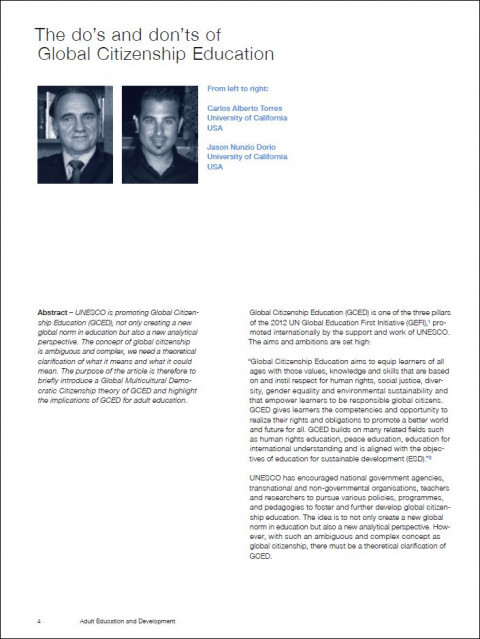 The Do's and Don’ts of Global Citizenship Education 出版年份: 2015 作者: Carlos Alberto Torres | Jason Nunzio Dorio 机构作者: Éducation des Adultes et Développement UNESCO is promoting Global Citizenship Education (GCED), not only creating a new global norm in education but also a new analytical perspective. The concept of global citizenship is ambiguous and complex, we need a theoretical clarification of what it means and what it could mean. The purpose of the article is therefore to briefly introduce a Global Multicultural Democratic Citizenship theory of GCED and highlight the implications of GCED for adult education. Qué hacer y qué evitar en la educación para la ciudadanía mundial 出版年份: 2015 作者: Carlos Alberto Torres | Jason Nunzio Dorio 机构作者: Éducation des Adultes et Développement La UNESCO está promoviendo la educación para la ciudadanía mundial (ECM), no solo creando una nueva normativa mundial sobre educación, sino introduciendo además una nueva perspectiva de análisis. Como el concepto de ciudadanía mundial es ambiguo y complejo, se requiere una aclaración teórica de lo que signifi ca y de lo que podría denotar. El objetivo de este artículo es, por tanto, exponer brevemente una teoría de ECM basada en una ciudadanía mundial democrática y multicultural, y subrayar las implicaciones de la ECM para la educación de adultos. Les choses à faire et à éviter dans le domaine de l’éducation à la citoyenneté mondiale 出版年份: 2015 作者: Carlos Alberto Torres | Jason Nunzio Dorio 机构作者: Éducation des Adultes et Développement L’UNESCO promeut l’éducation à la citoyenneté mondiale (ECM), en créant non seulement une nouvelle norme mondiale dans l’éducation, mais aussi un nouvel angle analytique. Le concept de la citoyenneté mondiale est ambigu et complexe. Aussi convient-il de mettre au point au plan théorique ce qu’il veut dire et ce qu’il pourrait vouloir dire. Par conséquent, cet article a pour objectif de présenter rapidement une théorie de l’ECM portant sur la citoyenneté mondiale multiculturelle et démocratique, et de mettre en lumière ce qu’implique l’ECM pour l’éducation des adultes.
 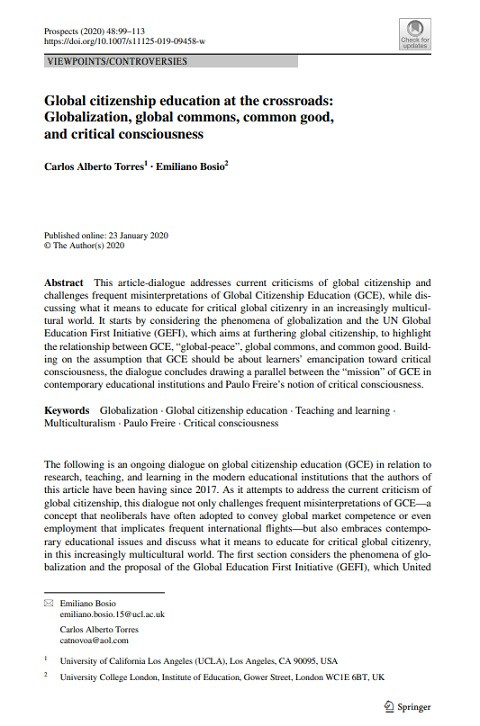 Global Citizenship Education at the Crossroads: Globalization, Global Commons, Common Good, and Critical Consciousness (Prospects; Vol.48) 出版年份: 2020 作者: Carlos Alberto Torres | Emiliano Bosio 机构作者: Springer Nature This article-dialogue addresses current criticisms of global citizenship and challenges frequent misinterpretations of Global Citizenship Education (GCE), while discussing what it means to educate for critical global citizenry in an increasingly multicultural world. It starts by considering the phenomena of globalization and the UN Global Education First Initiative (GEFI), which aims at furthering global citizenship, to highlight the relationship between GCE, “global-peace”, global commons, and common good. Building on the assumption that GCE should be about learners’ emancipation toward critical consciousness, the dialogue concludes drawing a parallel between the “mission” of GCE in contemporary educational institutions and Paulo Freire’s notion of critical consciousness.
 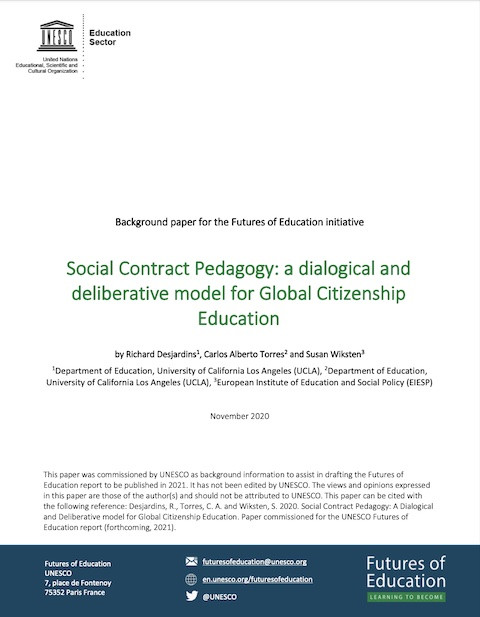 Social Contract Pedagogy: A Dialogical and Deliberative Model for Global Citizenship Education (Background paper for the Futures of Education initiative) 出版年份: 2020 作者: Richard Desjardins | Carlos Alberto Torres | Susan Wiksten 机构作者: UNESCO We propose that together Social Contract Pedagogy (SCP) and Global Citizenship Education (GCE) offer a comprehensive vision including key principles and core elements that are important for rethinking education and shaping the future of the world. We introduce the novel concept of Social Contract Pedagogy (SCP) as a means to adapt the social contract in liberal democracies which has been (conceptually) located at the level of the state, to the level of the classroom and other pedagogically relevant contexts. A key feature of this pedagogy is the negotiation of values and norms in ways that maintain cohesion and inclusion and avoids too much power in the hands of sectarian extremes (of any kind) which tend to impose their views on others, oppress and exclude. This includes using fake news, denying scientific debates and/or any extremely politicized interpretations of evidence and facts to obfuscate or deny consequences of individual and group choices and behavior, but also ‘othering’ of any kind whether from the political right or the political left. In our view, this is an essential premise for the education of democratic citizens. Citizenship education of this kind is seen as essential for the survival and growth of liberal democracies in the future.