
相关资源
探索丰富的全球公民教育资源,深化理解,促进研究、倡导、教学与学习。
共找到91条结果
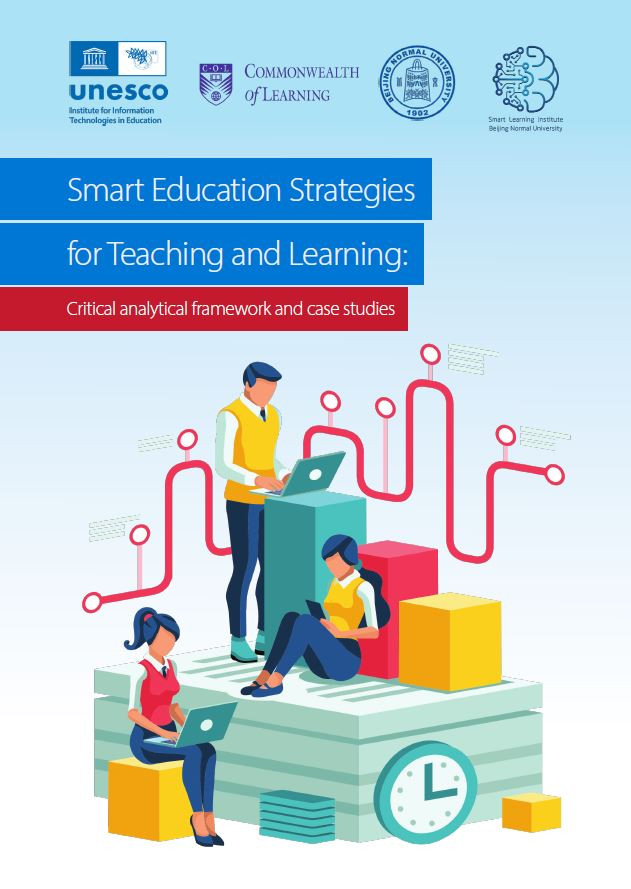 Smart Education Strategies for Teaching and Learning: Critical Analytical Framework and Case Studies 出版年份: 2022 作者: Shafika Isaacs | Sanjaya Mishra 机构作者: UNESCO Institute for Information Technologies in Education (IITE) | Beijing Normal University This electronic publication about smart education strategies for building the resilience of education and training systems in the postpandemic environment provides a framework to develop appropriate policy and strategy in existing and emerging forms of schooling, higher education, technical and vocational education, and training (TVET), adult education and lifelong learning, including formal, nonformal and informal educational environments. The publication reviews the status of smart education policies in 10 countries. It includes 15 case studies within the six policy themes: infrastructure, curriculum and pedagogy, digital education resources and platforms, skills and competencies, governance, management and administration, and partnership.
  미래교육시대의 인간교사와 인공지능(AI) 교사의 역할 및 기능 정립 방향 탐색 연구 出版年份: 2021 作者: 전제상 机构作者: 한국교육정책연구소 이 연구는 인공지능의 급격한 발전과 사회의 변화로 교육 현장에 점차 도입될 인공지능이 어떤 모습으로 존재해야 하는지 그리고 어떤 방식으로 학생들에게 도움을 줄 수 있는지 길을 찾고자 하였다. 이를 위하여 인공지능의 현재 상황과 선행연구를 분석하는 것으로 시작하여 인공지능(AI) 교사에 대한 현장 교사들의 인식을 양적, 질적으로 살펴보았다. 이를 토대로 미래교육시대의 교사와 인공지능(AI) 교사의 역할과 기능을 정립하고 상호보완적인 협업 방안을 모색한 후 인공지능(AI) 교사 도입에 따른 제도적, 법적, 윤리적 기준을 확인하였다.인공지능 기반의 미래 사회가 도래했다고 하여 인간교사의 역할이 크게 바뀌지는 않는다. 기존의 해오던 여러 수업과 업무 중에 우선순위의 변화가 생길 수 있고, 수업보다 행정에 할애했던 시간을 수업과 학생지도, 상담 등에 집중할 수 있게 될 것으로 기대한다. 다만 인공지능(AI) 교사 도입에 따라 야기될 윤리적 문제를 해결하기 위해서는 도입 단계부터 준비하여 지속적인 확인과 점검, 성찰을 통해 협업 과정이 목적에 알맞게 기능하도록 모든 요소에 대해 철저하게 대비하고 점검하여야 한다.
 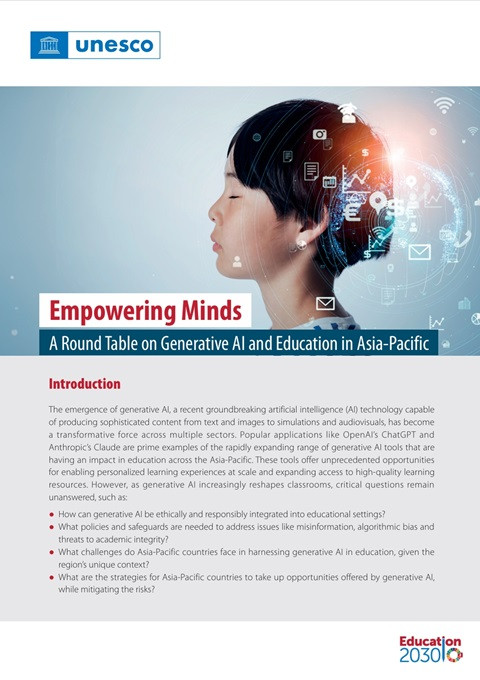 Empowering Minds: A Round Table on Generative AI and Education in Asia-Pacific 出版年份: 2023 机构作者: UNESCO Bangkok The emergence of generative AI, a recent groundbreaking artificial intelligence (AI) technology capable of producing sophisticated content from text and images to simulations and audiovisuals, has become a transformative force across multiple sectors. Popular applications like OpenAI’s ChatGPT and Anthropic’s Claude are prime examples of the rapidly expanding range of generative AI tools that are having an impact in education across the Asia-Pacific. These tools offer unprecedented opportunities for enabling personalized learning experiences at scale and expanding access to high-quality learning resources. However, as generative AI increasingly reshapes classrooms, critical questions remain unanswered, such as:- How can generative AI be ethically and responsibly integrated into educational settings?- What policies and safeguards are needed to address issues like misinformation, algorithmic bias and threats to academic integrity?- What challenges do Asia-Pacific countries face in harnessing generative AI in education, given the region’s unique context?- What are the strategies for Asia-Pacific countries to take up opportunities offered by generative AI, while mitigating the risks? In response to these questions and emerging challenges in the region, the UNESCO Regional Office in Bangkok (UNESCO Bangkok), in collaboration with The Southeast Asian Ministers of Education Organization (SEAMEO), organized the regional experts meeting on 7-9 November 2023 in Bangkok, Thailand. This hybrid meeting, titled ‘Empowering Minds: A Round Table on Generative AI and Education in Asia-Pacific’, explored the implications of generative AI for teacher training and development. It served as an important platform to leverage opportunities and mitigate risks of generative AI in education across the Asia-Pacific region.
  Artificial Intelligence: Media and Information Literacy, Human Rights and Freedom of Expression 出版年份: 2020 作者: Igor Shnurenko | Tatiana Murovana | Ibrahim Kushchu 机构作者: UNESCO Institute for Information Technologies in Education (IITE) | TheNextMinds The collection of papers “Artificial Intelligence: Media and Information Literacy, Human Rights and Freedom of Expression” continues the UNESCO IITE’s series of publications entitled “Digital Transformation of Education”.The publication describes the fundamentals of artificial intelligence and AI-based technologies, their impact on the modern information and media environment, new challenges in the field of media and information literacy associated with the growing automation of the processes of creating, disseminating and accessing information, the use of AI in decision-making and control systems in various areas. There is a strong focus on the growing risks of reducing individual agency, people’s ability to interpret reality autonomously and to act according to their own agenda.These issues are more relevant now than ever before for education undergoing digital transformation. The publication seeks to contribute to a critical understanding of the digital environment in which learning and teaching unfold, and strategies and tactics for the use of new technologies and the digitalization of educational interactions.
  The Impact of AI on Curriculum Systems: Towards an Orbit-Shifting Dialogue (In-Progress Reflection; no. 32, 2019) 出版年份: 2019 机构作者: UNESCO International Bureau of Education (IBE) ‘Artificial Intelligence’ (AI) refers to the theory and development of computer systems able to perform tasks normally requiring human intelligence. In order to achieve transformational change in contemporary curriculum systems and learning environments, we need to engender an orbitshifting dialogue about the potential relationship between AI and education, in terms of both independent variables (threats), and dependent variables (opportunities). Through such a dialogue, we need to create foresight indicators that can predict the process of this relationship. It is, however, crucial that the relationship between AI and education is strong and directly proportionate. If the potential of the relationship is not exploited sufficiently, then underdeveloped education systems will lag behind and fail to achieve their potential for transformation, whether radical or incremental. Indeed, some may even become obsolete. The paper contends that in order to effectively contribute to the knowledge economy and to sustainable development in the age of the 4th Industrial Revolution (characterized by a fusion of cyber-physical technologies) modern educational systems need to overcome obstacles to innovation in order to maximize the potential for transformative change. To achieve this will require an ‘orbital shift’ in educational planning, practice and resourcing, to enable schools to respond more effectively to the rapidly changing needs of young people, society, the economy and environment in the third decade of the 21st century. Schools, educational institutions and environments, need to transform from being primarily spaces for teaching and taking exams, into spaces for innovation and personal learning, based on a culture of actively listening to the voices, choices, needs and goals of learners. Teachers need to become facilitators, coaches and mentors for learners. Schools need to create AI-enabled, flexible, collaborative working spaces. Visionary, energetic educational leaders need to communicate effectively with all stakeholders, including employers and parents, to inspire and manage change and smart decision-making to develop schools of the future. The aim of this reflection is to initiate an ‘orbit-shifting’ dialogue about the potential of AI applications to transform all components of the curriculum system to meet emergent 21st century educational goals. The conceptualization aims to explore the variable roles and impact of curriculum learning and assessment on these emerging educational goals. Theme 1 of the paper outlines the concepts and characteristics of a range of existing AI systems and their potential to enhance teaching learning and assessment. Theme 2 reflects on the potential to embrace AI systems across the curriculum system. Theme 3 proposes an action model to enable AI to have an ‘orbit shifting impact’ on all the components of the curriculum system (i.e. learners, teachers, learning environments, leadership and management, content, pedagogy and assessment) by enhancing opportunities for individualization, creativity and uniqueness.
 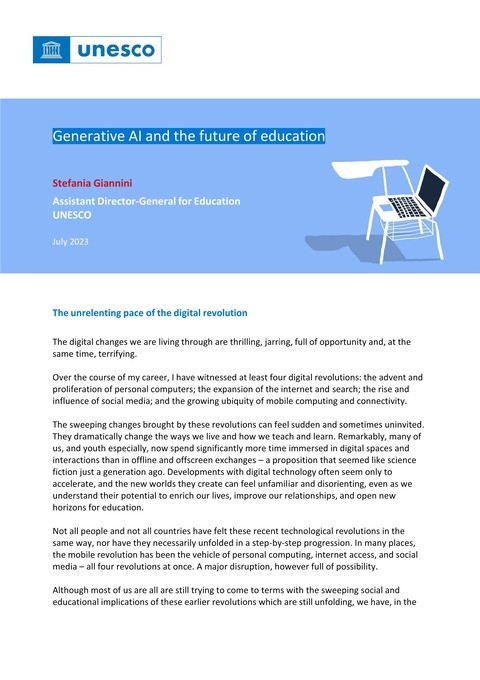 Generative AI and the Future of Education 出版年份: 2023 机构作者: UNESCO. Assistant Director-General for Education, 2018- (Giannini, Stefania) The digital revolution has brought about significant changes in how we live, learn, and interact, with multiple waves of technological advancements. The current AI revolution represents a new and profound shift, particularly through AI's ability to simulate human language and conversation. This development challenges our understanding of language, intelligence, and the role of technology in education and society.As AI begins to generate human-like responses and knowledge, it raises fundamental questions about its impact on education, societal values, and our concept of humanity. Education systems are now grappling with how to integrate and regulate AI, which has been rapidly introduced into classrooms without sufficient oversight. The author emphasizes the importance of carefully considering the risks and ethical implications of AI, particularly in its potential to manipulate and shape knowledge systems. There is a need for balanced development, where AI technology is aligned with human values, and education remains a deeply human-centered process.UNESCO is working with countries to develop strategies for the safe use of AI in education, emphasizing the need for a cautious approach and robust regulatory frameworks. The overarching message is that while AI offers immense possibilities, it must be integrated thoughtfully to ensure it enhances education and society without undermining human agency, equity, or the foundational values of learning. La IA generativa y el futuro de la educació 出版年份: 2023 机构作者: UNESCO. Assistant Director-General for Education, 2018- (Giannini, Stefania) La revolución digital ha traído cambios significativos en cómo vivimos, aprendemos e interactuamos, con múltiples olas de avances tecnológicos. La actual revolución de la inteligencia artificial representa un cambio nuevo y profundo, particularmente a través de la capacidad de la IA para simular el lenguaje humano y la conversación. Este desarrollo desafía nuestra comprensión del lenguaje, la inteligencia y el papel de la tecnología en la educación y la sociedad. A medida que la IA comienza a generar respuestas y conocimientos similares a los humanos, surgen preguntas fundamentales sobre su impacto en la educación, los valores sociales y nuestro concepto de humanidad. Los sistemas educativos ahora están lidiando con la forma de integrar y regular la IA, que ha sido introducida rápidamente en las aulas sin una supervisión adecuada. El autor enfatiza la importancia de considerar cuidadosamente los riesgos y las implicaciones éticas de la IA, particularmente en su potencial para manipular y moldear los sistemas de conocimiento. Existe una necesidad de un desarrollo equilibrado, donde la tecnología de la IA esté alineada con los valores humanos y la educación siga siendo un proceso profundamente centrado en el ser humano. UNESCO está trabajando con los países para desarrollar estrategias para el uso seguro de la IA en la educación, enfatizando la necesidad de un enfoque cauteloso y marcos regulatorios robustos. El mensaje general es que, si bien la IA ofrece inmensas posibilidades, debe integrarse de manera reflexiva para asegurar que mejore la educación y la sociedad sin socavar la agencia humana, la equidad o los valores fundamentales del aprendizaje. L’IA générative et le futur de l’éducation 出版年份: 2023 机构作者: UNESCO. Assistant Director-General for Education, 2018- (Giannini, Stefania) La révolution numérique a apporté des changements significatifs dans nos modes de vie, d'apprentissage et d'interaction, avec plusieurs vagues de progrès technologiques. La révolution actuelle de l'IA représente un nouveau tournant profond, notamment grâce à la capacité de l'IA à simuler le langage et la conversation humaine. Ce développement remet en question notre compréhension du langage, de l'intelligence et du rôle de la technologie dans l'éducation et la société.Alors que l'IA commence à générer des réponses et des connaissances semblables à celles des humains, cela soulève des questions fondamentales quant à son impact sur l'éducation, les valeurs sociétales et notre conception de l'humanité. Les systèmes éducatifs se retrouvent désormais face au défi d'intégrer et de réguler l'IA, qui a été introduite rapidement dans les salles de classe sans une supervision suffisante. L'auteur insiste sur l'importance de prendre en compte les risques et les implications éthiques de l'IA, en particulier son potentiel à manipuler et à influencer les systèmes de connaissance. Il est nécessaire d'adopter un développement équilibré, où la technologie de l'IA est en phase avec les valeurs humaines, et où l'éducation reste un processus profondément centré sur l'humain.L'UNESCO travaille avec les pays pour élaborer des stratégies visant à utiliser l'IA en toute sécurité dans l'éducation, en insistant sur la nécessité d'une approche prudente et de cadres réglementaires solides. Le message principal est que, bien que l'IA offre d'immenses possibilités, elle doit être intégrée de manière réfléchie afin de garantir qu'elle améliore l'éducation et la société sans compromettre l'autonomie humaine, l'équité ou les valeurs fondamentales de l'apprentissage.
  Governing AI for Humanity: Final Report 出版年份: 2024 机构作者: United Nations (UN) The United Nations Secretary-General’s High-level Advisory Body on AI’s Final Report, “Governing AI for Humanity,” builds on months of work, including extensive global consultations, and the publication of an interim report in December 2023. Proposals for Global Governance on AI This report outlines a blueprint for addressing AI-related risks and sharing its transformative potential globally, including by:• Urging the UN to lay the foundations of the first globally inclusive and distributed architecture for AI governance based on international cooperation;• Proposing seven recommendations to address gaps in current AI governance arrangements;• Calling on all governments and stakeholders to work together in governing AI to foster development and protection of all human rights. This includes light institutional mechanisms to complement existing efforts and foster inclusive global AI governance arrangements that are agile, adaptive and effective to keep pace with AI’s evolution. Extensive Global Consultations The report is the product of extensive consultations, involving more than 2,000 participants across all regions of the world, including via: • 18 deep-dive discussions on key issues with top experts• More than 50 consultation sessions across all regions• More than 250 written submissions from over 150 organizations and 100 individuals The Advisory Body also commissioned an AI Risk Global Pulse Check – the most comprehensive global horizon scanning exercise on AI risks to date – and an AI Opportunity Scan to crowdsource expert assessments of emerging AI trends.
 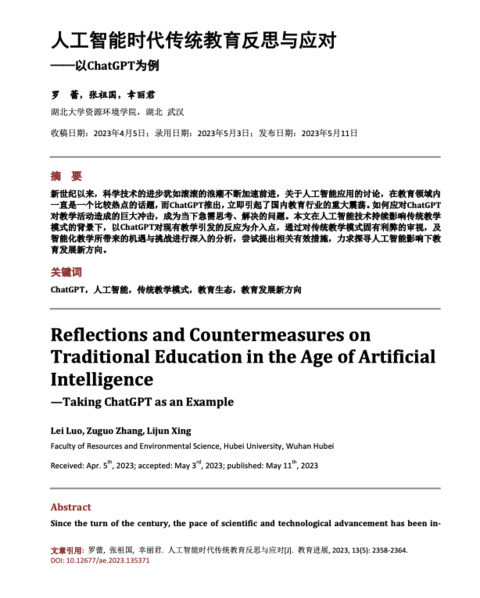 Reflections and Countermeasures on Traditional Education in the Age of Artificial Intelligence: Taking ChatGPT as an Example (Advances in Education; Vol.13, No.5) 出版年份: 2023 作者: 罗蕾 | 张祖国 | 幸丽君 Since the turn of the century, the pace of scientific and technological advancement has been increasing rapidly, like a rolling wave gaining momentum. As a result, the topic of artificial intelli-gence and its potential applications has remained a hot topic in the field of education. The introduction of ChatGPT had an immediate and significant impact on the domestic education industry. Addressing how to manage this impact on teaching activities has become an urgent issue that requires prompt consideration and resolution. In light of the ongoing impact of artificial intelligence technology on traditional teaching methods, this article focuses on ChatGPT’s response as an intervention point, delving into a thorough analysis of the inherent strengths and weaknesses of traditional teaching modes, as well as the opportunities and challenges presented by intelligent teaching. Through our analysis of artificial intelligence, we aim to propose effective measures and explore new directions for the development of education in its influence.