
相关资源
探索丰富的全球公民教育资源,深化理解,促进研究、倡导、教学与学习。
共找到28条结果
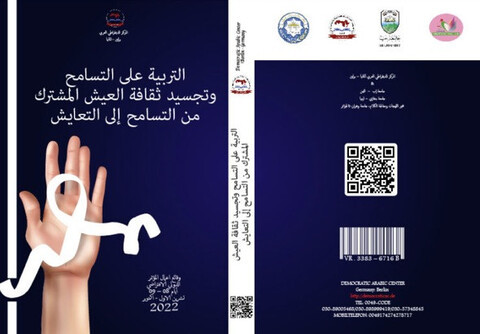 Tolerance Education and the Embodiment of Coexistence Culture: From Tolerance to Coexistence 出版年份: 2022 机构作者: Democratic Arab Center The concept of tolerance has received great attention in light of contemporary societal changes in order to ensure the stability of society and the coexistence of its members in harmony and peace, in addition to its importance at the level of relations between countries.Tolerance is a human value of a universal nature. The concept of tolerance emerged from the need of societies mired in war and civil strife. It gave remarkable progress to societies and institutions in the West, and liberated people from the shackles of fear. The concept of tolerance established more humane laws and imposed on countries new patterns of thinking. And using reason to devise ways to avoid violence and intolerance for humanity. The United Nations has committed to strengthening tolerance by promoting mutual understanding between cultures and peoples.The United Nations Educational, Scientific and Cultural Organization, UNESCO, became aware of the issue of the culture of tolerance and issued, on November 16, 1995, a declaration containing the basic principles of tolerance as an educational, psychological and social culture. Since the twenty-eighth session of the UNESCO General Conference, this day has become an international day for tolerance.
 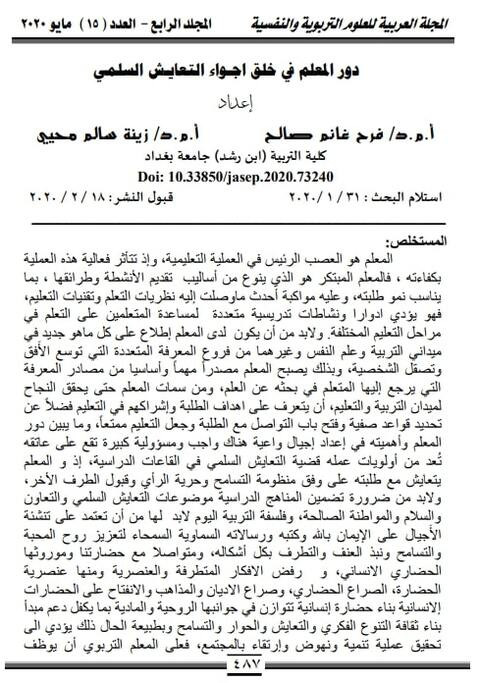 دور المعلم في خلق اجـواء التعايـش السلمي (المجلة العربية للعلوم التربوية والنفسية; Vol. 4, No. 15) 出版年份: 2020 作者: Farah Ghanem Saleh | Zeina Salem Mohy 机构作者: Ibn Rushd College of Education المعلم هو العصب الرئيس في العملية التعليمية، وإذ تتأثر فعالية هذه العملية بکفاءته ، فالمعلم المبتکر هو الذي ينوع من أساليب تقديم الأنشطة وطرائقها ، بما يناسب نمو طلبته، وعليه مواکبة أحدث ماوصلت إليه نظريات التعلم وتقنيات التعليم، فهو يؤدي ادوارا ونشاطات تدريسية متعددة لمساعدة المتعلمين على التعلم في مراحل التعليم المختلفة. ولابد من أن يکون لدى المعلم إطلاع على کل ماهو جديد في ميداني التربية وعلم النفس وغيرهما من فروع المعرفة المتعددة التي توسع الأَفق وتصقل الشخصية، وبذلک يصبح المعلم مصدراً مهماً وأساسيا من مصادر المعرفة التي يرجع إليها المتعلم في بحثه عن العلم، ومن سمات المعلم حتى يحقق النجاح لميدان التربية والتعليم، أن يتعرف على اهداف الطلبة وإشراکهم في التعليم فضلاً عن تحديد قواعد صفية وفتح باب التواصل مع الطلبة وجعل التعليم ممتعاً، وما يبين دور المعلم وأهميته في إعداد إجيال واعية هناک واجب ومسؤولية کبيرة تقع على عاتقه تُعد من أولويات عمله قضية التعايش السلمي في القاعات الدراسية، إذ و المعلم يتعايش مع طلبته على وفق منظومة التسامح وحرية الرأي وقبول الطرف الأخر، ولابد من ضرورة تضمين المناهج الدراسية موضوعات التعايش السلمي والتعاون والسلام والمواطنة الصالحة The Role of the Teacher in Creating an Atmosphere of Peaceful Coexistence (Arab Journal of Educational and Psychological Sciences; Vol.4, No.15) 出版年份: 2020 作者: Farah Ghanem Saleh | Zeina Salem Mohy 机构作者: Ibn Rushd College of Education The teacher is the main nerve in the educational process, and the effectiveness of this process is affected by his competence. The innovative teacher is the one who diversifies the approaches and methods of presenting activities to suit the growth of his students. He must keep up with the latest developments in learning theories and teaching techniques. He performs multiple teaching roles and activities to help learners achieve Learning at different stages of education. The teacher must have knowledge of everything new in the fields of education, psychology, and other multiple branches of knowledge that broaden the horizon and refine the personality. Thus, the teacher becomes an important and essential source of knowledge that the learner returns to in his search for knowledge. One of the characteristics of a teacher, in order to achieve success in the field of education, is to know the goals of students and involve them in education, in addition to setting classroom rules, opening the door to communication with students, and making education enjoyable. What shows the role of the teacher and his importance in preparing conscious generations is that there is a great duty and responsibility that falls on his shoulders, which is considered one of the priorities of his work are the issue of peaceful coexistence in the classrooms, as the teacher coexists with his students according to the system of tolerance, freedom of opinion, and acceptance of the other party, and it is necessary to include in the school curricula the topics of peaceful coexistence, cooperation, peace, and good citizenship.
  التسامح (اللاعنف) في مناهج المرحلة الابتدائية للمدرسة الجزائرية (مجلة حقول معرفية للعلوم الاجتماعية والإنسانية vol.2, no.1) 出版年份: 2021 作者: Morad Fatima Zahra | Fantazi Karima 机构作者: Algeria. Ministry of Higher Education and Scientific Research جاءت هذه الدراسة بهدف الكشف عن وجود وكيفية تناول المقررات الدراسية للمرحلة الابتدائية لقيمة التسامح بشقيها الضمني والصريح وتحديدا مقررات التربية الإسلامية بوصفها أكثر المواد تأكيدا على التعايش مع الآخر والتسامح معه نظرا لما للتربية على التسامح والإقرار بوجود الآخر ووجوب احترامه والاعتراف به من أهمية. ولانجاز هذه الدراسة تم إتباع المنهج الوصفي وتقنية تحليل المحتوى أداة على عينة للمقرر السالف ذكره للسنوات الخمسة المشكلة للمرحلة الابتدائية، كما تم تطبيق التكرارات والنسب المئوية كأسلوب إحصائي. وقد توصلت الدراسة الى ان تناول المقررات الدراسية الوطنية للمرحلة الابتدائية لقيمة التسامح) اللاعنف (جاء متأرجحا بين الطرح الصريح والضمني على الرغم من أهمية الطرح الصريح في مثل هذه المرحلة العمرية وما يتركه من اثر في المتلقي أي التلميذ، كما تم استخلاص ان التربية على التسامح تعد مسؤولية المجتمع ككل وليس المدرسة فقط. Tolerance (Non violence) in the Curricular of Algerian Primary Schools (vol.2, no.1; Journal of Cognitive Fields for Social and Human Sciences) 出版年份: 2021 作者: Morad Fatima Zahra | Fantazi Karima 机构作者: Algeria. Ministry of Higher Education and Scientific Research This study aims to identify tolerance values within primary school curricula in two ways: explicitly and implicitly, focusing specifically on Islamic books due to their significant role in instilling values, particularly respect. The study utilizes the descriptive method and content analysis to analyze primary school books spanning five years. Statistical analysis is conducted using duplicates and percentages. The findings indicate that these books predominantly convey tolerance values implicitly rather than explicitly, which is believed to be more readily accepted by children of this age group. It is concluded that fostering tolerance values should be a shared responsibility of both the community and the school, not solely the latter.
 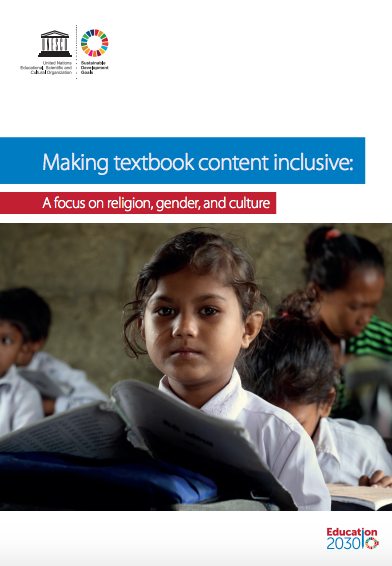 Making Textbook Content Inclusive: A Focus on Religion, Gender, and Culture 出版年份: 2017 机构作者: UNESCO UNESCO has been working on textbook development issues since its inception in 1945 as part of its fundamental mandate to “build peace in the minds of men and women.” The present guide’s primary task is to enable its users to address and counter stereotypes in a variety of educational contexts, through teaching and learning materials. The three key issues – religion, gender and culture – were chosen for their common link to the concept of human diversity. These three potentially controversial topics are important aspects of inclusive education because they help shape the learning environment of a school as well as its educational practices.The guide was intentionally written in a simple, practical style so as to be immediately accessible to textbook developers, adopters, and users, even those who are working on their own. Although it is designed primarily for textbook authors, curriculum developers, and teachers, it might also be particularly useful for publishers, political stakeholders, and teacher educators. Pour des manuels scolaires au contenu inclusif 出版年份: 2017 机构作者: UNESCO UNESCO has been working on textbook development issues since its inception in 1945 as part of its fundamental mandate to “build peace in the minds of men and women.” The present guide’s primary task is to enable its users to address and counter stereotypes in a variety of educational contexts, through teaching and learning materials. The three key issues – religion, gender and culture – were chosen for their common link to the concept of human diversity. These three potentially controversial topics are important aspects of inclusive education because they help shape the learning environment of a school as well as its educational practices.The guide was intentionally written in a simple, practical style so as to be immediately accessible to textbook developers, adopters, and users, even those who are working on their own. Although it is designed primarily for textbook authors, curriculum developers, and teachers, it might also be particularly useful for publishers, political stakeholders, and teacher educators.
  Guidelines for educators on countering intolerance and discrimination against Muslims: addressing islamophobia through education 出版年份: 2013 机构作者: UNESCO | Council of Europe | OSCE. Office for Democratic Institutions and Human Rights (ODIHR) Intolerance and discrimination against Muslims are not new phenomena. However, they have evolved and gained momentum in recent years, particularly under conditions of the “war on terror”, the global economic crisis, anxieties about national identity and difficulties in coping with the increased diversity in many societies. Such developments have contributed to a growth in resentment and fear of Muslims and Islam that often been fuelled by sections of the media and by some political discourse. Muslims are often portrayed as extremists who threaten the security and well-being of others.These stereotypes have impact not only on young people but also on their parents, as well as on teachers and other education professionals. This presents a new challenge for educators. While teachers cannot be expected to resolve the political and social tensions among communities, they can play a central role in shaping the attitudes and behaviours of young people. The actions and approaches adopted by teachers and school administrators can be crucial in promoting respect for diversity and mutual understanding, both in schools and in society.Developed by OSCE/ODIHR, the Council of Europe and UNESCO, these Guidelines aim to support educators in countering intolerance and discrimination against Muslims. They are intended for a wide audience, including teachers, principals and head teachers, education policymakers and officials, teacher trainers, teacher unions and professional associations, and NGOs. The Guidelines are relevant for both primary and secondary education and can also be used in non-formal education settings. Principes directeurs à l'attention des éducateurs pour combattre l'intolérance et la discrimination à l'encontre des musulmans: aborder l'islamophobie à travers l'éducation 出版年份: 2013 机构作者: UNESCO | Conseil de l'Europe | OSCE. Office for Democratic Institutions and Human Rights (ODIHR) Intolerance and discrimination against Muslims are not new phenomena. However, they have evolved and gained momentum in recent years, particularly under conditions of the “war on terror”, the global economic crisis, anxieties about national identity and difficulties in coping with the increased diversity in many societies. Such developments have contributed to a growth in resentment and fear of Muslims and Islam that often been fuelled by sections of the media and by some political discourse. Muslims are often portrayed as extremists who threaten the security and well-being of others.These stereotypes have impact not only on young people but also on their parents, as well as on teachers and other education professionals. This presents a new challenge for educators. While teachers cannot be expected to resolve the political and social tensions among communities, they can play a central role in shaping the attitudes and behaviours of young people. The actions and approaches adopted by teachers and school administrators can be crucial in promoting respect for diversity and mutual understanding, both in schools and in society.Developed by OSCE/ODIHR, the Council of Europe and UNESCO, these Guidelines aim to support educators in countering intolerance and discrimination against Muslims. They are intended for a wide audience, including teachers, principals and head teachers, education policymakers and officials, teacher trainers, teacher unions and professional associations, and NGOs. The Guidelines are relevant for both primary and secondary education and can also be used in non-formal education settings. Directrices para educadores sobre la manera de combatir la intolerancia y la discriminación contra los musulmanes: afrontar la islamofobia mediante la educación 出版年份: 2013 机构作者: UNESCO | Council of Europe | OSCE. Office for Democratic Institutions and Human Rights (ODIHR) Intolerance and discrimination against Muslims are not new phenomena. However, they have evolved and gained momentum in recent years, particularly under conditions of the “war on terror”, the global economic crisis, anxieties about national identity and difficulties in coping with the increased diversity in many societies. Such developments have contributed to a growth in resentment and fear of Muslims and Islam that often been fuelled by sections of the media and by some political discourse. Muslims are often portrayed as extremists who threaten the security and well-being of others.These stereotypes have impact not only on young people but also on their parents, as well as on teachers and other education professionals. This presents a new challenge for educators. While teachers cannot be expected to resolve the political and social tensions among communities, they can play a central role in shaping the attitudes and behaviours of young people. The actions and approaches adopted by teachers and school administrators can be crucial in promoting respect for diversity and mutual understanding, both in schools and in society.Developed by OSCE/ODIHR, the Council of Europe and UNESCO, these Guidelines aim to support educators in countering intolerance and discrimination against Muslims. They are intended for a wide audience, including teachers, principals and head teachers, education policymakers and officials, teacher trainers, teacher unions and professional associations, and NGOs. The Guidelines are relevant for both primary and secondary education and can also be used in non-formal education settings.