
相关资源
探索丰富的全球公民教育资源,深化理解,促进研究、倡导、教学与学习。
共找到2,668条结果
 Intercultural Education : Special Issue : Holocaust Education : Promise, Practice, Power and Potential (Vol 24) Issue 1 & 2 出版年份: 2013 机构作者: International Association for Intercultural Education | Routledge "Intercultural Education is a global forum for the analysis of issues dealing with education in plural societies. It provides educational professionals with the knowledge and information that can assist them in contributing to the critical analysis and the implementation of intercultural education." This issue is about the promise, practice, power and potential of Holocaust Education. The Coverage of the Holocaust in High School History textbooks 出版年份: 2009 作者: David H. Lindquist The Holocaust is now a regular part of high school history curricula throughout the United States and, as a result, coverage of the Holocaust has become a standard feature of high school textbooks. As with any major event, it is important for textbooks to provide a rigorously accurate and valid historical account. In dealing with the Holocaust, however, textbook authors face particular challenges. The Holocaust had complex causes, both immediate and long-term; different groups played roles in perpetrating or assisting it; and the meticulous accuracy required in detailing its occurrence imposes many demands on authors. Unlike many other events listed in history textbooks, students have often heard of the Holocaust and may bring considerable prior conceptions of it to the classroom but many of these impressions may come from sources for whom historical accuracy is of little concern. Textbooks are often the first recourse for teachers and students interested in dispelling inaccurate notions and seeking to acquire valid knowledge. In addition, the existence of Holocaust denial makes it crucial that textbook narratives should be completely accurate because deniers often contend that the presence of any error calls into question the actual occurrence of the Holocaust. This article presents the results of a study the author conducted of the treatment of the Holocaust in major history textbooks. While the textbooks provide substantial coverage of the Holocaust, there are also problems in the coverage that can foster inaccurate perspectives about the event. The author recommends that substantive changes be made in future editions of these textbooks to ensure that accurate, comprehensive Holocaust units are presented to students. (By the author) Does addressing prejudice and discrimination through Holocaust education produce better citizens? 出版年份: 2007 作者: Paula Cowan | Henry Maitles Previous research on teaching the Holocaust, primarily case studies in either the primary or the secondary sectors, suggests that Holocaust education can contribute to pupils' citizenship values in a positive way. Yet, in common with other initiatives, this evidence focuses exclusively on the short term impact of Holocaust education. Our ongoing longitudinal research is concerned with both the immediate and longer term effects of Holocaust education on pupils' values and attitudes. Initially focused on primary pupils aged 11–12 years, it has followed them into the first year of secondary to examine whether the general improvements in attitudes found in the first stage of the research has been maintained. Further, we are able to compare their attitudes with pupils in their year who did not study the Holocaust in their primary schools. This article draws conclusions from this study. (By the author) The pain of knowledge : Holocaust and genocide issues in education 出版年份: 2005 作者: Yair Auron Violation of the rights of a human being and indifference in the face of suffering jeopardize the very existence of human society. The Holocaust is the most extreme example of such violations, and the greatest moral failure mankind has experienced. Confronting the Holocaust, as well as genocide, may contribute to understanding the importance of humanistic and democratic values, and help construct tools for making moral judgments. That is why courses on the study of genocide and the Holocaust have become part of the curricula of educational institutions in the United States and elsewhere. This book asks how the moral messages of the Holocaust and genocide can best be transmitted. The Pain of Knowledge deals not with historical events, but with possible ways of learning about these events and their significance. It attempts to examine and deal critically with some of the profound dilemmas at the core of Holocaust and genocide issues in education. The underlying purpose of this book is to expose the reader to sometimes antithetical, and at other times complementary, views concerning the teaching of these subjects, both in Israel and elsewhere in the world. This book will contribute to the teaching of the Holocaust and genocide, and encourage readers to examine these issues from a broad perspective. Among the subjects dealt with in The Pain of Knowledge are: how societies crystallize their collective memories; historical processes and changes in the teaching of the Holocaust in Israel during different periods of time; commemoration of Holocaust Martyrs and Heroes Remembrance Day; journeys of Israeli youth to sites connected with the Holocaust in Poland; attitudes of Israeli adolescents toward the Holocaust; attitudes of Israeli Arabs toward the Holocaust; general world attitudes toward the Holocaust; teaching of the Holocaust throughout the world; and teaching of genocide in Israel and elsewhere. (By the publisher) Perceptions of the Holocaust in Europe and Muslim communities : Sources, Comparisons and Educational challenges 出版年份: 2012 作者: Gunther Jikeli | Joëlle Allouche-Benayoun The way people think about the Holocaust is changing. The particular nature of the transformation depends on people’s historical perspectives and how they position themselves and their nation or community vis-à-vis the tragedy. Understandably, European Muslims perceive the Holocaust as less central to their history than do other Europeans. Yet while the acknowledgement and commemoration of the horrors of the Holocaust are increasingly important in Europe, Holocaust denial and biased views on the Holocaust are widespread in European Muslims’ countries of origin. In this book, a number of distinguished scholars and educators of various backgrounds discuss views of the Holocaust. Problematic views are often influenced by a persistent attitude of Holocaust denial, which is derived, in part, from discourses in the Muslim communities in their countries of origin. The essays collected here explore the backgrounds of these perceptions and highlight positive approaches and developments. Many of the contributions were written by people working in the field and reflecting on their experiences. This collection also reveals that problematic views of the Holocaust are not limited to Muslim communities. (By the publisher)
 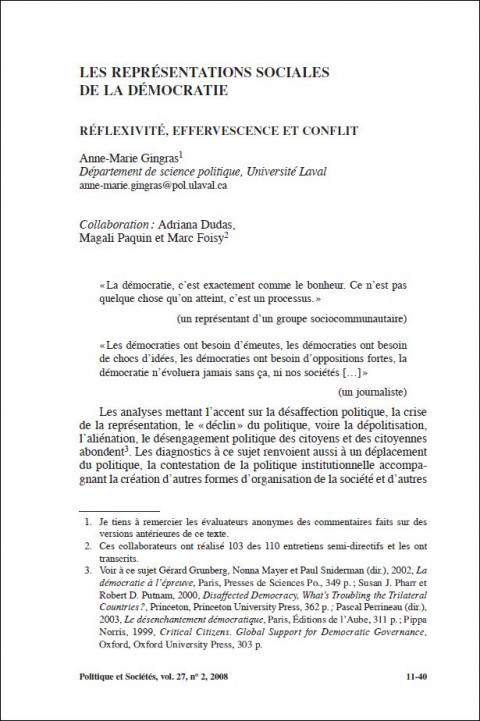 The Social Representations of Democracy: Reflexivity, Efferevescence and Conflict 出版年份: 2008 作者: Anne-Marie Gingras | Adriana Dudas | Magali Paquin | Marc Foisy 机构作者: Politique et Sociétés (Canada) This paper deals with “democracy within society” that appears predominantly in our research on social representations of democracy. We have interviewed 110 persons who have a regular access to the public sphere to perceive their understanding of democracy, its many dimensions, and its main stakes. Democracy within society, or democracy as a state of society, is opposed to institutional democracy (that is, political practices and Rule of law) toward which critics abound. Democracy within society is twofold: on the one hand, emphasis on effervescence and reflexivity that crystallize in collective organisations and in debate and communication and, on the other hand, assimilation of democracy to conflict, considered in terms of normality and processes. Moreover, democracy within society needs an actor, the citizen, who does not respond to the call of democracy, as shown in the many social sciences studies of the last decades. Les représentations sociales de la démocratie: réflexivité, effervescence et conflit 出版年份: 2008 作者: Anne-Marie Gingras | Adriana Dudas | Magali Paquin | Marc Foisy 机构作者: Politique et Sociétés (Canada) Cet article porte sur la « démocratie sociale », un concept qui ressort avec force dans notre recherche sur les représentations sociales sur la démocratie. Nous avons interviewé 110 personnes ayant accès à l’espace public dans le but de saisir leur compréhension de la démocratie, de ses diverses dimensions et des principaux enjeux qui l’affectent. La démocratie sociale, ou démocratie comme état de société, s’oppose à la démocratie institutionnelle (pratiques politiques institutionnelles et État de droit) à l’égard de laquelle les critiques abondent. La démocratie sociale comporte deux volets : d’une part, l’insistance sur l’effervescence et la réflexivité qui s’incarnent dans l’organisation collective et dans le débat et la communication et, d’autre part, l’assimilation de la démocratie au conflit qui est pensé en termes de normalité et de processus. Cependant, la démocratie sociale a besoin d’un acteur, le citoyen, qui, comme le montrent les travaux en sciences sociales depuis des décennies, ne répond pas à l’appel de la construction de la démocratie. Never again!: how the lessons from Auschwitz project impacts on schools in Scotland As the education for citizenship agenda continues to make an impact on schools in Scotland, and with the Holocaust Educational Trust (HET) in conjunction with the Scottish Government organizing its Lessons From Auschwitz Project for Scottish students and teachers until 2011, this study aimed to investigate the school processes by which students were chosen to participate in the Lessons From Auschwitz (LFA) project; examine student and teacher perceptions of the LFA Project; investigate the impact the LFA Project has on student citizenship values and on their schools and communities; and investigate the impact the LFA Project has on teachers. (By the author) Entre generaciones. La experiencia de la transmisión en el relato testimonial. Profesorado. Revista de currículum y formación del profesorado The purpose of this paper is to rethink the relationship between experience and education, when what we face, as readers, learners and educators, is an altogether inconceivable experience: the account of the surviving witness of the concentration camps, a literary genre that is the end of the Bildungsroman or coming-of-age novel. Some questions guide this effort: Is there any way to read and give our young people, within the discourse of the learning society, where the crisis of transmissions is more than evident, some texts suggesting a discontinuous type of transmission? What kind of experience is the experience of reading this literature? What learning experience and transmission does it contain, if any? (By the author) Memoria, trasmissione e verità storica How can we explain the contradiction between, on the one hand, the decline of teaching in contemporary history, which necessarily brings about the decline of the "Shoah" historical event itself, and, on the other hand, the ever growing attention on the memory of the genocide of the Jews? In the past year alone, ten " memory trains" left Italy with more than fifteen thousand students to visit Poland - thereby making our country the third country in the world in terms of the number of visitors to Holocaust sites. Under the banner of the "duty of memory" and an approach to the Shoah, with more and more devotion to human rights and moral education, most teachers prefer to focus on the visit to the places of the massacre and on the testimonies of survivors, rather than on a historical and political reconstruction of the context and the facts. Precisely because the narrator-victims are survivors of the camps, they are the mediators between the darkness of the obscene world they were compelled to see, and the world of the listeners: they are the human faces of a universe of nameless victims, and their stories are the key for us to question our sense of responsibility. However, with no solid historical teaching, their narration elicits only an emotive participation; it provides the impression that we have fulfilled a moral duty, but it remains, in actual fact, incomprehensible. (By the author)