
相关资源
探索丰富的全球公民教育资源,深化理解,促进研究、倡导、教学与学习。
共找到3,436条结果
 Programs of Peace Education in Pre-University Education on the Light of Some Countries’ Experiences and the Extent of Benefit in Egypt 出版年份: 2014 作者: Amel Ahmed Hassan Mohamed 机构作者: Association of Arab Educators Education for peace has got an international, regional and local interests, in particular, today's world desperately needs more than ever before to face the problems afflicting the human race, and the conflict expected to increase in the coming years. This situation confirms the importance of achieving peace in all dimensions with oneself, family, society, and the environment.This study aimed to investigate the experiences of some countries in the field of education for peace and to draw some benefits from them. For achieving this aim, the study followed the Descriptive-Analytic Approach because of its appropriateness to the nature of the study. The sample of study dealt with three experiments in the field of education for peace in Northern Ireland, Bosnia and Herzegovina, and Sierra Leone, which were chosen after passing through a relatively long period of conflicts and disputes. By analyzing the three experiments, the similarities and differences among countries were reviewed in terms of, period and nature of conflict, foundations, objectives and content of the programs, teacher training. The study achieved some benefits through reviewing literature and analyzing the three experiences. The suggestions of the study were classified under some themes, including: foundations of peace education, its objectives, contents, and teacher training. برامج التربية من أجل السلام بالتعليم قبل الجامعي في بعض الدول وامكانية الاستفادة منها في مصر 出版年份: 2014 作者: Amel Ahmed Hassan Mohamed 机构作者: Association of Arab Educators تحظى التربية من أجل السلام باهتمام دولي وإقليمي ومحلى، ولا سيما أن عالم اليوم أحوج أكثر من ذي قبل لمواجهة المشكلات التي يعاني منها الجنس البشري والصراعات المرتقب زيادتها في السنوات القادمة؛ هذا بالإضافة إلى تنامي معدلات العنف المجتمعي ومظاهره؛ مما يدعم ضرورة السعي لتحقيق السلام بكافة أبعاده مع النفس وفي الأسرة وداخل المجتمع ومع البيئة. لذا هدفت هذه الدراسة إلى رصد تجارب بعض الدول في مجال التربية من أجل السلام وتقديم أوجه الاستفادة منها للارتقاء بمستوى تقديم هذا الاتجاه التعليمي المعاصر بنظام التعليم بمصر. لتحقيق هذا الهدف تم الاستناد إلى المنهج الوصفي التحليلي حيث أنه أكثر ملائمة لطبيعة الدراسة، وقد تكونت عينة الدراسة من ثلاث تجارب في مجال التربية من أجل السلام بالدول الآتية: إيرلندا الشمالية، والبوسنة والهرسك، وسيراليون، والتي تم اختيارها لكونها عاصرت فترة من الصراعات والنزاعات الطويلة نسبياً، تلتها مبادرات لدمج التربية من اجل السلام في النظام التعليمي. وقد تم تحليل التجارب الثلاث في ضوء عدد من المحاور شملت: السياق العام للدولة، والجهود المبكرة للتربية من أجل السلام، وأسسها، وأهدافها، وأليات تضمينها في نظام التعليم، وتدريب المعلمين بكل دولة. وقد توصلت الدراسة إلى عدد من الدروس المستفادة التي تم رصدها من خلال ما ورد من أدبيات عربية وأجنبية، وتجارب الدول الثلاث، والتي تم تصنيفها تحت المحاور الآتية: فترة الصراع وطبيعته، أسس التربية من أجل السلام، وأهدافها، وأليات تضمينها في نظام التعليم، وتدريب المعلمين.
  Education and Conflict: Complexity and Chaos 出版年份: 2003 作者: Lynn Davies Based on the author's extensive research and experience of education in several areas afflicted by conflict, the book explores the relationship between schooling and social conflict and looks at conflict internal to schools. It posits a direct link between the ethos of a school and the attitudes of future citizens towards 'others'. It also looks at the nature and purpose of peace education and war education, and addresses the role of gender and masculinity. Education and Conflict: Complexity and Chaos 出版年份: 2003 作者: Lynn Davies Basé sur une recherche approfondie de l'auteur et sur son expérience en terme d'éducation dans plusieurs zones affectées par des conflits, ce livre analyse la relation entre le fait d'aller à l'école et le conflit social, et s'attache aux conflits qui surviennent au sein des établissements scolaires. L’auteur postule un lien direct entre l'éthos adopté par une école donnée et le comportement de ses futures citoyens envers « les autres ». Il s'attache également à la nature et à l'objet de l'éducation pour la paix et de l'enseignement des conflits, et aborde la question du rôle joué par le genre et la masculinité.
  Schools and war: urgent agendas for comparative and international education 出版年份: 2005 作者: Lynn Davies 机构作者: Taylor & Francis This paper looks first at the contributions that education makes to conflict, through the reproduction of inequality and exclusion, through perpetuation of ethnic or religious divisions, through its acceptance of dominant aggressive masculinities, through selection, competition and fear, and through distorted curricular emphases on narrow cognitive areas of learning. However, the paper also outlines some ‘possibilities for hope’, such as resilient schools, the impact of peace education initiatives and the rise of global citizenship education. Schools and war: urgent agendas for comparative and international education 出版年份: 2005 作者: Lynn Davies 机构作者: Taylor & Francis Cet article examine en premier lieu les contributions de l'éducation aux conflits, à travers la reproduction de l'inégalité et de l’exclusion, la perpétuation des divisions ethniques ou religieuses, l’acceptation de la dominance de l’agressivité masculine ; à travers la sélection, la compétition et la peur, et à travers une déformation des programmes scolaires mettant l’accent sur des zones cognitives étroites de l'apprentissage. Toutefois, le document décrit également quelques « notes positives », telles que les écoles de la résilience, l'impact des initiatives de l'éducation à la paix et l’importance croissante donnée à l'éducation à la citoyenneté mondiale.
  Lessons Learned from Mental Health and Education: Identifying Best Practices for Addressing Violent Extremism 出版年份: 2015 作者: Stevan Weine | B. Heidi Ellis | Ron Haddad | Alisa B. Miller | Rebecca Lowenhaupt | Chloe Polutnik 机构作者: National Consortium for the Study of Terrorism and Responses to Terrorism (START) The overall purpose of this research was to identify assets from the mental health and education fields that could contribute to best practices for preventing and intervening against violent extremism. Specifically we aimed to address the following questions:1) What prior knowledge, programmes or interventions within the mental health and education fields could contribute to best practices and other strategies that could help stop violent extremism? 2) How can professionals from the mental health and education fields best become involved in stopping violent extremism? Lessons Learned from Mental Health and Education: Identifying Best Practices for Addressing Violent Extremism 出版年份: 2015 作者: Stevan Weine | B. Heidi Ellis | Ron Haddad | Alisa B. Miller | Rebecca Lowenhaupt | Chloe Polutnik 机构作者: National Consortium for the Study of Terrorism and Responses to Terrorism (START) Il s’agit dans cette recherche d'identifier des ressources dans le domaine de l'éducation à la santé mentale qui pourraient contribuer aux meilleures pratiques dans la prévention et l'intervention contre l'extrémisme violent. Plus précisément, les auteurs ont cherché à répondre aux questions suivantes : 1) Quelles sont les connaissances, les programmes ou les interventions requis dans le domaine de l'éducation à la santé mentale pouvant contribuer aux meilleures pratiques et autres stratégies dans la lutte contre l'extrémisme violent ? 2) Comment les professionnels de l'éducation à la santé mentale peuvent s’impliquer davantage dans la lutte contre l'extrémisme violent ?
 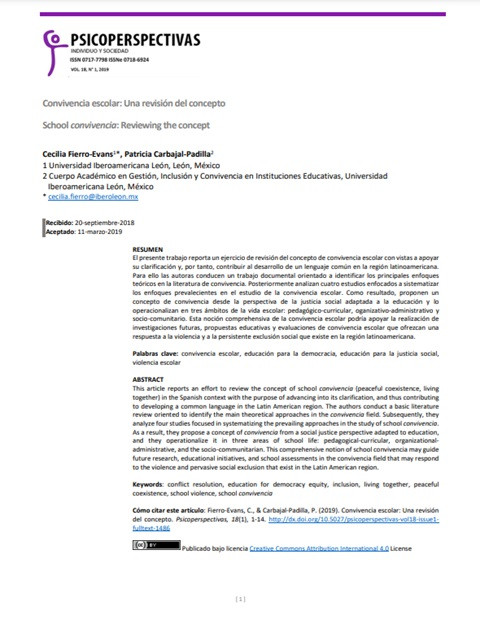 School Convivencia : Reviewing the Concept (Psicoperspectivas; No. 18, Vol. 1) 出版年份: 2019 作者: Cecilia Fierro-Evans | Patricia Carbajal-Padilla 机构作者: Catholic University of Valparaíso. School of Psychology This article reports an effort to review the concept of school convivencia (peaceful coexistence, living together) in the Spanish context with the purpose of advancing into its clarification, and thus contributing to developing a common language in the Latin American region. The authors conduct a basic literature review oriented to identify the main theoretical approaches in the convivencia field. Subsequently, they analyze four studies focused in systematizing the prevailing approaches in the study of school convivencia. As a result, they propose a concept of convivencia from a social justice perspective adapted to education, and they operationalize it in three areas of school life: pedagogical-curricular, organizationaladministrative, and the socio-communitarian. This comprehensive notion of school convivencia may guide future research, educational initiatives, and school assessments in the convivencia field that may respond to the violence and pervasive social exclusion that exist in the Latin American region. Convivencia escolar: Una revisión del concepto (Psicoperspectivas; No. 18, Vol. 1) 出版年份: 2019 作者: Cecilia Fierro-Evans | Patricia Carbajal-Padilla 机构作者: Catholic University of Valparaíso. School of Psychology El presente trabajo reporta un ejercicio de revisión del concepto de convivencia escolar con vistas a apoyar su clarificación y, por tanto, contribuir al desarrollo de un lenguaje común en la región latinoamericana. Para ello las autoras conducen un trabajo documental orientado a identificar los principales enfoques teóricos en la literatura de convivencia. Posteriormente analizan cuatro estudios enfocados a sistematizar los enfoques prevalecientes en el estudio de la convivencia escolar. Como resultado, proponen un concepto de convivencia desde la perspectiva de la justicia social adaptada a la educación y lo operacionalizan en tres ámbitos de la vida escolar: pedagógico-curricular, organizativo-administrativo y socio-comunitario. Esta noción comprehensiva de la convivencia escolar podría apoyar la realización de investigaciones futuras, propuestas educativas y evaluaciones de convivencia escolar que ofrezcan una respuesta a la violencia y a la persistente exclusión social que existe en la región latinoamericana.