
相关资源
探索丰富的全球公民教育资源,深化理解,促进研究、倡导、教学与学习。
共找到2,199条结果
 IEA 국제시민 교육연구의 초기 결과 出版年份: 2010 作者: Wolfram Schulz | John Ainley | Julian Fraillon | David Kerr | Bruno Losito 机构作者: International Association for the Evaluation of Educational Achievement (IEA) 국제시민교육연구(ICCS)는 시민으로서 자신의 역할을 수행하기 위해서 국가가 그들의 젊은이들을 준비시키는 방법에 대한 연구를 하였다. 여기에서는 학생들의 태도와 인식, 그리고 시민의식 및 시민권과 관련된 그들의 활동과 더불어 학생들의 시민의식과 시민권에 대한 이해와 지식에 대한 조사를 하였다. 또한, 시민교육의 결과와 관련된 국가 간의 차이를 조사하고, 그러한 차이가 학생의 특성, 학교 및 지역사회의 상황, 국가의 특성 사이에서 어떻게 다른가도 탐구하였다. 국제시민교육연구(ICCS)는 다음과 관련된 여섯 가지 연구 문제를 고려한다. 1. 시민 지식의 변화 2. 1999년 이래 교과 지식의 변화 3. 공적이고 정치적인 생활에 참여하는 것에 대한 학생의 관심도 및 실제적 이행 4. 시민 사회를 위협하는 것에 대한 인식 5. 시민교육과 관련된 교실과 학교, 교육 시스템의 특징 6. 시민교육의 결과와 관련된 학생의 배경 국제시민교육연구(ICCS)는 38개국 5,300개 이상의 학교에서 8학년(혹은 동급)의 14만면 이상의 학생들로부터 데이터를 수집하였다. 그리고 이 학생 데이터는 국립 연구 센터와 학교장이 수집한 상황별 데이터와 해당 학교 내 62,000명 이상의 교사들에 의해 증강되었다. 시민교육의 제공에 관한 다른 접근 방법은 국제시민교육연구(ICCS) 국가에서 분명히 드러났다. 이 접근 방식은 특정 주제를 가진 다른 과목과 연관된 콘텐츠를 통합하고, 상호 교육 과정을 테마로 하는 내용이 포함되어 있다. ICSS 38개국 중 21개 국가에서 그들의 교과 과정에 시민교육과 관련된 특정 주제를 포함시켰다. 시민교육은 사회, 지역 커뮤니티의 응집력, 다양성, 환경, 커뮤니케이션, 글로벌 사회와같은 새로운 주제 뿐만 아니라, 인권과 같은 정치적 개념의 이해와 지식을 포함한 폭넓은 범위의 주제도 아우르고 있다.
  Resultados iniciales del estudio Internacional de educación cívica y ciudadana de la IEA 出版年份: 2010 作者: Wolfram Schulz | John Ainley | Julian Fraillon | David Kerr | Bruno Losito 机构作者: International Association for the Evaluation of Educational Achievement (IEA) The International Civic and Citizenship Education Study (ICCS) studied the ways in which countries prepare their young people to undertake their roles as citizens. It investigated student knowledge and understanding of civics and citizenship as well as student attitudes, perceptions, and activities related to civics and citizenship. It also examined differences among countries in relation to these outcomes of civic and citizenship education, and it explored how differences among countries relate to student characteristics, school and community contexts, and national characteristics. ICCS considered six research questions concerned with the following:1. Variations in civic knowledge;2. Changes in content knowledge since 1999;3. Student interest in engaging in public and political life and their disposition to do so;4. Perceptions of threats to civil society;5. Features of education systems, schools, and classrooms related to civic and citizenship education; and6. Aspects of student background related to the outcomes of civic and citizenship education.ICCS gathered data from more than 140,000 Grade 8 (or equivalent) students in over 5,300 schools from 38 countries. These student data were augmented by data from more than 62,000 teachers in those schools and by contextual data collected from school principals and the study’s national research centers. Different approaches to provision of civic and citizenship education were evident in the ICCS countries. These approaches included having a specific subject, integrating relevant content into other subjects, and including content as a cross-curricular theme. Twenty-one of the 38 countries in ICCS included a specific subject concerned with civic and citizenship education in their curriculum. Civic and citizenship education covered a wide range of topics, including knowledge and understanding of political institutions and concepts, such as human rights, as well as newer topics covering social and community cohesion, diversity, the environment, communications, and global society. Philippine Education for All 2015 review report 出版年份: 2015 A country's vision of inclusive growth and development entails investment in human capital, particularly through the provision of quality basic education, competitive technical vocational skills training, and relevant and responsive higher education as stated in the Philippine Development Plan 2011-2016. The current administration has placed a high regard for education and has pushed for educational reforms that promote inclusive education especially for the marginalized. Education, being the priority of the government, has produced active public-private partnerhsips over the years both at the national and the school levels. The fruits of the past and the current EFA-related programs and projects resulted in increased performance of the country in most of the EFA indicators. However, at this time, which require greater efforts to accelerate and reach national EFA targets by 2015. L'éducation philippine pour tous 2015 Rapport d'examen 出版年份: 2015 La vision d'un pays de la croissance et le développement inclusif implique l'investissement dans le capital humain, en particulier grâce à la fourniture de l'éducation de base de qualité, la formation technique concurrentielle des compétences professionnelles et pertinentes, et l'enseignement supérieur répondant comme indiqué dans le Plan de développement 2011-2016. L'administration actuelle a placé une grande estime pour l'éducation et a poussé des réformes éducatives qui favorisent l'éducation inclusive en particulier pour les groupes marginalisés. L'éducation, étant la priorité du gouvernement, a produit partnerhsips public-privé actifs au cours des années, tant au niveau de l'école nationale et. Les fruits du passé et les programmes EPT liés actuels et les projets ont donné lieu à une performance accrue du pays dans la plupart des indicateurs de l'EPT. Cependant, à ce moment, ce qui nécessite davantage d'efforts pour accélérer et atteindre les objectifs de l'EPT nationaux d'ici à 2015. Initial findings from the IEA international civic and citizenship education study 出版年份: 2010 作者: Wolfram Schulz | John Ainley | Julian Fraillon | David Kerr | Bruno Losito 机构作者: International Association for the Evaluation of Educational Achievement (IEA) The International Civic and Citizenship Education Study (ICCS) studied the ways in which countries prepare their young people to undertake their roles as citizens. It investigated student knowledge and understanding of civics and citizenship as well as student attitudes, perceptions, and activities related to civics and citizenship. It also examined differences among countries in relation to these outcomes of civic and citizenship education, and it explored how differences among countries relate to student characteristics, school and community contexts, and national characteristics. ICCS considered six research questions concerned with the following:1. Variations in civic knowledge;2. Changes in content knowledge since 1999;3. Student interest in engaging in public and political life and their disposition to do so;4. Perceptions of threats to civil society;5. Features of education systems, schools, and classrooms related to civic and citizenship education; and6. Aspects of student background related to the outcomes of civic and citizenship education.ICCS gathered data from more than 140,000 Grade 8 (or equivalent) students in over 5,300 schools from 38 countries. These student data were augmented by data from more than 62,000 teachers in those schools and by contextual data collected from school principals and the study’s national research centers. Different approaches to provision of civic and citizenship education were evident in the ICCS countries. These approaches included having a specific subject, integrating relevant content into other subjects, and including content as a cross-curricular theme. Twenty-one of the 38 countries in ICCS included a specific subject concerned with civic and citizenship education in their curriculum. Civic and citizenship education covered a wide range of topics, including knowledge and understanding of political institutions and concepts, such as human rights, as well as newer topics covering social and community cohesion, diversity, the environment, communications, and global society. Les premiers résultats de l'étude de l'éducation civique et à la citoyenneté internationale AIE 出版年份: 2010 作者: Wolfram Schulz | John Ainley | Julian Fraillon | David Kerr | Bruno Losito 机构作者: International Association for the Evaluation of Educational Achievement (IEA) La Civic Internationale et la Citoyenneté Étude sur l'Éducation (CICÉ) ont étudié les façons dont les pays préparent leurs jeunes à assumer leur rôle en tant que citoyens. Il a étudié les connaissances des élèves et la compréhension de l'éducation civique et la citoyenneté ainsi que les attitudes des élèves, les perceptions et les activités liées à l'éducation civique et la citoyenneté. Il a également examiné les différences entre les pays par rapport à ces résultats de l'éducation civique et à la citoyenneté, et il a exploré comment les différences entre les pays se rapportent aux caractéristiques des élèves, des contextes scolaires et communautaires, et des caractéristiques nationales. CICÉ a examiné six questions de recherche concernés par les suivants: 1. Les variations de connaissances civiques; 2. Modifications de contenu des connaissances depuis 1999; 3. l'intérêt des étudiants dans l'engagement dans la vie publique et politique et leur disposition à le faire; 4. Les perceptions des menaces pour la société civile; 5. Caractéristiques des systèmes d'éducation, les écoles et les salles de classe liées à l'éducation civique et à la citoyenneté; et 6. Les aspects de fond de l'étudiant en rapport avec les résultats de l'éducation civique et à la citoyenneté. CICÉ a recueilli des données provenant de plus de 140.000 8 e année (ou l'équivalent) étudiants dans plus de 5300 écoles de 38 pays. Ces données sur les élèves ont été complétées par des données provenant de plus de 62.000 enseignants dans les écoles et par des données contextuelles recueillies auprès des directeurs d'écoles et de centres de recherche nationaux de l'étude. Différentes approches de l'éducation civique et à la citoyenneté étaient évidentes dans les pays CICÉ. Parmi ces approches ayant un sujet spécifique, intégrant un contenu pertinent dans d'autres matières, et y compris le contenu en tant que thématique transversale. Vingt et un des 38 pays de CICÉ inclus un sujet spécifique concerné par l'éducation civique et à la citoyenneté dans leur curriculum. Éducation civique et à la citoyenneté ont couvert un large éventail de sujets, y compris la connaissance et la compréhension des institutions et des concepts politiques, tels que les droits de l'homme, ainsi que de nouveaux sujets couvrant la cohésion sociale et de la communauté, la diversité, l'environnement, les communications, et de la société mondiale.
 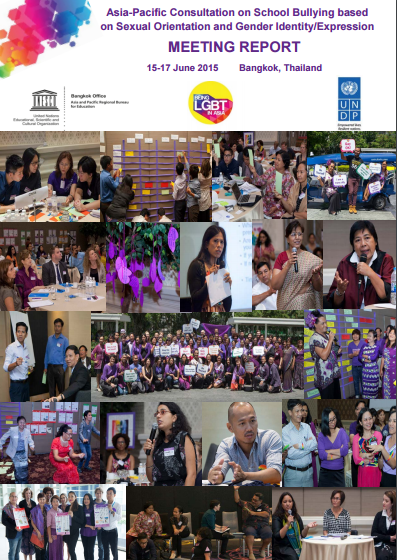 Asia-Pacific Consultation on School Bullying Based on Sexual Orientation and Gender Identity/Expression 出版年份: 2015 机构作者: UNESCO Bangkok This report documents the presentations and discussions made during the Asia-Pacific Consultation on School Bullying based on Sexual Orientation and Gender Identity/Expression held from 15-17 June 2015 at the Pullman King Power Hotel in Bangkok, Thailand.
  School-related violence and bullying on the basis of Sexual Orientation and Gender Identity or Expression (SOGIE): synthesis report on China, the Philippines, Thailand and Viet Nam 出版年份: 2018 机构作者: UNESCO Bangkok School related violence and bullying is a problem in all countries. UNESCO is committed to ensuring that all children and young people have access to safe, inclusive, health-promoting learning environments as part of its strategy on education for health and well-being. This synthesis report on school related violence and bullying on the basis of Sexual Orientation and Gender Identity or Expression (SOGIE), covering China, the Philippines, Thailand and Viet Nam, was developed to broaden awareness and understanding about this issue, while also identifying best practices and policies. It also aims to mobilize support for advocacy among educators, research institutions, policy makers and activists at the national and regional levels.
  COVID-19: How to Include Marginalized and Vulnerable People in Risk Communication and Community Engagement 出版年份: 2020 机构作者: United Nations Entity for Gender Equality and the Empowerment of Women (UN Women) | Regional Risk Communication and Community Engagement (RCCE) Women, the elderly, adolescents, youth, and children, persons with disabilities, indigenous populations, refugees, migrants, and minorities experience the highest degree of socio-economic marginalization. Marginalized people become even more vulnerable in emergencies. This is due to factors such as their lack of access to effective surveillance and early-warning systems, and health services. The COVID-19 outbreak is predicted to have significant impacts on various sectors. The development of this guide was led by UN Women and Translators without Borders on behalf of the Risk Communication and Community Engagement Working Group on COVID-19 Preparedness and Response in Asia and the Pacific, co-chaired by WHO, IFRC and OCHA.
  [Video] Central Asian Kids Share Their Views on Gender Inequality 出版年份: 2020 机构作者: World Bank In Central Asia, and around the world, women earn 30% less than men. In anticipation of March 8, we asked the children what they think about it.