
相关资源
探索丰富的全球公民教育资源,深化理解,促进研究、倡导、教学与学习。
共找到3,436条结果
 双创背景下高校教育教学改革探索研究 出版年份: 2022 作者: 任爽 在双创背景下,高校教学应该紧跟时代发展潮流,积极进行更新和变革,尤其要注重教学方式和教学理念的转变,更注重对学生创新意识和创造能力的培养,通过开展系统化的教学研究,对当前教学中存在的问题和缺陷进行总结和整理,通过教育教学改革为我国输送更加优秀的双创人才。本文在研究中主要围绕高校教育教学展开,以双创为基本的叙述背景,指出问题的同时探讨可行性措施,以此为相关教育工作者提供可行性思考。
  基于信息化仿真的物理实验教学改革与实践 出版年份: 2022 作者: 刘美玲 | 张震 | 谢艳妮 | 萧雅楠 物理实验是物理的基础,它对于培养物理概念、掌握物理规律、培养科学探究意识有着至关重要的作用。当前,我国的物理实验教学存在着许多不足,包括实验环节讲授理论化、仪器配备不足、不操作演示实验等问题。随着教育改革的不断深化,信息技术和教育的结合越来越密切,教学方法也在不断地变化,逐步弥补了传统的实验教学模式,而仿真实验作为信息时代的新产品,已经在教学中得到了广泛的应用,而如何将仿真实验和传统的实验教学有机地结合起来,这是困扰着一线物理老师的一个难题。为了解决这一问题,本文就如何把仿真实验和物理实验相结合,以改善实验教学的质量。本文将指出仿真实验的概念及其特点,其次阐述基于信息化仿真的物理实验教学流程,最后指出基于信息化仿真的物理实验教学改革与实践的相关建议,以期推动信息化时代仿真物理实验教学改革。
  《商品学》课堂教学模式改革: 以"任务"法为例 出版年份: 2022 作者: 何晓存 | 尹云平 本课题的研究成果将改变教师的传统教育观,形成在现代教学思维引导下的以学习者为中心,将学习者自由探究、自主学习和老师有效引导相结合的新教育形式,以实现培养及有探究性学习品质,并具备有创造精神的教育目的,采用"任务驱动法"将全面提高学生的掌握与运用现代信息技术的能力,并培养学生的学习兴趣,以促使教学主动性。结语:多样化的专业教学方法变革的构想,是以现代物流管理专业课堂教学发展的实际状况为依据,并根据最新的教学模式而提出的,借助于此教学模式的实现,促进现代物流管理专业教学方法的变革既是长期的系统任务,同时它所面对的教学变革任务又是多领域性和多元化的,促进了现代物流管理专业课堂教学实践与教学改革实践的相结合,在进一步探索和实践过程中寻找适合的新教学方法,而不仅仅是要求实现传统教学方法的变革,更关键的是培育专业综合型的现代物流管理人才培养。
 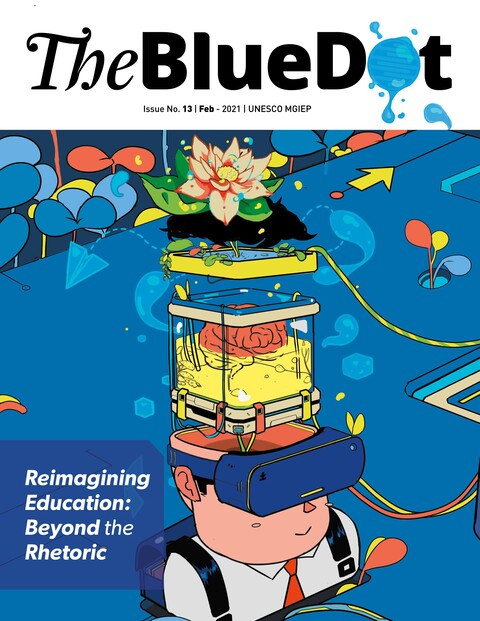 Reimagining Education: Beyond the Rhetoric (The Blue Dot; No.13, 2021) 出版年份: 2021 机构作者: Mahatma Gandhi Institute of Education for Peace and Sustainable Development (MGIEP) The events of the year 2020, driven predominantly by the COVID-19 pandemic, have forced governments, policymakers, educators and organisations to rethink the purpose, structure and modality of existing education systems. Even while the world is struggling with climate change, decreased empathy, violent extremism, xenophobia and an increase in mental health issues in children, with a recent report by WHO highlighting that 800,000 people between the ages of 15-29 are dying by suicide ever year, globally1 , the COVID-19 virus singlehandedly shut down access to face-to-face school education for roughly half of the world’s student population. These ongoing and unexpected challenges bring to light the urgent need for education systems to be more adaptable, responsive, and resilient to future shocks and disasters. We can work to transform education in many ways, such as by translating our understanding of how the brain learns from the research laboratory to the classroom and leveraging the power of technology to ensure that learning can reach every child who hungers to learn. It is time we reimagine education to ensure learning continues with minimal disruption but also empowers students as compassionate human beings, prepared for an unpredictable future, but also as global citizens seeking a peaceful and kinder world. The purpose of education needs to change from being instrumental (based on human capital) to one that is constitutive (human-flourishing), accessible to all and structured such that learning can happen anytime and anywhere and always.
 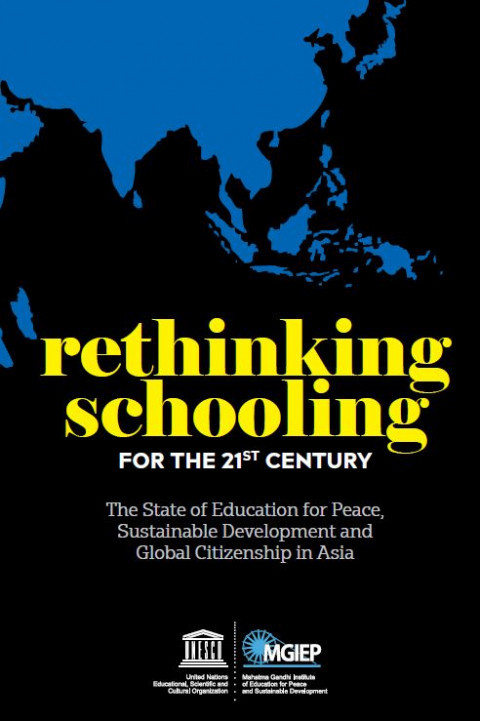 Rethinking Schooling for the 21st Century: The State of Education for Peace, Sustainable Development and Global Citizenship in Asia 出版年份: 2017 机构作者: Mahatma Gandhi Institute of Education for Peace and Sustainable Development (MGIEP) Calls to gear up schools for the 21st century are ubiquitous today. Dominant international educational discourse hails the potential of 'the youth dividend' and digital technology for enhancing growth. Some Asian education systems are held up as models for an innovation-led utopian future. But across much of Asia, neither the reality of schooling nor the patterns of development with which it is associated give cause for blithe optimism.This study is informed by UNESCO’s commitment to realising the Sustainable Development Goals (SDGs) through educational reform worldwide. Since its inception, UNESCO has championed a humanistic vision of education — a vision today encapsulated in SDG 4.7. These ideals need to be strongly restated and defended in an era when educational debate worldwide has come to be framed by a narrowly economistic and instrumentalist agenda.Deriving urgent significance from this broader context, the present report analyses how far the ideals of SDG 4.7 – of 'education for peace, sustainable development and global citizenship' - are embodied in policies and curricula across 22 Asian societies. At one level, it seeks to develop benchmarks against which future progress can be assessed. It also argues forcefully that conceptions of the fundamental purposes of schooling need to be reconfigured, if the ideals to which the global community has subscribed are actually to be realised.
  Education for conflict prevention and peacebuilding: meeting the global challenges of the 21st century 出版年份: 2012 作者: Phyllis Kotite 机构作者: UNESCO International Institute for Educational Planning (IIEP) The 21st century is witnessing global concern over the interrelated effects of climate change, the economic crisis, energy depletion, food and water shortages, natural disasters and conflicts all of which have devastating effects on humanity and the future of the planet. These events impact education systems and can impair the ability of governments to provide quality education for their citizens. However, when governments and ministries of education analyse and anticipate the risk of such events through careful planning, education can play an important role in preventing violent conflict, and in supporting peacebuilding efforts. An estimated 1.5 billion people live in countries affected by repeated cycles of political and other forms of violence, and the same population is often affected by hunger and poverty. Furthermore, such countries have difficulty meeting development goals. For example, no low-income fragile or conflict-affected country has yet achieved a single MDG (World Bank, 2011). In 2010 world military expenditures reached US$1.6 trillion as a result of fifteen ongoing conflicts (SIPRI, 2011). Yet, it is estimated that only US$16 billion is needed to fill the education gap to reach the EFA goals (UNESCO, 2011b: 11). This paper argues that we have the knowledge, legal instruments and mechanisms to prevent conflict and to transfer resources to sustainable development and education to meet the challenges of the 21st century. The paper describes a range of conflict prevention initiatives and examines the role of policy-makers, youth, women, and the media in maintaining and restoring peace as part of a holistic vision of education. International institutions, governments and civil society are increasingly developing conflict prevention mechanisms and utilizing political and economic incentives to avoid conflicts. They are also creating new technology for sustainable development, adaptation to climate change and renewable forms of energy. Educational planning must therefore go beyond traditional mechanisms. It must take into consideration the unpredictable nature of our times; be flexible and rapid in implementation and responsive to local needs. Training and research in sustainable development; and skills for peaceful inter-human relations, good governance, the prevention of conflict and peacebuilding are priorities elaborated in the paper. In addition, specific recommendations are highlighted such as: capacity development for conflict prevention within the education sector and other ministries, analysing the root causes of conflict and the role that education can play in mitigating tensions. This paper is an elaboration of Chapter 1.2 of the IIEP-UNESCO Guidebook for Planning Education in Emergencies and Reconstruction (IIEP-UNESCO, 2010). A brief treatment of additional global challenges (e.g. water scarcity, food insufficiency, energy depletion and economic instability), which are beyond the educational focus of this paper, may be found in Annex I. Education for conflict prevention and peacebuilding: meeting the global challenges of the 21st century 出版年份: 2012 作者: Phyllis Kotite 机构作者: UNESCO International Institute for Educational Planning (IIEP) Le 21ème siècle est témoin de préoccupation mondiale sur les effets interdépendants du changement climatique, la crise économique, l'épuisement de l'énergie, la pénurie de nourriture et d'eau, les catastrophes naturelles et les conflits qui ont tous des effets dévastateurs sur l'humanité et l'avenir de la planète. Ces événements influent sur les systèmes d'éducation et peuvent nuire à la capacité des gouvernements à fournir une éducation de qualité pour leurs citoyens. Toutefois, lorsque les gouvernements et les ministères de l'éducation analysent et anticipent le risque de ces événements à travers une planification minutieuse, l'éducation peut jouer un rôle important dans la prévention des conflits violents, et à soutenir les efforts de consolidation de la paix. On estime que 1,5 milliard de personnes vivent dans des pays touchés par des cycles répétés de formes politiques et autres de la violence, et la même population est souvent affectée par la faim et la pauvreté. En outre, ces pays ont des difficultés à atteindre les objectifs de développement. Par exemple, aucun pays à faible revenu fragiles ou touchés par un conflit n'a encore atteint un seul OMD (Banque mondiale, 2011). En 2010 dépenses militaires mondiales ont atteint US $ 1,6 trillions en raison de quinze conflits en cours (SIPRI, 2011). Pourtant, on estime que seulement 16 milliards $ US est nécessaire pour combler le déficit de l'éducation pour atteindre les objectifs de l'EPT (UNESCO, 2011b: 11). Ce document fait valoir que nous avons les connaissances, les instruments juridiques et des mécanismes de prévention des conflits et de transférer des ressources pour le développement durable et l'éducation pour relever les défis du 21e siècle. Le document décrit une série d'initiatives de prévention des conflits et examine le rôle des décideurs politiques, les jeunes, les femmes et les médias dans le maintien et le rétablissement de la paix dans le cadre d'une vision holistique de l'éducation. Les institutions internationales, les gouvernements et la société civile sont de plus en plus de développer des mécanismes de prévention des conflits et de l'utilisation des incitations politiques et économiques pour éviter les conflits. Ils créent également une nouvelle technologie pour le développement durable, l'adaptation aux changements climatiques et les énergies renouvelables. Planification de l'éducation doit donc aller au-delà des mécanismes traditionnels. Il doit prendre en considération la nature imprévisible de notre temps; être flexible et rapide et répondre aux besoins locaux. Formation et recherche dans le développement durable; et les compétences pour les relations inter-humaines pacifiques, la bonne gouvernance, la prévention des conflits et de consolidation de la paix sont des priorités élaborées dans le document. En outre, des recommandations spécifiques sont mis en évidence, tels que: le renforcement des capacités de prévention des conflits dans le secteur de l'éducation et d'autres ministères, l'analyse des causes profondes des conflits et le rôle que l'éducation peut jouer pour atténuer les tensions. Ce document est une élaboration du Chapitre 1.2 du Guide de l'IIPE-UNESCO pour l'Éducation de la Planification en situation d'Urgence et de Reconstruction (IIPE-UNESCO, 2010).
 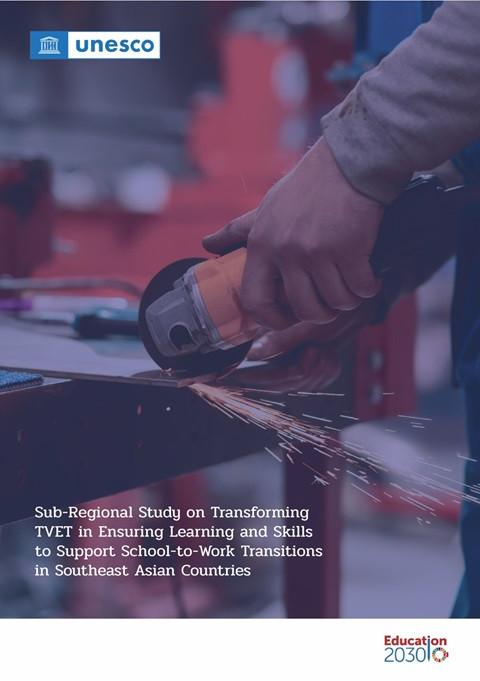 Sub-Regional Study on Transforming TVET in Ensuring Learning and Skills to Support School-to Work Transitions in Southeast Asian Countries 出版年份: 2023 作者: Jann Hidajat Tjakraatmadja | Hary Febriansyah | Yorga Permana | Lala Nurfitria | Farenza Fadil 机构作者: UNESCO Jakarta Technical and Vocational Education and Training (TVET) and the transition from school to work are critical for young individuals to be prepared for entering the job market. The school-to-work transition signifies the transition from education to professional work and involves stages such as finding a job, applying theoretical knowledge and adapting to work expectations. In line with SDG-4, there is a need to improve the relevance of TVET systems, equipping individuals with the necessary skills for employment, entrepreneurship and lifelong learning. Three strategic priorities include promoting lifelong learning opportunities, fostering skills for an inclusive and sustainable economy, and ensuring inclusive and resilient communities. UNESCO supports Member States to address current and future challenges in the field of TVET, including the transition from school to work. Recognising the significant role of TVET in achieving SDG-4, UNESCO works closely with countries like Brunei Darussalam, Indonesia, Malaysia, the Philippines, and Timor-Leste to enhance the relevance and effectiveness of their TVET systems. These countries have demonstrated a strong commitment to improving the quality of education and equipping individuals with the necessary skills for employment, entrepreneurship, and lifelong learning. In the discussion of innovations and trends in TVET systems, there is a need to respond to rapidly changing labour markets through leveraging labour market data, tracer studies, and employer insights, expanding work-based learning to support the transition from school to work, modernising TVET curricula with new skills and competencies, strengthening TVET through private sector and community engagement. TVET is important for the transition from school to work in the sub-region of Southeast Asia, in line with SDG-4. Standardised practices are needed for better employability and mobility. Challenges include labour market mismatches and negative perceptions, but there are opportunities to partner with industry, update curricula, promote inclusivity and gender equality, and adapt to changing labour markets. Using labour market data, expanding work-based learning, and engaging the private sector and local communities are critical. TVET can transform individuals and contribute to sustainable development in the subregion of South-East Asia, creating prosperous and inclusive societies.
  The New educational pact: education, competitiveness and citizenship in modern society 出版年份: 1997 作者: Juan Carlos Tedesco 机构作者: UNESCO International Bureau of Education (IBE) As things are, individuals are just not sure where exactly they stand. The identity of the progressive educational movement and thought is in a state of crisis, and the simple answers of the past are no longer sufficient to define an educational policy which responds to the objectives of democracy and equity in the distribution of knowledge.This book is therefore a response to a personal need, which may be shared by others, namely the need to reflect on the role of education in this new social scenario laden with uncertainty and to try and find an alternative, both to the social disintegration derived from neo-liberal tendencies and to the totalitarian unity advocated in fundamentalist, anti-modern theories. The following script therefore moves between the past and the future. The look back at the past does not claim to be a historical analysis. It does try, on the other hand, to provide a useful instrument for a better understanding of what is changing. The glimpse into the future is not intended either to forecast what will happen, but to indicate which way we should be trying to guide our actions. As a result, the book is eclectic in more than one sense. From a theoretical point of view, it combines different disciplinary approaches : history, sociology, pedagogy, psychology and philosophy. From a political point of view, it adopts positions, but also allows for doubts and queries. Excluding doubt is a way of encouraging the predominance of dichotomous views, which promise us either a glorious destiny or total disaster. In this sense, the book tries not to fall into the trap of having to choose between pessimism and optimism and, perhaps excessively, assumes a conscious voluntarism based on a trust in the learning ability of human beings. Le Nouveau pacte éducatif: l'éducation, la compétitivité et la citoyenneté dans la société moderne 出版年份: 1997 作者: Juan Carlos Tedesco 机构作者: UNESCO International Bureau of Education (IBE) Comme les choses sont, les individus sont tout simplement pas sûr où ils se situent exactement. L'identité du mouvement éducatif progressive et de la pensée est dans un état de crise, et les réponses simples du passé ne sont plus suffisants pour définir une politique éducative qui répond aux objectifs de la démocratie et de l'équité dans la répartition des connaissances.Ce livre est donc une réponse à un besoin personnel, qui peut être partagé par d'autres, à savoir la nécessité de réfléchir sur le rôle de l'éducation dans ce nouveau scénario social chargé d'incertitude et d'essayer de trouver une solution de rechange, à la fois à la désintégration sociale dérivée des tendances néo-libérales et à l'unité totalitaire préconisée dans les théories fondamentalistes, anti-modernes. Le script suivant se déplace donc entre le passé et l'avenir. Le regard rétrospectif sur le passé ne prétend pas être une analyse historique. Il ne cherche, d'autre part, de fournir un instrument utile pour une meilleure compréhension de ce qui change. L'aperçu de l'avenir ne vise pas non plus de prévoir ce qui se passera, mais pour indiquer de quelle manière nous devrions essayer de guider nos actions. En conséquence, le livre est éclectique dans plus d'un sens. D'un point de vue théorique, il combine différentes approches disciplinaires: l'histoire, la sociologie, la pédagogie, la psychologie et la philosophie. D'un point de vue politique, il adopte des positions, mais permet également des doutes et des requêtes. Hors doute est un moyen d'encourager la prédominance des vues dichotomiques, qui nous promettent soit un destin glorieux ou d'une catastrophe totale. En ce sens, le livre essaie de ne pas tomber dans le piège d'avoir à choisir entre le pessimisme et l'optimisme et, peut-être trop, suppose un volontarisme conscient basée sur une confiance dans la capacité d'apprentissage des êtres humains.