
相关资源
探索丰富的全球公民教育资源,深化理解,促进研究、倡导、教学与学习。
共找到1,445条结果
 2022 인천 평화교육 포럼 出版年份: 2022 机构作者: 인천광역시교육청 인천시교육청, '2022 인천 평화교육 포럼' 개최1. 행사명: 2022 인천 평화교육 포럼2. 일시: 2022. 11. 10.(목) 16:00~18:003. 포럼 주제: (평화·공존을 실천하는 세계시민 양성)인천 평화교육의 방향과 과제4. 대상: 인천교육공동체 누구나5. 주관: 정책기획조정관 교육정책연구소, 동아시아시민교육과 평화・공존교육팀 ○ 자료집: https://url.kr/tmwez3
 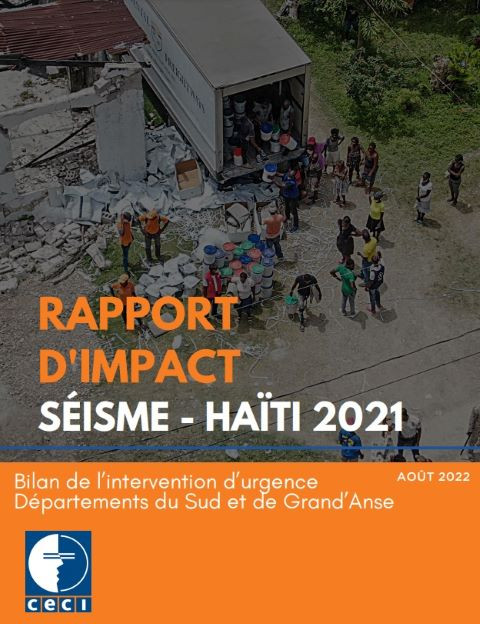 Impact Report-Earthquake-Haiti 2021 出版年份: 2022 机构作者: Centre for International Cooperation and Study (CECI) On August 14, 2021, a magnitude 7.2 earthquake struck the Great South of Haiti with full force, causing nearly of 2,300 dead and considerable material damage. This new natural disaster has come to worsen an already difficult socio-economic situation for families in this region of Haiti, which was barely within the devastating aftermath caused by Hurricane Matthew in 2016. From the first hours following the earthquake, CECI-Haiti, which was already carrying out 6 development in the departments of Grand-Anse and Sud, mobilized its teams to support government authorities, assess the needs of the population, in particular those of families and women, take stock of the damage and establish an action plan for recovery. The cities the most affected in the eastern region of the Grand'Anse department were the municipalities of Camp-Perrin, Roseaux, Coral, Beaumont, and Pestel.For the first emergency, the following priorities had been identified: Need for water supply; Need for drugs and agricultural inputs; Need for food and milk for the children; Need for tents and tarpaulins for temporary shelters; Need for sanitary products and clothing, portable toilets, etc.; Need for psychosocial support;To provide a rapid and significant response to urgent needs, CECI received funds from the public Canadian and obtained funding from the Ministry of International Relations and La Francophonie of the Government of Quebec. Rapport d'impact: SÉISME - HAÏTI 2021 出版年份: 2022 机构作者: Centre for International Cooperation and Study (CECI) Le 14 août 2021, un séisme de magnitude 7,2 a frappé de plein fouet le Grand Sud d’Haïti causant près de 2 300 morts et des dégâts matériels considérables. Cette nouvelle catastrophe naturelle est venue aggraver une situation socio-économique déjà difficile pour les familles de cette région d’Haïti qui se relevaient à peine des conséquences dévastatrices causées par l'ouragan Matthew en 2016.Dès les premières heures ayant suivi le passage du séisme, le CECI-Haïti qui menait déjà 6 projets de développement dans les départements de la Grand-Anse et du Sud, a mobilisé ses équipes pour appuyer les autorités gouvernementales, évaluer les besoins de la population, en particulier ceux des familles et des femmes, dresser un bilan des dégâts et établir un plan d’action pour le relèvement. Les communes les plus touchées dans la région Est du département de la Grand’Anse ont été les communes de Camp-Perrin, Roseaux, Corail, Beaumont et Pestel. Pour la première urgence, les priorités suivantes avaient été identifiées: Besoin d’approvisionnement en eau ; Besoin en médicaments et intrants agricoles ; Besoin en nourriture et lait pour les enfants ; Besoin en tentes et bâches pour des abris provisoires ; Besoin en produits hygiéniques et vêtements, toilettes portatives, etc. ; Besoin en appui psychosocial ;Pour apporter une réponse rapide et significative aux besoins urgents, le CECI a reçu des fonds du public canadien et obtenu un financement du ministère des Relations Internationales et de la Francophonie du gouvernement du Québec.
  Global Citizenship: A Path to a Better World 出版年份: 2022 机构作者: NGO-UNESCO Liaison Committee Presentation at the Forum of NGO Liaison Committee (UNESCO) by Stefania Giannini, Deputy Secretary General, UNESCO. The need for new pedagogies and solidarity that respects diversity. Education must also aim to develop peace, gender equity, and the meaning of the ODDs, notably 4.7 in relation to Global Citizenship Education. Civil society partners are critical to fighting extremism and hate. Citoyenneté mondiale: Une voie vers un monde meilleur 出版年份: 2022 作者: Comité de Liaison ONG-UNESCO 机构作者: NGO-UNESCO Liaison Committee Presentation at the Forum of NGO Liaison Committee (UNESCO) by Stefania Giannini, Deputy Secretary General, UNESCO. The need for new pedagogies and solidarity that respects diversity. Education must also aim to develop peace, gender equity and the meaning of the SDGs, notably 4.7 in relation to Global Citizenship Education. Civil society partners are critical to fighting extremism and hate.
  International Conference on Global Citizenship Education and International Solidarity 出版年份: 2022 机构作者: Quebec Association of International Cooperation Organizations (AQOCI) Sharing of practices and reflections on education for global and solidarity citizenship. The conference was initiated by the international committee of the Festival des Solidarités (Festisol) and led by AQOCI (Quebec Association of International Cooperation Organizations). Several speakers from several countries discuss the challenges of the decolonial approach to education for global citizenship. The possible emancipation of marginalized people is explored. Conférence internationale sur l'Éducation à la citoyenneté mondiale et la solidarité internationale 出版年份: 2022 机构作者: Association québécoise des organismes de coopération internationale (AQOCI) Partage de pratiques et de réflexions sur l'éducation à la citoyenneté mondiale et solidaire. Conférence initiée par le comité international du Festival des Solidarités (Festisol) et animée par l'AQOCI (Association québécoise des organismes de coopération internationale). Plusieurs intervenants venant de plusieurs pays discutent des enjeux de l’approche décoloniale de l’éducation à la citoyenneté mondiale. L’émancipation possible des gens marginalisés est explorée.
  Annual Report 2021 出版年份: 2021 机构作者: University of Sherbrooke. International Cooperation Group Our main orientations in 2021: Increase the capacities of GCIUS project management, through the development of management tools standardized; Increase outreach of the GCIUS with the student community of the UdeS, as well as with the community of practice; Promote mobilization, recruitment, and implementation of strategies equity, diversity, and inclusion in the GCIUS. Rapport annuel 2021 出版年份: 2021 作者: Groupe de Coopération Internationale de l'Université de Sherbrooke 机构作者: Université de Sherbrooke. Groupe de Coopération Internationale Nos grandes orientations en 2021: Accroître les capacités de gestion de projet du GCIUS, à travers le développement d'outils de gestion standardisés ; Accroître le rayonnement du GCIUS auprès de la communauté étudiante de l'UdeS, ainsi qu'auprès de la communauté de pratique ; Favoriser la mobilisation, le recrutement et la mise en oeuvre de stratégies en matière d'équité, de diversité et d'inclusion au GCIUS.
  Annual Report 2020 出版年份: 2020 机构作者: University of Sherbrooke. International Cooperation Group The GCIUS has set itself the task of encouraging the emergence of sustainable development of local communities in the countries of intervention and UdeS students, through supportive, inclusive, and dynamic networks. The GCIUS supports students and local communities in the co-construction of multidisciplinary sustainable development projects aimed at improving living conditions for communities in need.