
相关资源
探索丰富的全球公民教育资源,深化理解,促进研究、倡导、教学与学习。
共找到1,300条结果
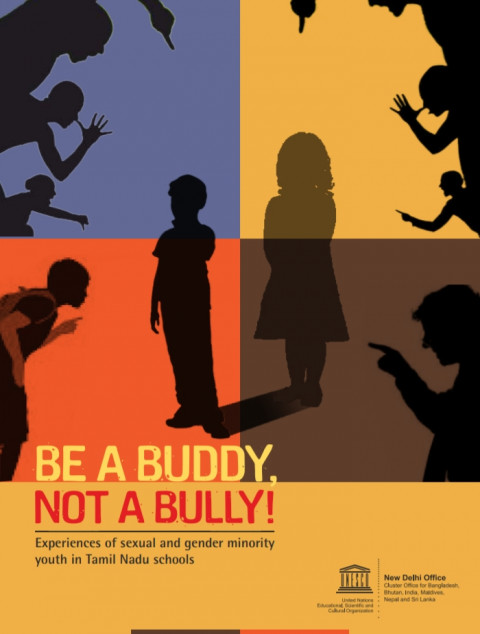 Be a buddy, not a bully: experiences of sexual and gender minority youth in Tamil Nadu schools 出版年份: 2019 作者: Menon C. Sunil, Chakrapani. Venkatesan, Jadav. Sarita 机构作者: UNESCO New Delhi We at UNESCO recognize that no country can achieve Sustainable Development Goal 4 - to ensure inclusive and equitable quality education and promote lifelong learning opportunities for all - if students are discriminated against or experience violence because of their actual or perceived sexual orientation and gender identity. This study conducted under the overall guidance of the School Education Department, Government of Tamil Nadu highlights our shared commitment to prevent and address bullying in educational institutions. We are confident that this report will be an effective tool for evidence based advocacy with school education departments and go a long way in promoting a comprehensive education sector response to SOGIE-based bullying, which includes enabling policy environments; inclusive curriculum and learning materials; professional development programmes for teachers and other school staff; support for learners including awarenessraising activities; and an overall school environment that is safe, nonviolent and that understands and appreciates diversity.
  Innovative Educational Reforms in Uzbekistan 出版年份: 2019 作者: Kh. Khakimjonova The article reveals the most important stages of reforming the education system of the Republic of Uzbekistan. The structure of the education system and the basic principles on which state reforms in the educational sphere are based are revealed. Describes the changes taking place in the education system of Uzbekistan in the light of recent government decrees and the challenges facing ministries and departments whose activities are directly or partially related to the education system of the Republic of Uzbekistan. Инновационные образовательные реформы в Узбекистане 出版年份: 2019 作者: Kh. Khakimjonova В статье раскрываются важнейшие этапы реформирования системы образования Республики Узбекистан. Раскрывается структура системы образования и основные принципы, на которых основываются государственные реформы в образовательной сфере. Описываются изменения, происходящие в системе образования Узбекистана в свете последних правительственных указов и задачи, стоящие перед министерствами и ведомствами, деятельность которых связана непосредственно или частично соприкасается с системой образования Республики Узбекистан.
  National Reforms of the Higher Education in Uzbekistan 出版年份: 2019 作者: G. Burkhonova This article addresses the issues of national reform of higher education in Uzbekistan. The author of the article believes that the reforms will lead to the further development of the education system as an important factor in the country's prosperity, sustainable economic growth, and employment. Национальные реформы высшего образования Узбекистана 出版年份: 2019 作者: G. Burkhonova Данная статья рассматривает вопросы национальных реформ высшего образования Узбекистана. Автор статьи считает, что реформы приведут к дальнейшему развитию системы образования как важнейшего фактора процветания страны, устойчивого роста экономики, обеспечения занятости населения.
  Identifying with Horror: Teaching about the Holocaust - A response to Simone Schweber's "Simulating Survival" The author responds to Simone Schweber's article "Simulating Survival", an article that praised the use of a simulation about the Holocaust by a public school teacher. In her response, Ben-Peretz discusses the impact of Schweber's article, some issues concerning the public school teacher's mode of teaching, why the Holocaust should be taught, and implications for teacher education. (Abstract In : Educating about Social Issues in the 20th and 21st Centuries: A Critical Annotated Bibliography) Quelques constats à propos de la transmission scolaire de la Shoah en Suisse This study is based on interviews conducted among teachers from the French-speaking cantons of Switzerland to determine how the history and memory of the Shoah are transmitted in the schools: it is at the intersection of the teaching of history and of social perception. The interviews reveal the high standards the teachers set for themselves. Consequently, they are caught between their own perception of the uniqueness of the Shoah and their concern that its exceptional nature might not be shared by their students. Thus, the combination of the exceptional nature of the subject and the teachers’ concern becomes a veritable pedagogical leitmotif that translates both the strength of their conviction and their difficulty in expressing it through effective teaching strategies. It is one of the factors that lead certain teachers to compare the Shoah with other genocides. And yet, when these teachers broach the subject of genocide in a comparative way, the uniqueness of the Shoah stands out, in their eyes, and is reinforced by the strong identification that a majority of them feel with the victims. (By the author)
  Global Citizenship Education in Children's Festivals 出版年份: 2012 作者: zhu jiehong Global citizenship education aims at cultivating modern citizens with an international outlook and global awareness. As an important carrier of culture, festivals play an important role in cultivating children's understanding and respect for multiculturalism. Kindergarten can fully pass the idea of global citizenship education through a series of world festival activities. In addition, global citizenship education of young children should pay attention to the creation of the activity environment, the use of materials in the activity area, and the creation of a multicultural environment. 幼儿节日活动中的世界公民教育 出版年份: 2012 作者: zhu jiehong 世界公民教育旨在培养具有国际视野和全球意识的现代公民。节日作为文化的重要载体在培养儿童对多元文化的认识和尊重方面有重要意义。幼儿园可以通过一系列的世界节日活动设计充分渗透世界公民教育。此外,幼儿的世界公民教育还应注意活动环境的创设、活动区材料的投放、多元文化环境的营造这几个方面。
 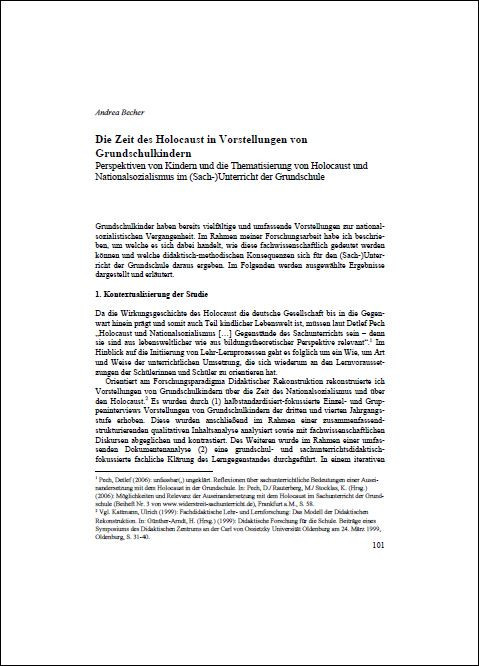 The Time Period of the Holocaust in the Beliefs of Primary School Children – Children’s Perspectives and the Thematization of the Holocaust and National Socialism in Primary-School Instruction (in General Subjects) 出版年份: 2012 作者: Andrea Becher The original title: Die Zeit des Holocaust in Vorstellungen von Grundschulkindern – Perspektiven von Kindern und die Thematisierung von Holocaust und Nationalsozialismus im (Sach-)Unterricht der Grundschule(In I. Enzenbach, C. Klätte, & D. Pech, (Eds.). Kinder und Zeitgeschichte: Jüdische Geschichte und Gegenwart, Nationalsozialismus und Antisemitismus, Supplement, 8, pp. 101–120) This is a summary of a study of German primary school children’s beliefs about the Holocaust, based on interviews conducted in two classes in 2005. The author finds that the children almost exclusively focus on Hitler; that one can find “latent anti-Semitic fragments” in their statements; that, even without formal education, the pupils still possess knowledge about the Holocaust; and their main source of information about Nazi Germany seems to be family members. However, the family narratives mainly touch upon everyday-life and avoid the topic of the Holocaust. From these findings, the author argues that one could and should teach the Holocaust already in the German primary school. The above abstract is taken from the International Holocaust Remembrance Alliance Education Research Project. Please also consult the full list of abstracts in 15 languages and the accompanying publication Research in Teaching and Learning about the Holocaust: A Dialogue Beyond Borders. Ed: IHRA, Monique Eckmann, Doyle Stevick, Jolanta Ambrosewicz-Jacobs, 2017, Metropol Verlag.