
相关资源
探索丰富的全球公民教育资源,深化理解,促进研究、倡导、教学与学习。
共找到1,447条结果
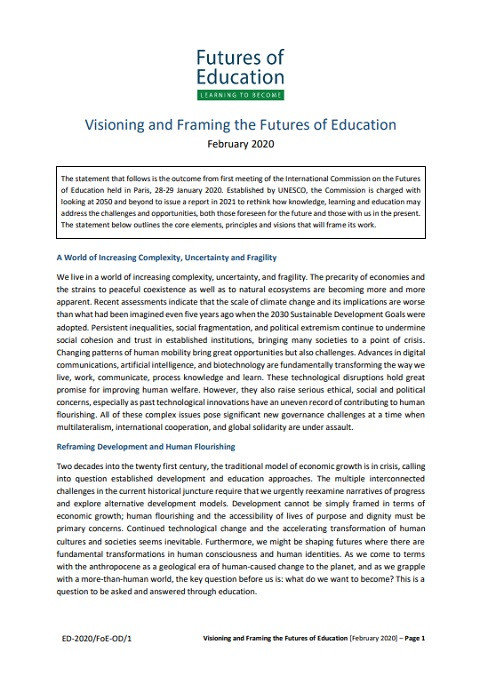 Концептуальное осмысление и определение перспектив развития образования: Февраль 2020года 出版年份: 2020 机构作者: Организация Объединенных Наций по вопросам образования, науки и культуры (UNESCO) Представленное ниже заявление является итоговым документом первого заседания Международной комиссии по перспективам развития образования, состоявшегося 28-29 января 2020 года в Париже. Ко-миссия была создана решением ЮНЕСКО с задачей проанализировать перспективы развития образо-вания до 2050 года и в последующий период с целью подготовки к публикации в 2021 году доклада, в котором будет по-новому осмыслено то, каким образом знания, обучение и образование могли бы со-действовать использованию возможностей и решению сложных проблем, причем не только прогнози-руемых, но и уже существующих. رؤية مستقبل التعليم وتأطيره: فبراير 2020 出版年份: 2020 机构作者: منظمة الأمم المتحدة للتربية والعلم والثقافة (UNESCO) نورد فيما أييت البيان الصادر عن االجتماع األول للجنة الدولية ملستقبل الرتبية و التعليم الذي قد ُ ع يف ابريس يف ُ ُون الفرتة من 28 إىل 29 َكان لثَّ ِان ٱ ُ ر ِ اي َ ن َ / ي 2020 .وذلك يف إطار عمل اللجنة املكلفة من قبل اليونسكو للنظر ً وأييت هذا البيان متهيدا إلصدار تقرير اللجنة يف عام 2021 إلعادة التفكري يف املستقبل إىل عام 2050 وما بعده، يف كيف ميكن للمعرفة والتعلم والتعليم مواجهة التحدايت والفرص، سواء تلك املتوقعة للمستقبل أو تلك املوجودة 展望并构筑教育的未来: 2020年2月 出版年份: 2020 机构作者: 联合国教科文组织 (UNESCO) 以下是关于教育的未来国际委员会第一次会议(2020年1月28–29日,巴黎)成果的声明。该委员会由教科文组织创设,其任务是展望2050年及以后,在2021年发布一份报告,重新思考知识、学习和教育可如何应对挑战、把握机遇,包括未来可预见的以及当前存在的挑战和机遇。
  Dialogue: diversité culturelle et mondialisation, l'expérience arabo-japonaise, actes 出版年份: 2005 机构作者: Organisation des Nations Unies pour l'éducation, la science et la culture (UNESCO) The symposium on “Cultural Diversity and Globalization: the Arab-Japanese Experience, a Cross-Regional Dialogue”, organized on 6 - 7 May 2004 at UNESCO in Paris with the purpose of promoting dialogue and cooperation between the Arab world and Japan, gave its participants an opportunity to lay the groundwork for thinking about the key concepts enshrined in the UNESCO Universal Declaration on Cultural Diversity adopted by the General Conference at its 31st session, on 2 November 2001. Los dos primeros años del Decenio de las Naciones Unidas de la Educación para el Desarrollo Sostenible (2005-2014) 出版年份: 2007 机构作者: Organización de las Naciones Unidas para la Educación, la Ciencia y la Cultura (UNESCO) The implementation of the DESD has made considerable progress since its international launch in March 2005. Apart from regional and national launches, progress has been achieved in both institutional and programmatic areas at international, regional and national levels. The objective of this report is not solely to highlight and showcase to Member States all that has been achieved in the two years since the international launch. The report also takes stock of on-going UNESCO initiatives, established prior to the Decade, which are providing major contributions to the implementation of the DESD, and thus cannot be by-passed. Equally important are the recommendations to remedy problems in the implementation of the DESD and strengthen those measures that are working efficiently. Apprendre à s'adapter au changement climatique et à atténuer ses effets: l'UNESCO et l'éducation au changement climatique 出版年份: 2009 机构作者: Organisation des Nations Unies pour l'éducation, la science et la culture (UNESCO) This report is a result of the UNESCO International Seminar on Climate Change Education at UNESCO Headquarters in Paris, 27-29 July, 2009. Over the past 30 years, UNESCO has actively contributed to building the global knowledge base on climate change. Primarily through its contribution to climate science (global ocean observation systems, assessment and monitoring) and secondarily by promoting education, capacity development, public awareness and access to information. As Task Manager of Chapter 36 of Agenda 21 – which relates to the promotion of education, public awareness and training – and lead agency for the UN Decade of Education for Sustainable Development (DESD, 2005-2014), the Organization plays a lead role in promoting Education for Sustainable Development (ESD). Climate change is one of the key action themes of the Decade, as was reaffirmed at the World Conference on Education for Sustainable Development held in Bonn in April 2009. Education has a central role to play in understanding, mitigating and adapting to the changing climate. While education at all levels and in both formal and informal settings is needed, instilling climate change awareness and understanding at a young age is ultimately the best way to change behaviours and attitudes. What children learn today will shape tomorrow’s world. Through the New Delhi work programme – which is a flexible programme for country-driven action engaging all stakeholders on education, training and public awareness on climate change, UNESCO supports its Member States to implement Article 6 of the United Nations Framework Convention on Climate Change. Similarly, the UNESCO Enhanced Plan of Action for the Strategy for Action on Climate Change recognizes the importance of and outlines action for education in promoting mitigation of and adaptation to climate change. Learning to mitigate and adapt to climate change: UNESCO and climate change education 出版年份: 2009 机构作者: UNESCO This report is a result of the UNESCO International Seminar on Climate Change Education at UNESCO Headquarters in Paris, 27-29 July, 2009. Over the past 30 years, UNESCO has actively contributed to building the global knowledge base on climate change. Primarily through its contribution to climate science (global ocean observation systems, assessment and monitoring) and secondarily by promoting education, capacity development, public awareness and access to information. As Task Manager of Chapter 36 of Agenda 21 – which relates to the promotion of education, public awareness and training – and lead agency for the UN Decade of Education for Sustainable Development (DESD, 2005-2014), the Organization plays a lead role in promoting Education for Sustainable Development (ESD). Climate change is one of the key action themes of the Decade, as was reaffirmed at the World Conference on Education for Sustainable Development held in Bonn in April 2009. Education has a central role to play in understanding, mitigating and adapting to the changing climate. While education at all levels and in both formal and informal settings is needed, instilling climate change awareness and understanding at a young age is ultimately the best way to change behaviours and attitudes. What children learn today will shape tomorrow’s world. Through the New Delhi work programme – which is a flexible programme for country-driven action engaging all stakeholders on education, training and public awareness on climate change, UNESCO supports its Member States to implement Article 6 of the United Nations Framework Convention on Climate Change. Similarly, the UNESCO Enhanced Plan of Action for the Strategy for Action on Climate Change recognizes the importance of and outlines action for education in promoting mitigation of and adaptation to climate change. Apprendre à atténuer et adapter au changement climatique: l'UNESCO et éducation au changement climatique 出版年份: 2009 机构作者: Organisation des Nations Unies pour l'éducation, la science et la culture (UNESCO) Ce rapport est le résultat du séminaire international de l'UNESCO sur le changement climatique Education au Siège de l'UNESCO à Paris, 27-29 Juillet 2009. Au cours des 30 dernières années, l'UNESCO a contribué activement à la construction de la base de connaissances mondiale sur le changement climatique. Principalement au moyen de sa contribution à la science du climat (systèmes d'observation des océans mondiaux, l'évaluation et suivi) et secondairement par l'éducation la promotion, le développement des capacités, la sensibilisation du public et l'accès à l'information. Comme le Gestionnaire des tâches du chapitre 36 d'Action 21 - qui a trait à la promotion de l'éducation, la sensibilisation du public et de la formation - et organisme chef de file pour la Décennie des Nations Unies pour l'éducation au développement durable (DEDD, 2005-2014), l'Organisation joue un rôle de premier plan dans la promotion de l'éducation pour le développement durable (EDD). Le changement climatique est l'un des thèmes d'action clés de la Décennie, comme cela a été réaffirmé à l'éducation Worldconférenceon pour le développement durable tenu à Bonn en Avril 2009. L'éducation a un rôle central à jouer dans la compréhension, atténuation et l'adaptation au changement climatique. Alors que l'éducation à tous les niveaux et dans les deux contextes formels et informels est nécessaire, instillant la sensibilisation au changement climatique et de la compréhension à un jeune âge est finalement la meilleure façon de changer les comportements et les attitudes. Qu'est-ce que les enfants apprennent aujourd'hui façonneront le monde de demain. Grâce au programme de travail de New Delhi - qui est un programme d'action souple axée sur les pays engageant toutes les parties prenantes sur l'éducation, la formation et la sensibilisation du public sur le changement climatique, l'UNESCO soutient ses États membres à mettre en œuvre l'article 6 de la Convention-cadre des Nations Unies sur les changements climatiques. De même, le Plan UNESCO amélioré d'action pour la Stratégie d'action sur les changements climatiques reconnaît l'importance et présente action pour l'éducation dans la promotion de l'atténuation et l'adaptation au changement climatique.
 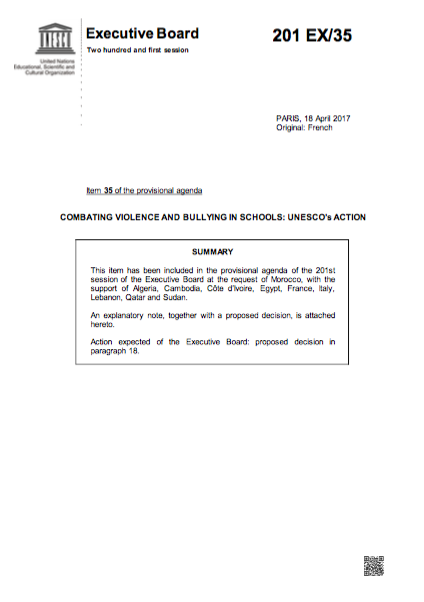 Борьба с насилием и притеснениями в школьной среде: деятельность ЮНЕСКО 出版年份: 2017 机构作者: Организация Объединенных Наций по вопросам образования, науки и культуры (UNESCO) This item has been included in the provisional agenda of the 201st session of the Executive Board at the request of Morocco, with the support of Algeria, Cambodia, Côte d’Ivoire, Egypt, France, Italy, Lebanon, Qatar and Sudan. 打击校园暴力和欺凌行为:教科文组织的行动 出版年份: 2017 机构作者: 联合国教科文组织 (UNESCO) This item has been included in the provisional agenda of the 201st session of the Executive Board at the request of Morocco, with the support of Algeria, Cambodia, Côte d’Ivoire, Egypt, France, Italy, Lebanon, Qatar and Sudan.