
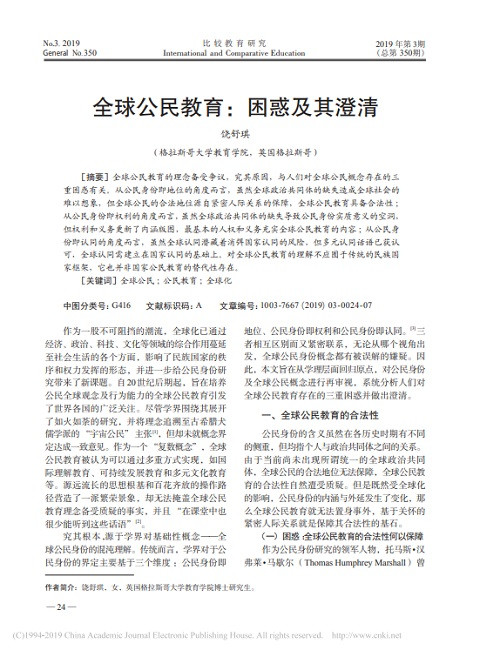
Global Citizenship Education: Confusion and Clarification (International and Comparative Education; No. 3)
- المؤلف
- Rao Shuqi
- المؤلف المؤسسي
- Beijing Normal University
- ISBN
- ISSN 1003-7667
- الترتيب
- p. 24-30
- لغة المورد
- الصينية
- سنة النشر
- 2019
- أنواع الموارد
- الأوراق البحثية/ مقالات المجالات
- مستوى التعليم
- التعليم الابتدائيالتعليم الثانويالتعليم العالي
- المناطق
- آسيا والمحيط الهادئ
- مكان النشر
- Beijing
As a debatable and controversial area, global citizenship education has not been elevated to the center of practical agenda due to three confusion surround the term. From the aspect of regarding citizenship as status, the absence of global political community makes global society unimaginable. However, as the legal status of global citizen originates from the confirmation of intimate interpersonal relationship, global citizenship education enjoys legitimacy. From the aspect of conceiving citizenship as rights, the absence of global political community leads to global citizenship vacuous in essence. However, as the landscape of rights and responsibilities has been transformed, the contents of global citizenship education are enriched by pervasive human rights and responsibilities. From the aspect of considering citizenship as identity, global identity runs a risk of diminishing the need for national identity. However, given the consensus concerning the discourse of multidimensional identity, global identity should be developed on the basis of national identity. The perception of global citizenship education should not be confined within the traditional nation-state framework. Global citizenship education is not an alternative to national citizenship education.
موارد ذات صلة
-
 IIEP-UNESCO 12th Medium-Term Strategy: 2026–2029
 -
 Advancing Intergenerational Learning: Identifying Challenges and Opportunities for Older Adults; Integrated Case Study Report
 -
 Digital Empowerment for Lifelong Learning and Transformative Andragogy (DELTA) for Adult Educators: Introduction to the DELTA Framework and Resources
 -
 Bridging the Grey Digital Divide: Enhancing ICT Learning for Older Adults; Research Report