
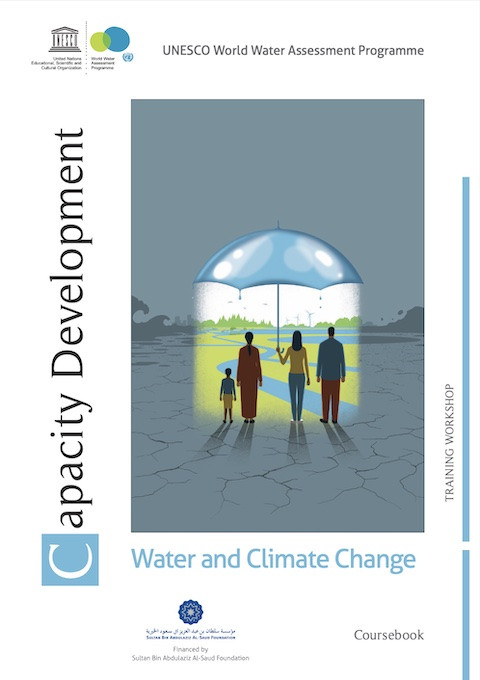
Water and Climate Change: Coursebook
- Corporate Author
- UNESCO World Water Assessment Programme (WWAP)
- Collation
- 42 p.
- Resource Language
- EnglishArabic
- Year of publication
- 2020
- Resource Type
- Curriculum, teaching-learning materials and guides
- Level of education
- Others
- Region
- Global
- Place of publication
- باريس
The United Nations World Water Development Report (WWDR) is UN-Water’s flagship report on water and sanitation issues, focusing on a different theme each year. The report is published by UNESCO, on behalf of UN-Water and its production is coordinated by the UNESCO World Water Assessment Programme. The report gives insight on main trends concerning the state, use and management of freshwater and sanitation, based on work done by the Members and Partners of UN-Water. Launched in conjunction with World Water Day, the report provides decision-makers with knowledge and tools to formulate and implement sustainable water policies. It also offers best practices and in-depth analyses to stimulate ideas and actions for better stewardship in the water sector and beyond.
The 2020 edition of the WWDR, titled ‘Water and Climate Change’ illustrates the critical linkages between water and climate change in the context of the broader sustainable development agenda. Supported by examples from across the world, it describes both the challenges and opportunities created by climate change, and provides potential responses – in terms of adaptation, mitigation and improved resilience – that can be undertaken by enhancing water resources management, attenuating water-related risks, and improving access to water supply and sanitation services for all in a sustainable manner. It addresses the interrelations between water, people, environment and economics in a changing climate, demonstrating how climate change can be a positive catalyst for improved water management, governance and financing to achieve a sustainable and prosperous world for all.
The report provides a fact-based, water-focused contribution to the knowledge base on climate change. It is complementary to existing scientific assessments and designed to support international political frameworks, with the goals of helping the water community tackle the challenges of climate change, and informing the climate change community about the opportunities that improved water management offers in terms of adaptation and mitigation.
Related Resources
-
 Study on the Historical Impact of the 1974 Recommendation concerning Education for International Understanding, Cooperation and Peace and Education relating to Human Rights and Fundamental Freedoms
 -
 IIEP-UNESCO 12th Medium-Term Strategy: 2026–2029
 -
 More than Welcome: Intercultural Integration of Migrants in and Through Higher Education
 -
 Advancing Intergenerational Learning: Identifying Challenges and Opportunities for Older Adults; Integrated Case Study Report